
Int J Chron Obstruct Pulmon Dis. 2016;11:1317-26.
Prevalence of and risk factors for postoperative pulmonary complications after lung cancer surgery in patients with early-stage COPD.
제1저자 김은선 · 교신저자 유철규
소속 (2)
- Division of Pulmonary and Critical Care Medicine, Department of Internal Medicine, Seoul National University College of Medicine, Seoul, Republic of Korea.
- Department of Thoracic and Cardiovascular Surgery, Seoul National University College of Medicine, Seoul, Republic of Korea.
Abstract
PURPOSE This study aimed to investigate whether the prevalence of postoperative pulmonary complications (PPCs) in patients with non-small-cell lung cancer (NSCLC) is even higher in the early stages of COPD than in such patients with normal lung function and to verify the usefulness of symptom- or quality of life (QoL)-based scores in predicting risk for PPCs.
PATIENTS AND METHODS Patients undergoing pulmonary resection for NSCLC between July 2012 and October 2014 were prospectively enrolled. Preoperative measurements of lung function, dyspnea, and QoL, operative characteristics, PPCs, duration of postoperative hospitalization, and in-hospital mortality were assessed.
RESULTS Among 351 consecutive patients with NSCLC, 343 patients with forced expiratory volume in 1 second (FEV1) ≥70% of predicted value were enrolled. At least one PPC occurred in 57 (16.6%) patients. Prevalence of PPC was higher in patients with COPD (30.1%) than in those with normal spirometry (10.0%; P<0.001). However, in patients with COPD, the prevalence of PPC was not different in patients with FEV1 ≥70% compared to those with FEV1 <70% and between group A (low risk and less symptoms) and group B (low risk and more symptoms) patients with COPD, based on the new Global initiative for chronic Obstructive Lung Disease 2011 guidelines. In patients with COPD, body mass index (odds ratio [OR]: 0.80, P=0.007), carbon monoxide diffusing capacity of the lung (DLCO), % predicted value (OR: 0.97, P=0.024), and operation time (OR: 1.01, P=0.003), but not COPD assessment test or St George Respiratory Questionnaire scores, were significantly associated with PPCs.
CONCLUSION Even in patients with early-stage COPD, the prevalence of PPCs is higher than in patients with NSCLC with normal spirometry. However, this rate is not different between group A and group B patients with COPD. In accordance with this, scores based on symptoms or QoL are not predictors of risk of PPCs in patients with early-stage COPD.
Keywords
early COPDpostoperative pulmonary complicationprevalencerisk factor
Figures
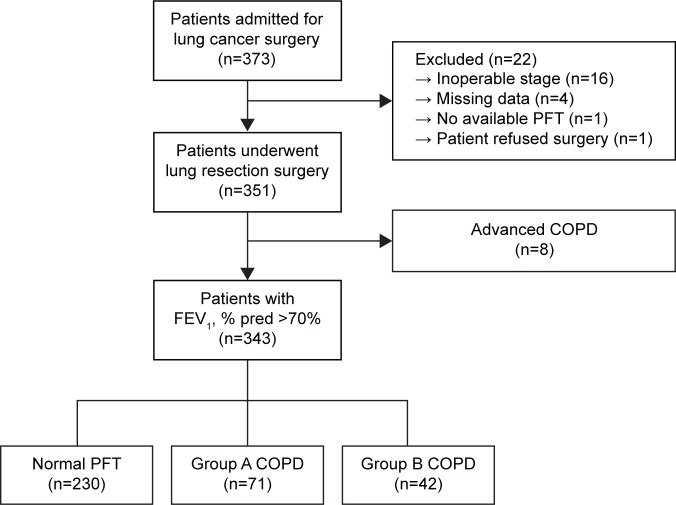
그림 출처: PubMed Central 공개 논문 (PMC4914071)
그 밖의 정보
- 출판 형태
- Journal Article
- 저널
- International journal of chronic obstructive pulmonary disease · eISSN 1178-2005
- 전자 출판
- 2016-06-16
- MeSH
- Adult · Aged · Aged, 80 and over · Carcinoma, Non-Small-Cell Lung / diagnosis / mortality / physiopathology / surgery · Chi-Square Distribution · Dyspnea / epidemiology / physiopathology · Female · Forced Expiratory Volume · Hospital Mortality · Humans · Length of Stay · Logistic Models · Lung / physiopathology / surgery · Lung Neoplasms / diagnosis / mortality / physiopathology / surgery · Male · Middle Aged · Multivariate Analysis · Odds Ratio · Pneumonectomy / adverse effects / mortality · Postoperative Complications / diagnosis / epidemiology / mortality / physiopathology · Prevalence · Prospective Studies · Pulmonary Disease, Chronic Obstructive / diagnosis / epidemiology / mortality / physiopathology · Quality of Life · Risk Factors · Seoul / epidemiology · Spirometry · Surveys and Questionnaires · Time Factors · Treatment Outcome
- 참고문헌
- 45편