
Gut Liver. 2017;11(1):87-92.
Quality of Life after Endoscopic Submucosal Dissection for Early Gastric Cancer: A Prospective Multicenter Cohort Study.
제1저자 김상균, 지선미 · 교신저자 김재준
소속 (15)
- Department of Internal Medicine and Liver Research Institute, Seoul National University College of Medicine, Seoul, Korea.
- National Evidence-Based Healthcare Collaborating Agency, Seoul, Korea.
- National Health Insurance Service, Seoul, Korea.
- Center for Gastric Cancer, National Cancer Center, Goyang, Korea.
- Department of Internal Medicine, Chonnam National University Medical School, Gwangju, Korea.
- Department of Internal Medicine, Kosin University College of Medicine, Busan, Korea.
- Department of Medicine, Samsung Medical Center, Sungkyunkwan University School of Medicine, Seoul, Korea.
- Department of Internal Medicine, Inje University Busan Paik Hospital, Busan, Korea.
- Department of Internal Medicine, The Catholic University of Korea College of Medicine, Seoul, Korea.
- Digestive Disease Center, Soonchunhyang University Hospital, Seoul, Korea.
- Digestive Disease Center, CHA Bundang Medical Center, CHA University, Seongnam, Korea.
- Department of Internal Medicine, Pusan National University School of Medicine, Busan, Korea.
- Department of Internal Medicine, Institute of Digestive Diseases and Nutrition, Korea University College of Medicine, Seoul, Korea.
- Department of Internal Medicine, Yonsei University College of Medicine, Seoul, Korea.
- Department of Gastroenterology, Asan Medical Center, University of Ulsan College of Medicine, Seoul, Korea.
Abstract
BACKGROUND/AIMS Endoscopic submucosal dissection (ESD) has been an established treatment for indicated early gastric cancer (EGC) without deterioration of quality of life (QOL) compared with surgical resection. The aim of this study was to evaluate long-term QOL in patients undergoing ESD for EGC.
METHODS Patients scheduled to undergo curative ESD for EGC were prospectively enrolled from 12 institutions between May 2010 and December 2011. Assessments of QOL with Korean versions of the European Organization for Research and Treatment of Cancer (EORTC) QOL questionnaire-core (QLQ-C30) and a gastric cancer-specific questionnaire (STO22) were performed at baseline and at 7 days, 3 months, and 6 months after ESD.
RESULTS A total of 666 subjects were assessed for QLQ-C30 and QLQ-STO22. The mean QLQ-C30 score was 69.5 at baseline, 68.8 at 7 days, 73.1 at 3 months, and 73.2 at 6 months. The global health status on the EORTC QLQ-C30 was significantly improved after 3 and 6 months (p=0.0003 and p<0.0001, respectively). The QLQ-C30 and STO22 scores were not significantly different, or they only slightly deteriorated between before and immediately after ESD, but they were significantly improved after 3 and 6 months (p<0.05).
CONCLUSIONS QOL did not deteriorate immediately after ESD, and it improved more significantly at up to 6 months in patients who underwent curative ESD for EGC without significant complications.
Keywords
Early gastric cancerEndoscopic submucosal dissectionQuality of life
Figures
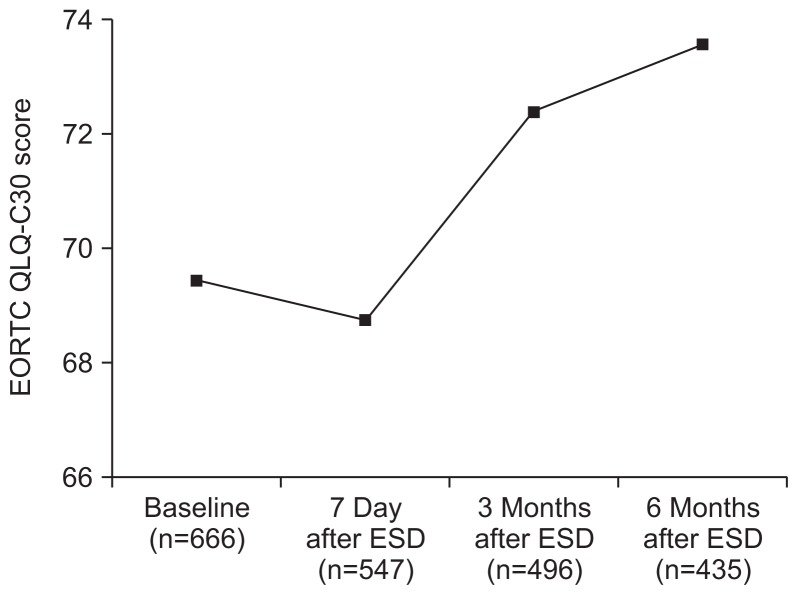
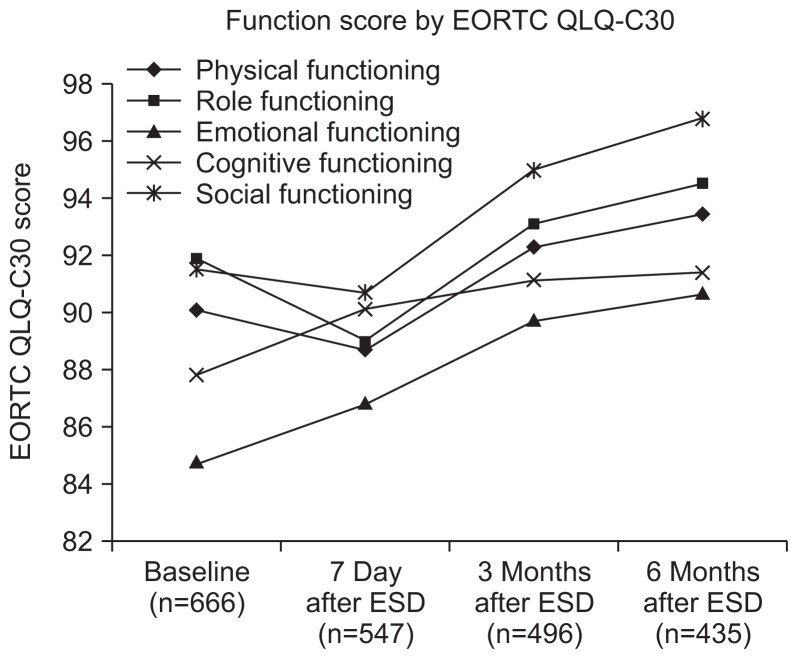
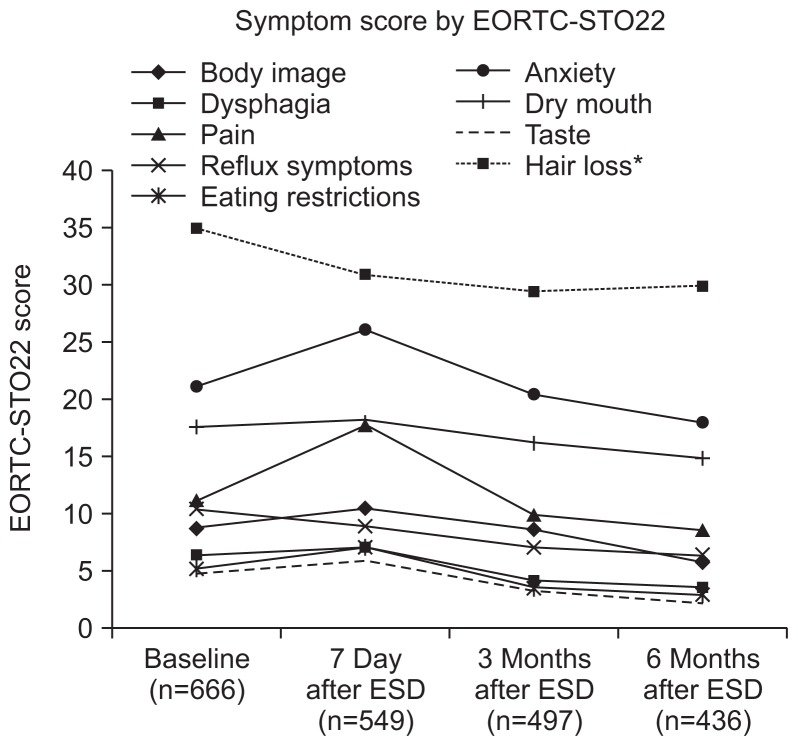
그림 출처: PubMed Central 공개 논문 (PMC5221865)
그 밖의 정보
- 출판 형태
- Journal Article, Multicenter Study
- 저널
- Gut and liver · eISSN 2005-1212
- MeSH
- Adenocarcinoma / pathology / surgery · Aged · Cohort Studies · Endoscopic Mucosal Resection* · Female · Humans · Male · Middle Aged · Neoplasm Staging · Prospective Studies · Quality of Life* · Stomach Neoplasms / pathology / surgery · Surveys and Questionnaires
- 참고문헌
- 10편