
Biol Sex Differ. 2020;11(1):66.
Sex differences in clinical characteristics and long-term outcomes in patients with vasospastic angina: results from the VA-Korea registry, a prospective multi-center cohort.
제1저자 김학령 · 교신저자 조상호
소속 (6)
- Division of Cardiology, Department of Internal Medicine, Boramae Medical Center, Seoul National University College of Medicine, Seoul, Korea.
- Division of Cardiology, Department of Internal Medicine, Hallym University Sacred Heart Hospital, Anyang, Korea. sophi5neo@gmail.com.
- Department of Cardiology in Internal Medicine, Hanyang University Guri Hospital, Guri, Korea.
- Department of Cardiovascular Medicine, Soonchunhyang Seoul Hospital, Seoul, Korea.
- Department of Cardiovascular Medicine, Hallym University Kangdong Hospital, Seoul, Korea.
- Department of Cardiovascular Medicine, Seoul St. Mary's Hospital, The Catholic University of Korea, Seoul, Korea.
Abstract
BACKGROUND Sex differences in clinical characteristics and prognosis of vasospastic angina (VA) have not been well elucidated. This study was performed to investigate sex-specific characteristics and predictors for long-term clinical outcomes in patients with VA.
METHODS We analyzed 1838 patients (55 years and 62% male) who were diagnosed with definite (n = 680) or intermediate (n = 1212) VA in ergonovine provocation test from a nation-wide VA registry. The primary study end-point was composite events including cardiac death, acute coronary syndrome, ventricular tachycardia or fibrillation, and atrioventricular block during clinical follow-up.
RESULTS Male patients were younger, and there were more smokers and alcohol drinkers in male patients than in female patients. During the median follow-up period of 760 days (interquartile range, 336-1105 days), there were 73 cases (3.97%) of composite events. There was no sex difference in the occurrence of composite events (log-rank p = 0.649). Concomitant significant (≥ 50%) organic coronary stenosis was associated with worse clinical outcomes in both male (hazard ration [HR], 1.97; 95% confidence interval [CI], 1.01-3.85; p = 0.047) and female (HR, 3.26; 95% CI, 1.07-9.89; p = 0.037) patients. Obesity (body mass index ≥ 25 kg/m2) was associated with better prognosis in female VA patients (HR, 0.22; 95% CI, 0.07-0.68; p = 0.008). Even when only patients with definite diagnosis of VA were considered, there was no significant sex difference in clinical outcomes (log-rank p = 0.876).
CONCLUSIONS In VA patients, there were several different clinical characteristics according to sex; however, long-term clinical outcome was similar between sexes. Significant organic coronary stenosis in both sexes and low body mass index (< 25 kg/m2) in females were associated with worse prognosis in VA patients.
Keywords
Clinical characteristicsPrognosisSex differenceVasospastic angina
Figures
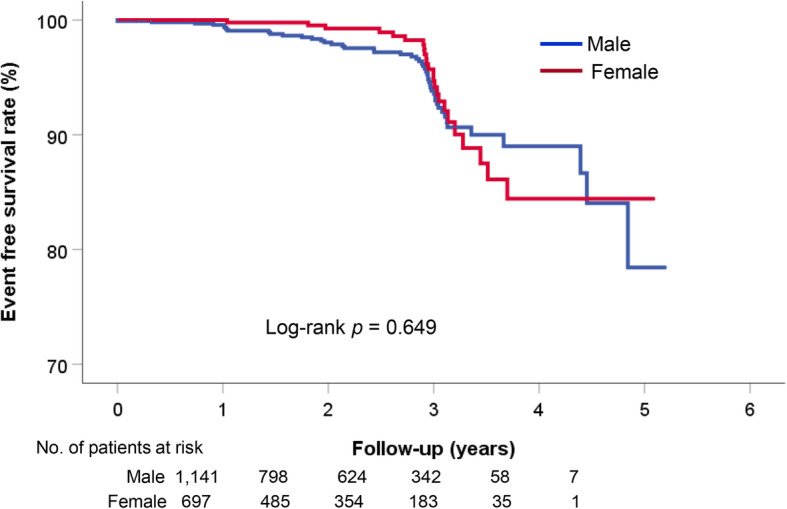
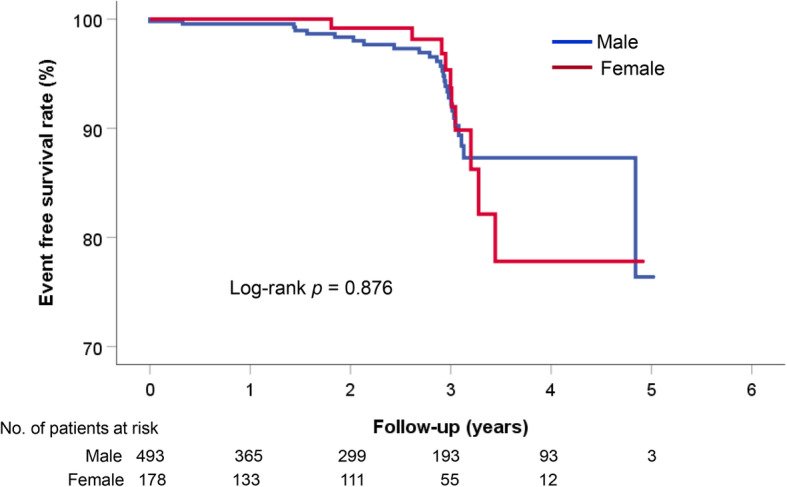
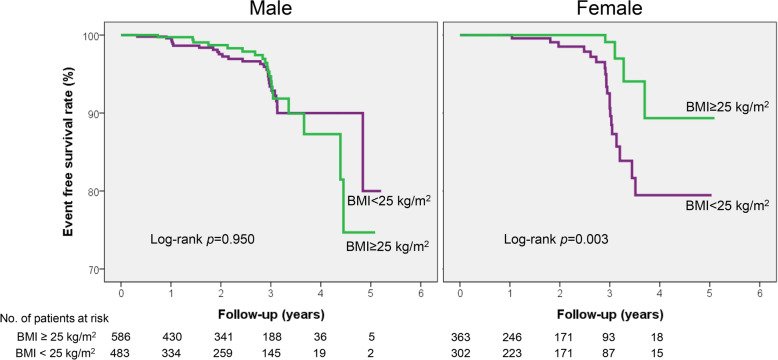
그림 출처: PubMed Central 공개 논문 (PMC7684896)
Conflict of interest statement
The authors declare there is no conflict of interest associated with this manuscript.
그 밖의 정보
- 출판 형태
- Journal Article, Multicenter Study
- 저널
- Biology of sex differences · eISSN 2042-6410
- 전자 출판
- 2020-11-23
- MeSH
- Adult · Aged · Angina Pectoris / complications / diagnosis / mortality · Cohort Studies · Coronary Vasospasm / complications / diagnosis / mortality · Female · Humans · Male · Middle Aged · Prognosis · Registries* · Republic of Korea / epidemiology · Sex Characteristics*
- 참고문헌
- 33편