
Sci Rep. 2021;11(1):3737.
Nonalcoholic fatty liver disease and the risk of atrial fibrillation stratified by body mass index: a nationwide population-based study.
제1저자 이소령, 한경도 · 교신저자 최의근
소속 (5)
- Department of Internal Medicine, Seoul National University Hospital, 101 Daehak-ro, Jongno-gu, Seoul, 03080, Republic of Korea.
- Statistics and Actuarial Science, Soongsil University, Seoul, Republic of Korea.
- Department of Internal Medicine, Seoul National University Hospital, 101 Daehak-ro, Jongno-gu, Seoul, 03080, Republic of Korea. choiek17@snu.ac.kr.
- Liverpool Centre for Cardiovascular Science, University of Liverpool and Liverpool Chest & Heart Hospital, Liverpool, UK.
- Department of Clinical Medicine, Aalborg University, Aalborg, Denmark.
Abstract
We evaluated the association between nonalcoholic fatty liver disease (NAFLD) and incident atrial fibrillation (AF) and analyzed the impact of NAFLD on AF risk in relation to body mass index (BMI). A total of 8,048,055 subjects without significant liver disease who were available fatty liver index (FLI) values were included. Subjects were categorized into 3 groups based on FLI: < 30, 30 to < 60, and ≥ 60. During a median 8-year of follow-up, 534,442 subjects were newly diagnosed as AF (8.27 per 1000 person-years). Higher FLI was associated with an increased risk of AF (hazard ratio [HR] 1.053, 95% confidence interval [CI] 1.046-1.060 in 30 ≤ FLI < 60, and HR 1.115, 95% CI 1.106-1.125 in FLI ≥ 60). In underweight subjects (BMI < 18.5 kg/m2), higher FLI raised the risk of AF (by 1.6-fold in 30 ≤ FLI < 60 and by twofold in FLI ≥ 60). In normal- and overweight subjects, higher FLI was associated with an increased risk of AF, but the HRs were attenuated. In obese subjects, higher FLI was not associated with higher risk of AF. NAFLD as assessed by FLI was independently associated with an increased risk of AF in nonobese subjects with BMI < 25 kg/m2. The impact of NAFLD on AF risk was accentuated in lean subjects with underweight.
Figures
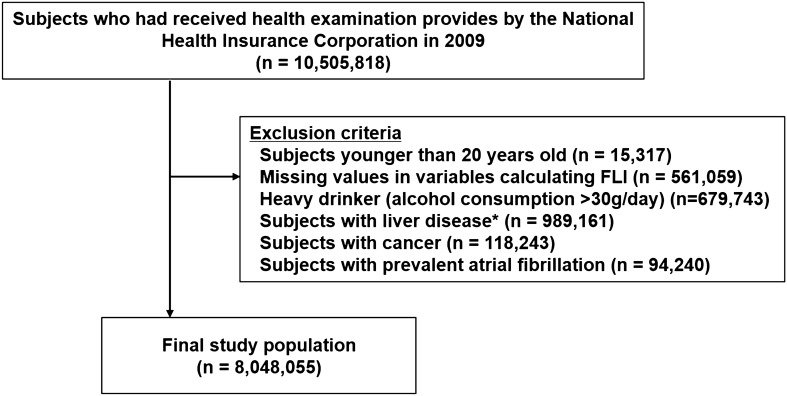
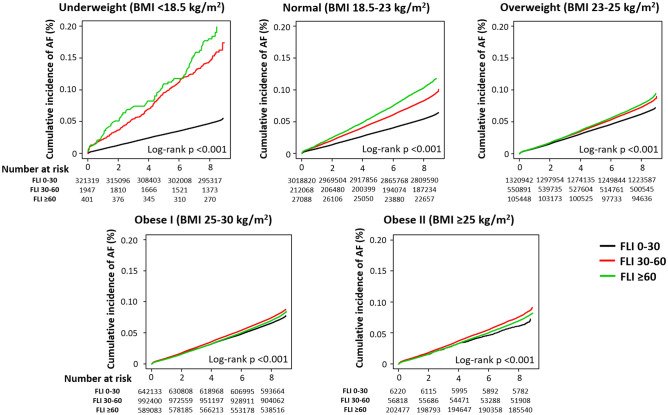
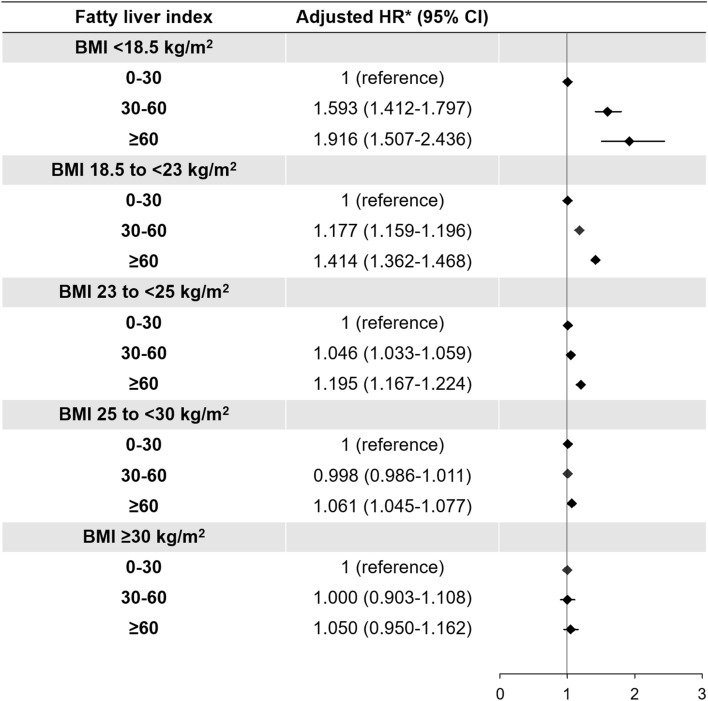
그림 출처: PubMed Central 공개 논문 (PMC7881181)
Conflict of interest statement
E-K.C.: Research grant from Sanofi-Aventis, Chong Kun Dang, Daiichi-Sankyo, BMS/Pfizer, Biosense Webster, and Skylabs. G.Y.H.L.: Consultant for Bayer/Janssen, BMS/Pfizer, Medtronic, Boehringer Ingelheim, Novartis, Verseon and Daiichi-Sankyo. Speaker for Bayer, BMS/Pfizer, Medtronic, Boehringer Ingelheim, and Daiichi-Sankyo. No fees are received personally. The other authors declare no competing interests.
그 밖의 정보
- 출판 형태
- Journal Article, Research Support, Non-U.S. Gov't
- 저널
- Scientific reports · eISSN 2045-2322
- 전자 출판
- 2021-02-12
- MeSH
- Adult · Atrial Fibrillation / etiology / physiopathology · Body Mass Index · Body Weight / physiology · Databases, Factual · Female · Humans · Liver Function Tests · Male · Middle Aged · Non-alcoholic Fatty Liver Disease / complications / physiopathology · Obesity / complications · Republic of Korea / epidemiology · Risk Factors · Thinness / complications · Waist Circumference
- 참고문헌
- 50편