
Sci Rep. 2021;11(1):10183.
Lung function decline is associated with serum uric acid in Korean health screening individuals.
제1저자 안경민 · 교신저자 김선신, 박흥우
소속 (7)
- Department of Internal Medicine, Seoul National University Hospital, Seoul, Republic of Korea.
- Seoul National University Hospital Healthcare System Gangnam Center, Seoul, Republic of Korea.
- Department of Internal Medicine, Seoul National University Hospital, Seoul, Republic of Korea. ssksting@hanmail.net.
- Seoul National University Hospital Healthcare System Gangnam Center, Seoul, Republic of Korea. ssksting@hanmail.net.
- Department of Internal Medicine, Seoul National University Hospital, Seoul, Republic of Korea. guinea71@snu.ac.kr.
- Department of Internal Medicine, Seoul National University College of Medicine, Seoul, Republic of Korea. guinea71@snu.ac.kr.
- Institute of Allergy and Clinical Immunology, Seoul National University Medical Research Center, Seoul, Republic of Korea. guinea71@snu.ac.kr.
Abstract
We performed a retrospective cohort study of 19,237 individuals who underwent at least three health screenings with follow-up periods of over 5 years to find a routinely checked serum marker that predicts lung function decline. Using linear regression models to analyze associations between the rate of decline in the forced expiratory volume in 1 s (FEV1) and the level of 10 serum markers (calcium, phosphorus, uric acid, total cholesterol, total protein, total bilirubin, alkaline phosphatase, aspartate aminotransferase, creatinine, and C-reactive protein) measured at two different times (at the first and third health screenings), we found that an increased uric acid level was significantly associated with an accelerated FEV1 decline (P = 0.0014 and P = 0.037, respectively) and reduced FEV1 predicted % (P = 0.0074 and P = 8.64 × 10⁻⁷, respectively) at both visits only in non-smoking individuals. In addition, we confirmed that accelerated forced vital capacity (FVC) and FEV1/FVC ratio declines were observed in non-smoking individuals with increased serum uric acid levels using linear mixed models. The serum uric acid level thus potentially predicts an acceleration in lung function decline in a non-smoking general population.
Figures
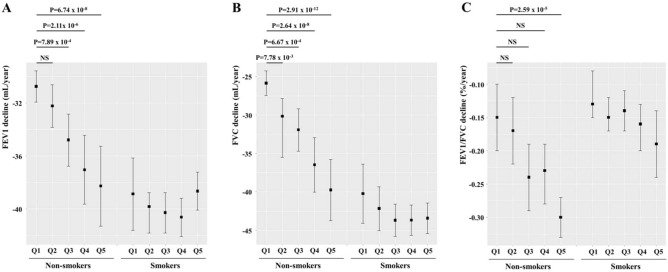
그림 출처: PubMed Central 공개 논문 (PMC8119944)
Conflict of interest statement
The authors declare no competing interests.
그 밖의 정보
- 출판 형태
- Journal Article
- 저널
- Scientific reports · eISSN 2045-2322
- 전자 출판
- 2021-05-13
- MeSH
- Adult · Aged · Biomarkers / blood · Female · Follow-Up Studies · Forced Expiratory Volume · Humans · Linear Models · Lung / physiopathology · Male · Mass Screening · Middle Aged · Regression Analysis · Republic of Korea / epidemiology · Respiration Disorders / blood / diagnosis / epidemiology / physiopathology · Retrospective Studies · Uric Acid / blood · Vital Capacity
- Substances
- Biomarkers · Uric Acid
- 참고문헌
- 60편