
Sci Rep. 2021;11(1):8080.
Pattern of inflammatory immune response determines the clinical course and outcome of COVID-19: unbiased clustering analysis.
제1저자 이은영, 송경호 · 교신저자 진범식, 박진균
소속 (10)
- Division of Rheumatology, Department of Internal Medicine, Uijeongbu Eulji Medical Center, Gyeonggi-do, Korea.
- Division of Infectious Diseases, Department of Internal Medicine, Seoul National University Bundang Hospital, Gyeonggi-do, Korea.
- Data Science for Knowledge Creation Research Center, Seoul National University, Seoul, Korea.
- Division of Infectious Diseases, Department of Internal Medicine, Armed Forces Capital Hospital, Gyeonggi-do, Korea.
- Department of Infectious Diseases, Myongji Hospital, Gyeonggi-do, Korea.
- Department of Medical Education, Seoul National University College of Medicine, Seoul, Korea.
- Division of Rheumatology, Department of Internal Medicine, Seoul National University College of Medicine, 101 Daehak-ro, Jongno-gu, Seoul, 03080, South Korea.
- Division of Infectious Diseases, Department of Internal Medicine, Seoul National University Hospital, Seoul, Korea.
- Division of Infectious Diseases, Department of Internal Medicine, National Medical Center, Euljiro 245, Jung-gu, Seoul, 04564, Korea. moberrer@nmc.or.kr.
- Division of Rheumatology, Department of Internal Medicine, Seoul National University College of Medicine, 101 Daehak-ro, Jongno-gu, Seoul, 03080, South Korea. jinkyunpark@gmail.com.
Abstract
The objective of the study was to identify distinct patterns in inflammatory immune responses of COVID-19 patients and to investigate their association with clinical course and outcome. Data from hospitalized COVID-19 patients were retrieved from electronic medical record. Supervised k-means clustering of serial C-reactive protein levels (CRP), absolute neutrophil counts (ANC), and absolute lymphocyte counts (ALC) was used to assign immune responses to one of three groups. Then, relationships between patterns of inflammatory responses and clinical course and outcome of COVID-19 were assessed in a discovery and validation cohort. Unbiased clustering analysis grouped 105 patients of a discovery cohort into three distinct clusters. Cluster 1 (hyper-inflammatory immune response) was characterized by high CRP levels, high ANC, and low ALC, whereas Cluster 3 (hypo-inflammatory immune response) was associated with low CRP levels and normal ANC and ALC. Cluster 2 showed an intermediate pattern. All patients in Cluster 1 required oxygen support whilst 61% patients in Cluster 2 and no patient in Cluster 3 required supplementary oxygen. Two (13.3%) patients in Cluster 1 died, whereas no patient in Clusters 2 and 3 died. The results were confirmed in an independent validation cohort of 116 patients. We identified three different patterns of inflammatory immune response to COVID-19. Hyper-inflammatory immune responses with elevated CRP, neutrophilia, and lymphopenia are associated with a severe disease and a worse outcome. Therefore, targeting the hyper-inflammatory response might improve the clinical outcome of COVID-19.
Figures
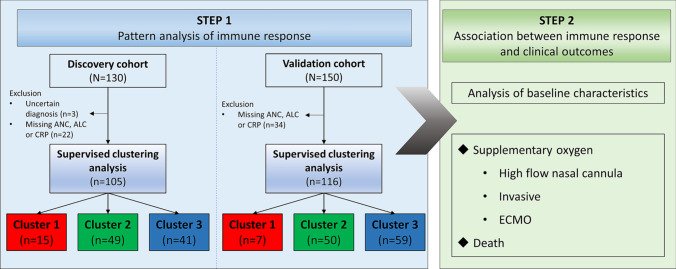
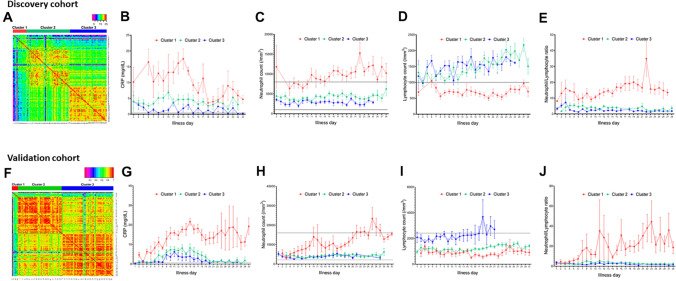
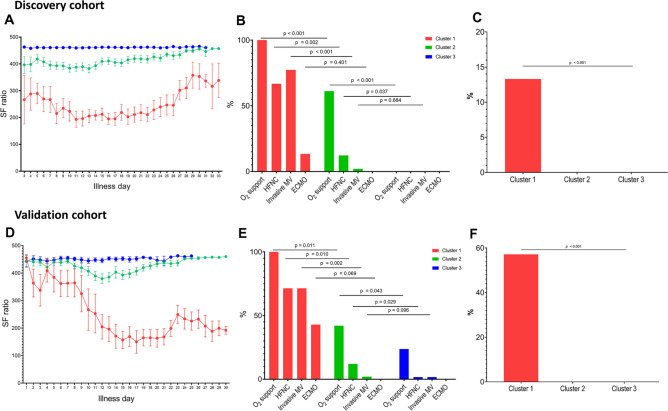
그림 출처: PubMed Central 공개 논문 (PMC8044143)
Conflict of interest statement
The authors declare no competing interests.
그 밖의 정보
- 출판 형태
- Journal Article
- 저널
- Scientific reports · eISSN 2045-2322
- 전자 출판
- 2021-04-13
- MeSH
- Adult · Aged · C-Reactive Protein / analysis · COVID-19 / immunology / pathology / virology · Cluster Analysis · Female · Humans · Immunity* · Lymphocytes / cytology · Male · Middle Aged · Neutrophils / cytology · Risk Factors · SARS-CoV-2 / isolation & purification
- Substances
- C-Reactive Protein
- 참고문헌
- 28편