
Sci Rep. 2021;11(1):17169.
Machine learning model to predict hypotension after starting continuous renal replacement therapy.
제1저자 강민우 · 교신저자 한승석
소속 (2)
- Department of Internal Medicine, Seoul National University College of Medicine, 103 Daehak-ro, Jongno-gu, Seoul, 03080, Korea.
- Department of Internal Medicine, Seoul National University College of Medicine, 103 Daehak-ro, Jongno-gu, Seoul, 03080, Korea. hansway80@gmail.com.
Abstract
Hypotension after starting continuous renal replacement therapy (CRRT) is associated with worse outcomes compared with normotension, but it is difficult to predict because several factors have interactive and complex effects on the risk. The present study applied machine learning algorithms to develop models to predict hypotension after initiating CRRT. Among 2349 adult patients who started CRRT due to acute kidney injury, 70% and 30% were randomly assigned into the training and testing sets, respectively. Hypotension was defined as a reduction in mean arterial pressure (MAP) ≥ 20 mmHg from the initial value within 6 h. The area under the receiver operating characteristic curves (AUROCs) in machine learning models, such as support vector machine (SVM), deep neural network (DNN), light gradient boosting machine (LGBM), and extreme gradient boosting machine (XGB) were compared with those in disease-severity scores such as the Sequential Organ Failure Assessment and Acute Physiology and Chronic Health Evaluation II. The XGB model showed the highest AUROC (0.828 [0.796-0.861]), and the DNN and LGBM models followed with AUROCs of 0.822 (0.789-0.856) and 0.813 (0.780-0.847), respectively; all machine learning AUROC values were higher than those obtained from disease-severity scores (AUROCs < 0.6). Although other definitions of hypotension were used such as a reduction of MAP ≥ 30 mmHg or a reduction occurring within 1 h, the AUROCs of machine learning models were higher than those of disease-severity scores. Machine learning models successfully predict hypotension after starting CRRT and can serve as the basis of systems to predict hypotension before starting CRRT.
© 2021. The Author(s).
Figures
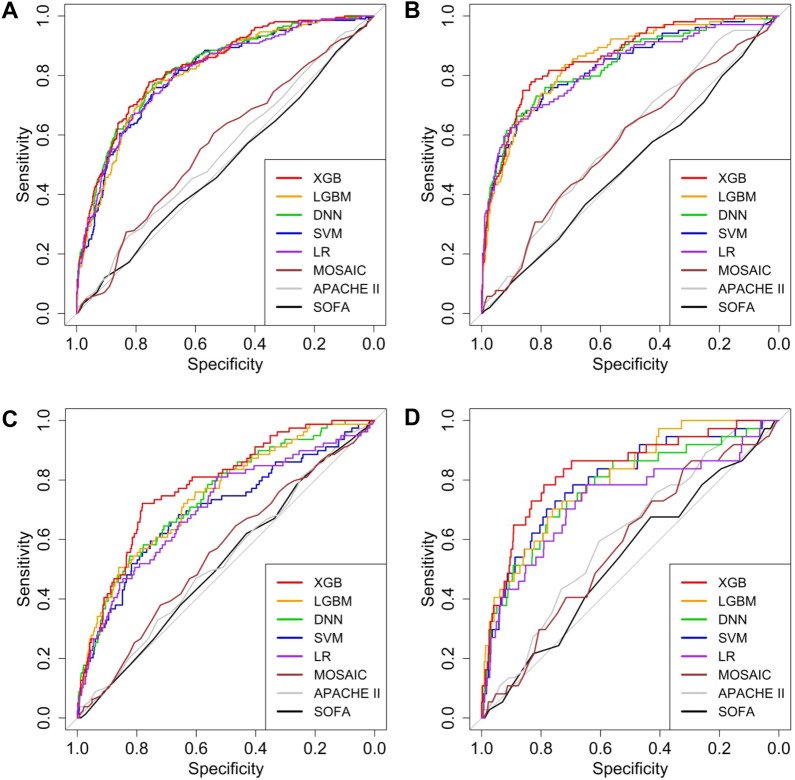
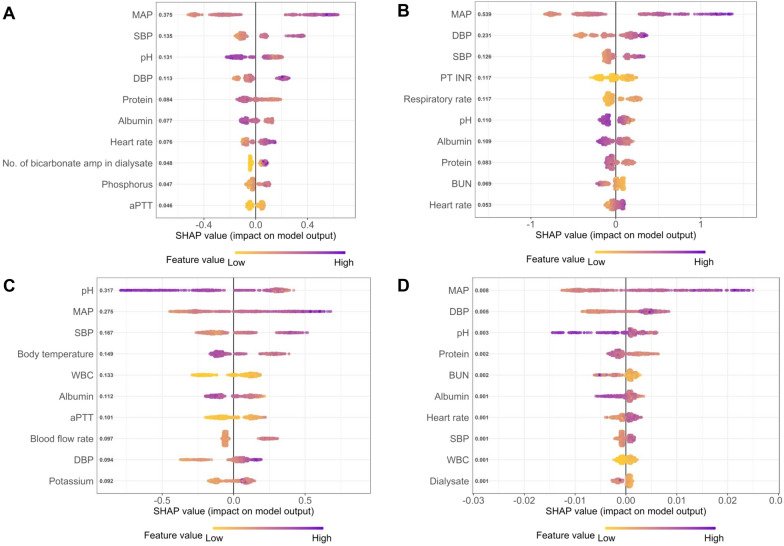
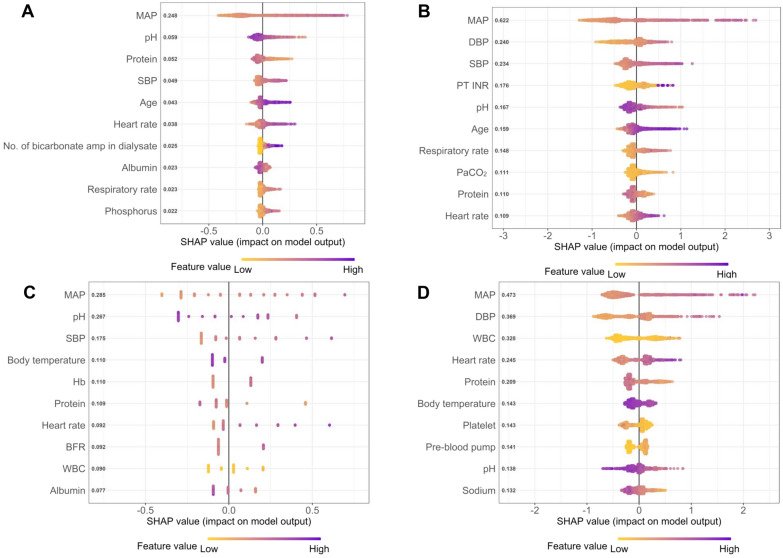
그림 출처: PubMed Central 공개 논문 (PMC8387375)
Conflict of interest statement
The authors declare no competing interests.
그 밖의 정보
- 출판 형태
- Journal Article
- 저널
- Scientific reports · eISSN 2045-2322
- 전자 출판
- 2021-08-25
- MeSH
- Acute Kidney Injury / epidemiology / therapy · Adult · Aged · Continuous Renal Replacement Therapy / adverse effects / statistics & numerical data · Female · Humans · Hypotension / epidemiology / etiology · Machine Learning* · Male · Middle Aged
- 참고문헌
- 30편