Department of Internal Medicine, Seoul National University Bundang Hospital, 82, Gumi-ro 173, Beon-gil, Seongnam, Gyeonggido, 13620, South Korea.
Department of Internal Medicine, Seoul National University Bundang Hospital, 82, Gumi-ro 173, Beon-gil, Seongnam, Gyeonggido, 13620, South Korea. dhljohn@yahoo.com.
Research Laboratories, ILDONG Pharmaceutical Co., Ltd., Hwaseong, South Korea.
MD Healthcare Inc., Seoul, Republic of Korea.
Abstract
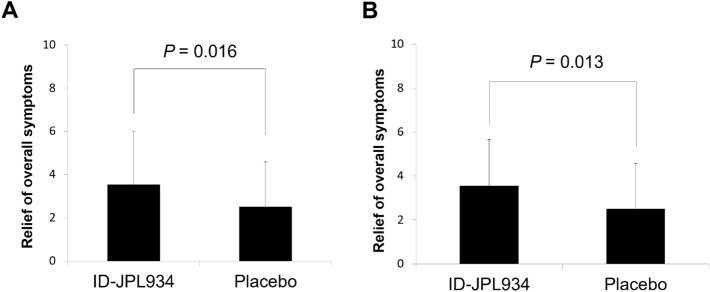
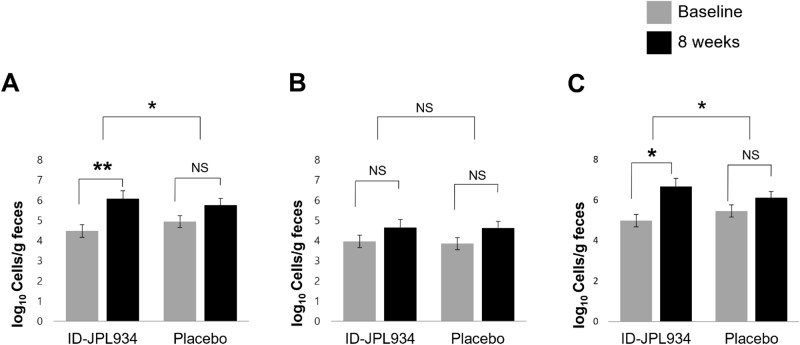
The study evaluated the efficacy of ID-JPL934, a probiotic preparation containing Lactobacillus johnsonii IDCC 9203, Lactobacillus plantarum IDCC 3501 and Bifidobacterium lactis IDCC 4301, in relieving lower gastrointestinal symptoms. A total of 112 subjects with lower gastrointestinal symptoms were consecutively enrolled. They were randomized into either ID-JPL934 administration group or placebo group. Bristol stool form, stool frequency, and abnormal bowel movement symptoms were recorded at baseline and week 2, 6, and 8. Primary endpoint was improvement in overall symptoms at week 8. Fecal samples were collected to measure the probiotic levels in feces using quantitative polymerase chain reaction (qPCR), and to perform metagenomic analysis of microbiome originating from bacteria-derived extracellular vesicles and bacterial cells via 16S rDNA sequencing. Of the 112 subjects, 104 (54 in ID-JPL934 group and 50 in placebo group) completed the entire study protocol. A higher relief of overall symptoms was found in ID-JPL934 group than in placebo group (p = 0.016). Among lower gastrointestinal symptoms, abdominal pain and bloating scores were more decreased in ID-JPL934 group than in placebo group (p < 0.05). The fecal microbiome profiles of the two groups did not differ. However, the qPCR analysis showed significant increase in the levels of Lactobacillus johnsonii and Bifidobacterium lactis in feces post-treatment in ID-JPL934 group than in placebo group (p < 0.05 by repeated measure ANOVA). In conclusion, ID-JPL934 is effective in relieving lower gastrointestinal symptoms. Exposure to ID-JPL934 may increase the abundance of Lactobacillus johnsonii and Bifidobacterium lactis in the gut.Trial registration: ClinicalTrials.gov number, NCT03395626.
Figures
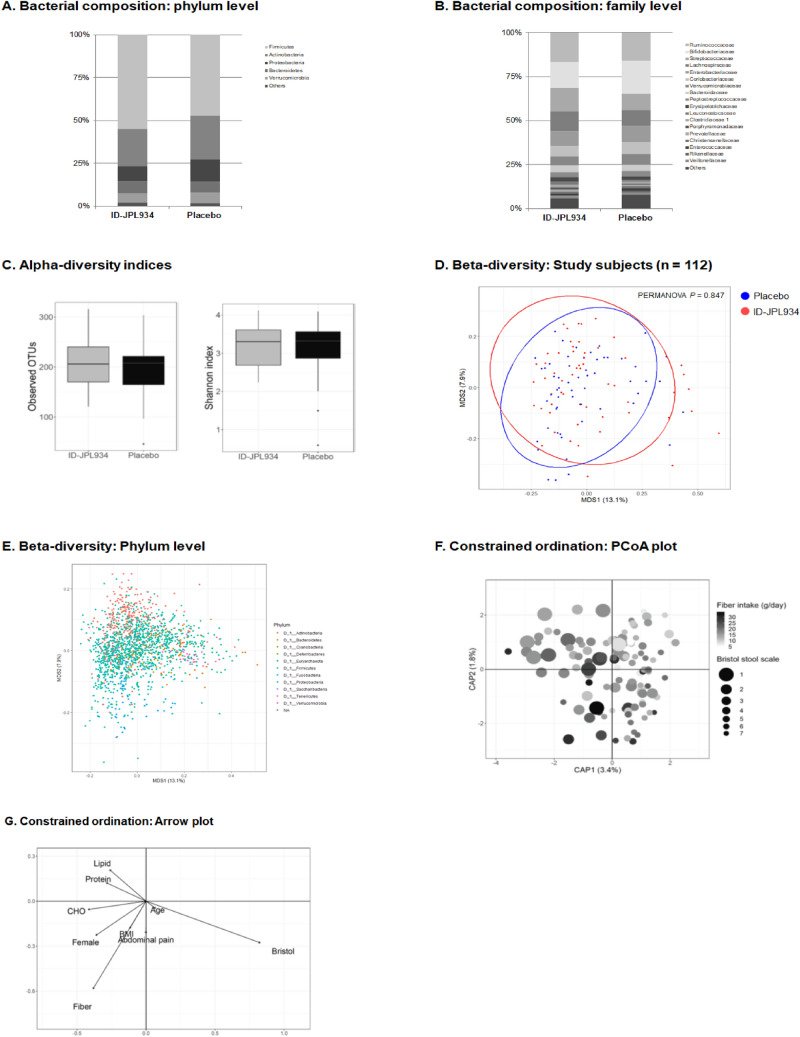
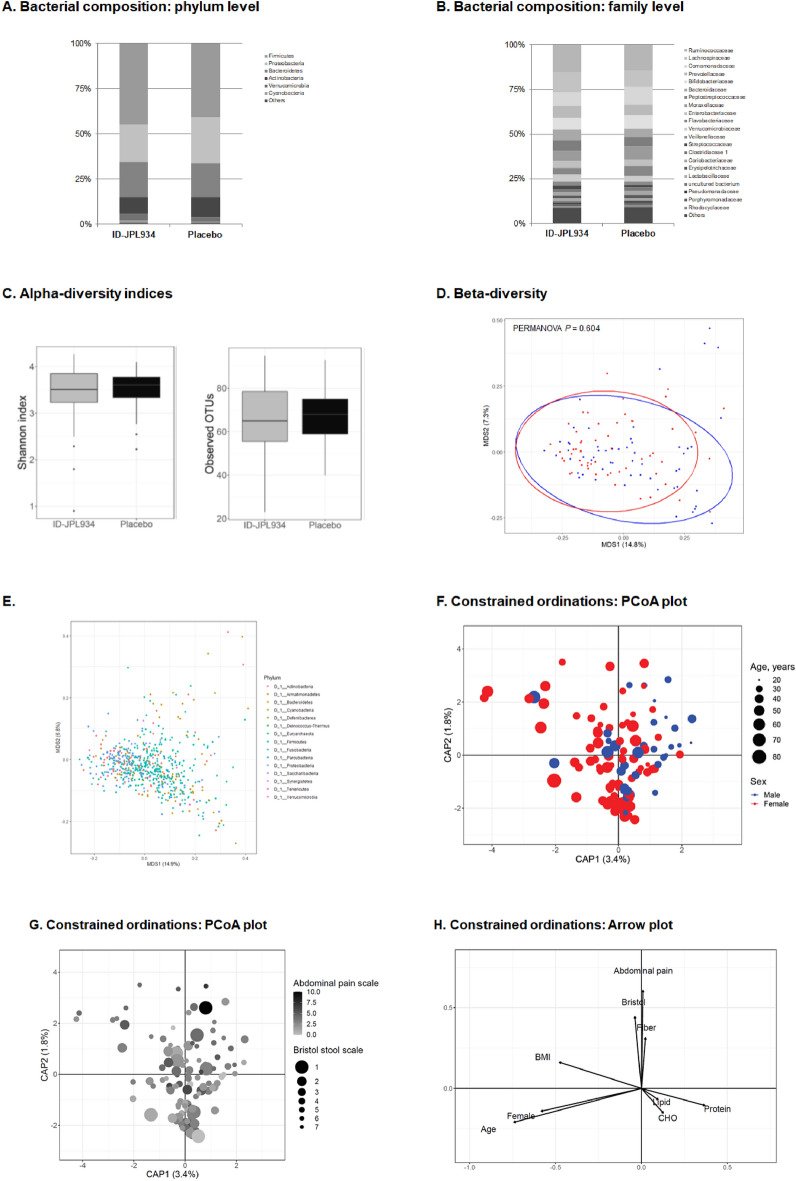
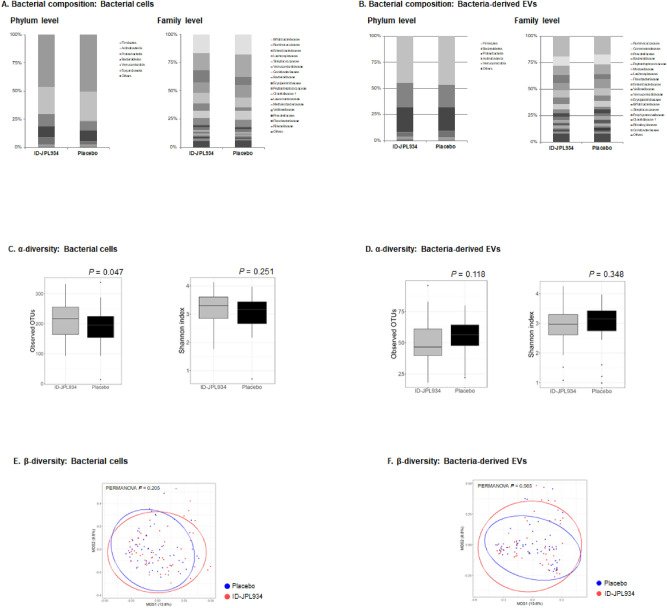
Figure 1Relief of overall symptoms in the ID-JPL934 group vs. placebo group after 8-week treatment. (A) Intention-to-treat analysis (n = 112). (B) Per protocol analysis (n = 104). A significantly higher relief of overall symptoms was observed in the ID-JPL934 than in the placebo group. P-values were calculated using Student’s t-test.Figure 2Summary of the metagenomic analysis of the microbiome originating from bacterial cells at baseline. The placebo and the ID-JPL934 groups are comparable in the bacterial composition at the phylum (A) and family levels (B). Microbial diversity is not significantly different between the placebo and the ID-JPL934 groups (C, p > 0.05). In β-diversity index, no significant difference was observed between the two groups (PERMANOVA p > 0.05, Bray–Curtis distance, D). The figure shows the ordination plot of the OTUs at the phylum level (E). Scatter plots of first 2 PC loadings in the canonical analysis of principal coordinates (F,G). Arrows indicate components of the clinical variables. Some of the clinical variables including stool consistency and fiber intake appear to correlate with the ordination. In contrast, age, BMI, and abdominal symptom show limited correlation with the ordination. CHO, carbohydrate; BMI, body mass index.Figure 3Summary of metagenomic analysis of the microbiome originating from bacteria-derived extracellular vesicles at baseline. The placebo group and the ID-JPL934 group are comparable in bacterial composition at the phylum (A) and family levels (B). Microbial diversity did not differ between the placebo group and the ID-JPL934 group (C, p > 0.05). No significant difference in β-diversity index was observed between the two groups (PERMANOVA p > 0.05, Bray–Curtis distance, D). The figure represents the ordination plot of the OTUs at the phylum level (E). Scatter plots of first 2 PC loadings in the canonical analysis of principal coordinates (F–H). Arrows indicate components of clinical variables. Some of the clinical variables including stool consistency, sex, age, abdominal pain, and fiber intake appear to correlate with the ordination. CHO, carbohydrate; BMI, body mass index.Figure 4Summary of metagenomic analyses of the ID-JPL934 group and the placebo group at week 8. The compositions of bacterial cells (A) and bacteria-derived EVs (B) in feces of the ID-JPL934 group and the placebo group at 8 weeks is comparable. The microbial diversity of bacterial cells was decreased in ID-JPL93 group compared with the placebo group based on observed OTU counts (p = 0.047) but not according to Shannon index (C). The microbial diversity of bacteria-derived EVs was not different between the two groups (D). In bacterial cells (E) and bacteria-derived EVs (F), no significant differences in β-diversity index were observed between the two groups (PERMANOVA p > 0.05, Bray–Curtis distance).Figure 5Quantitative changes in fecal probiotic levels at baseline and at week 8. (A) Lactobacillus johnsonii IDCC9203, (B) Lactobacillus plantarum IDCC3501, (C) Bifidobacterium lactis IDCC4301; P-values within the group were calculated using paired t-test; P-values between the 2 groups were calculated using repeated-measures analysis of variance. Means and standardized error are shown. *P < 0.05, **P < 0.001. NS, not significant.
그림 출처: PubMed Central 공개 논문 (PMC8219743)
Conflict of interest statement
The authors declare no competing interests.
그 밖의 정보
출판 형태
Journal Article, Randomized Controlled Trial, Research Support, Non-U.S. Gov't, Validation Study