
Sci Rep. 2021;11(1):13473.
Nonalcoholic fatty liver disease is associated with the development of obstructive sleep apnea.
제1저자 정고은, 조은주 · 교신저자 한경도, 유수종
소속 (10)
- Department of Internal Medicine and Healthcare Research Institute, Seoul National University Hospital Healthcare System Gangnam Center, Seoul, Republic of Korea.
- Department of Internal Medicine and Liver Research Institute, Seoul National University College of Medicine, 101 Daehak-no, Jongno-gu, Seoul, 03080, Republic of Korea.
- Department of Gastroenterology and Hepatology, Soonchunhyang University Bucheon Hospital, Bucheon, Gyeonggi-do, Republic of Korea.
- Department of Gastroenterology and Hepatology, Soonchunhyang University Seoul Hospital, Seoul, Republic of Korea.
- Center for Liver and Pancreatobiliary Cancer, National Cancer Center, Goyang, Republic of Korea.
- Department of Biostatistics, College of Medicine, Soongsil University, Seoul, Republic of Korea.
- Department of Family Medicine/Supportive Care Center, Samsung Medical Center Supportive Care Center, Samsung Comprehensive Cancer Center, Seoul, Republic of Korea.
- Center for Clinical Epidemiology, SAIHST, Sungkyunkwan University, Seoul, Republic of Korea.
- Department of Biostatistics, College of Medicine, Soongsil University, Seoul, Republic of Korea. hkd917@naver.com.
- Department of Internal Medicine and Liver Research Institute, Seoul National University College of Medicine, 101 Daehak-no, Jongno-gu, Seoul, 03080, Republic of Korea. ydoctor2@snu.ac.kr.
Abstract
Increasing evidence suggests that obstructive sleep apnea (OSA) is a metabolic syndrome-related disease; however, the association between nonalcoholic fatty liver disease (NAFLD) and OSA is not firmly established. In this study, we investigated the relationship between NAFLD and OSA in a general population drawn from a nationwide population-based cohort. Data from the Korean National Health Insurance System between January 2009 and December 2009 were analyzed using Cox proportional hazards model. NAFLD was defined as a fatty liver index (FLI) ≥ 60 in patients without excessive alcohol consumption (who were excluded from the study). Newly diagnosed OSA during follow-up was identified using claims data. Among the 8,116,524 participants, 22.6% had an FLI score of 30-60 and 11.5% had an FLI ≥ 60. During median follow-up of 6.3 years, 45,143 cases of incident OSA occurred. In multivariable analysis, the risk of OSA was significantly higher in the higher FLI groups (adjusted hazard ratio [aHR] 1.15, 95% confidence interval [CI] 1.12-1.18 for FLI 30-60 and aHR 1.21, 95% CI 1.17-1.26 for FLI ≥ 60). These findings were consistent regardless of body mass index and presence of abdominal obesity. In conclusion, a high FLI score may help identify individuals with a high risk of OSA. Understanding the association between NAFLD and OSA may have clinical implications for risk-stratification of individuals with NAFLD.
Figures
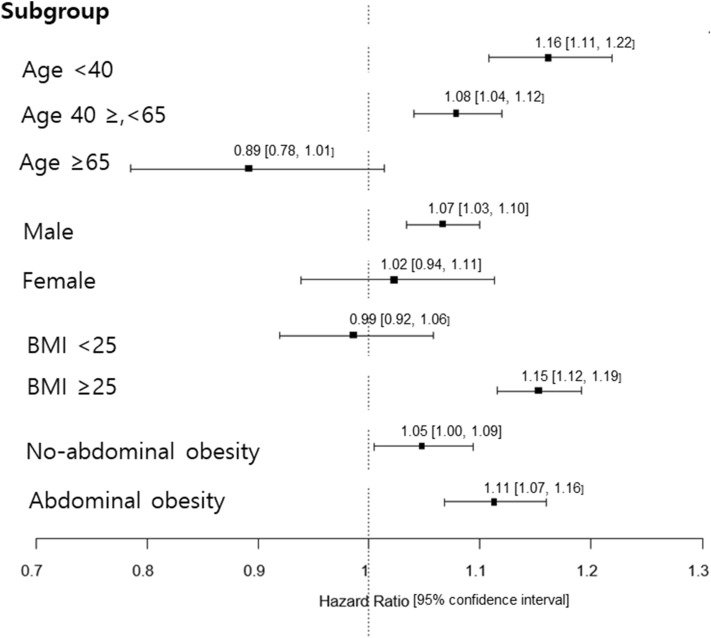
그림 출처: PubMed Central 공개 논문 (PMC8241839)
Conflict of interest statement
The authors declare no competing interests.
그 밖의 정보
- 출판 형태
- Journal Article, Research Support, Non-U.S. Gov't
- 저널
- Scientific reports · eISSN 2045-2322
- 전자 출판
- 2021-06-29
- MeSH
- Adult · Aged · Body Mass Index · Female · Follow-Up Studies · Humans · Insurance Claim Review · Male · Middle Aged · Non-alcoholic Fatty Liver Disease* / epidemiology / etiology · Obesity, Abdominal* / complications / epidemiology · Republic of Korea / epidemiology · Risk Factors · Sleep Apnea, Obstructive* / complications / epidemiology
- 참고문헌
- 42편