
PLoS One. 2013;8(1):e55106.
Potassium intake and the prevalence of metabolic syndrome: the Korean National Health and Nutrition Examination Survey 2008-2010.
제1저자 이하정 · 교신저자 허남주
소속 (1)
- Department of Internal Medicine, Seoul National University Hospital, Seoul, Korea.
Abstract
Lower potassium intake is considered to be correlated with diabetes incidence. However, few studies have investigated the effect of potassium intake on metabolic syndrome (MetS). Data was taken from the Korean National Health and Nutritional Examination Survey (2008-2010) using weighted adjustment. MetS was defined as per the revised National Cholesterol Education Program criteria. Homeostasis model assessment indices were calculated to diagnosis insulin resistance (IR). A total of 16,637 participants (44 ± 0.25 years) were included. Women ingested lower amounts of potassium (2.71 ± 0.02 g/day) than men (3.45 ± 0.03 g/day). A curvilinear association between potassium intake and MetS prevalence was found among women. Women with less than the Adequate Intake (4.7 g/day) of potassium had an 11% risk reduction for MetS (adjusted odds ratio [OR], 0.89; 95% confidence interval [CI], 0.82-0.96; P = 0.004) and a 10% risk reduction for IR (OR, 0.90; 95% CI, 0.82-0.99; P = 0.026) for every 1 g/day potassium increase. Compared with the reference group (3.5-4.5 g/day), potassium intake was inversely associated with an increased risk of MetS (1.5-2.5 g/day; OR, 1.29; 95% CI, 1.02-1.63; P = 0.035; <1.5 g/day; OR, 1.40; 95% CI, 1.06-1.85; P = 0.017) and IR (<1.5 g/day; OR, 1.36; 95% CI, 1.05-1.76; P = 0.021). This relationship was more prominent in postmenopausal women, but not observed among men. Higher potassium intake is significantly associated with a lower MetS prevalence in women, and IR is believed to be connected.
Figures

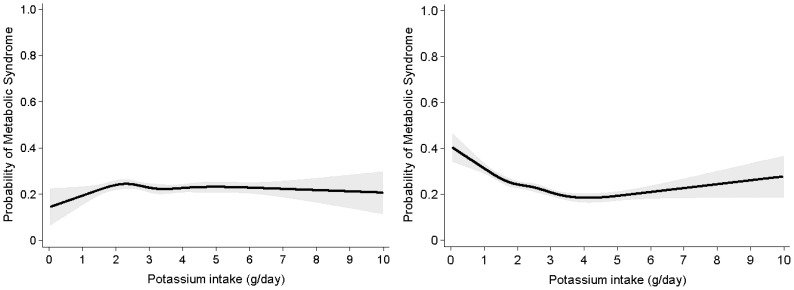

그림 출처: PubMed Central 공개 논문 (PMC3555937)
Conflict of interest statement
Competing Interests:The authors have declared that no competing interests exist.
그 밖의 정보
- 출판 형태
- Journal Article
- 저널
- PloS one · eISSN 1932-6203
- 전자 출판
- 2013-01-25
- MeSH
- Adult · Asian People · Cross-Sectional Studies · Dietary Supplements* · Female · Humans · Insulin Resistance · Male · Metabolic Syndrome / epidemiology · Middle Aged · Nutrition Surveys* · Potassium* · Prevalence · Republic of Korea / epidemiology · Risk · Sex Factors · Young Adult
- Substances
- Potassium
- 참고문헌
- 42편