SCI 발표논문

SCI 발표논문

← SCI 발표논문 목록

Sci Rep. 2015;5:18214.

Efficacy of a New Medical Information system, Ubiquitous Healthcare Service with Voice Inception Technique in Elderly Diabetic Patients.

, , , , , , , ,

제1저자 김경민 · 교신저자 임수

PMID 26658492 PMC4676004 DOI 10.1038/srep18214 IF 4.9 내분비대사내과
소속 (3)
  1. Department of Internal Medicine, Seoul National University Bundang Hospital and Seoul National University College of Medicine, Seongnam, 13620, South Korea.
  2. u-healthcare center, Seoul National University Bundang Hospital and Seoul National University College of Medicine, Seongnam, Korea.
  3. Aimmed Corporation Limited, Seoul, Korea.

Abstract

We have demonstrated previously that an individualized health management system using advanced medical information technology, named ubiquitous (u)-healthcare, was helpful in achieving better glycemic control than routine care. Recently, we generated a new u-healthcare system using a voice inception technique for elderly diabetic patients to communicate information about their glucose control, physical activity, and diet more easily. In a randomized clinical trial, 70 diabetic patients aged 60-85 years were assigned randomly to a standard care group or u-healthcare group for 6 months. The primary end points were the changes in glycated hemoglobin (HbA1c) and glucose fluctuation assessed by the mean amplitude glycemic excursion (MAGE). Changes in body weight, lifestyle, and knowledge about diabetes were also investigated. After 6 months, the HbA1c levels decreased significantly in the u-healthcare group (from 8.6 ± 1.0% to 7.5 ± 0.6%) compared with the standard care group (from 8.7 ± 0.9% to 8.2 ± 1.1%, P < 0.01). The MAGE decreased more in the u-healthcare group than in the standard care group. Systolic blood pressure and body weight decreased and liver functions improved in the u-healthcare group, but not in the standard care group. The u-healthcare system with voice inception technique was effective in achieving glycemic control without hypoglycemia in elderly diabetic patients (Clinicaltrials.gov: NCT01891474).

Figures
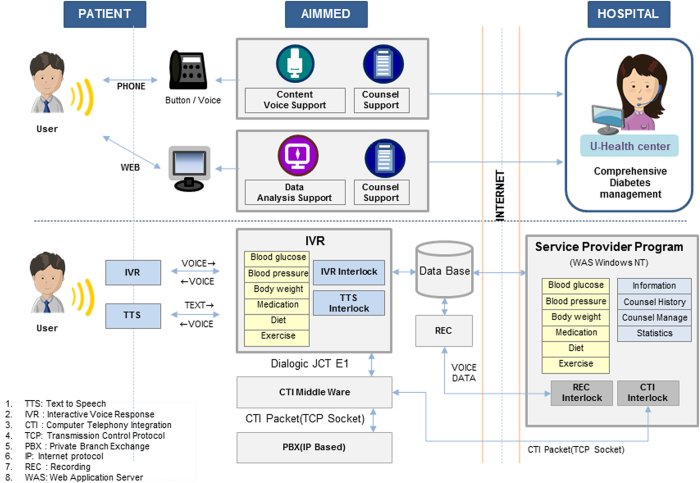
Figure 1
Figure 1 Scheme of the u-healthcare service using a voice inception IT solution. The participants in the u-healthcare group are educated about how to use the u-healthcare service. They are instructed to input their self-measured glucose levels into the u-healthcare service system using two alternative channels. (1) Channel 1 uses a mobile phone or landline, and it is possible to enter the health data through voice with ARS or touch pad tone. (2) Channel 2 uses the Web site in a conventional way, in which the user logs in to the disease-management Web site by typing the information directly into the patient’s administration page. Data input is automatically transmitted to the main server in the u-healthcare center and then tailored messages automatically generated from the CDSS rule engine are transmitted back to their phones instantly as a voice service or to their personal page on the Web site and stored in the u-healthcare system. For dietary feedback, participants are educated to give information on their food intake via phone. They are also able to upload a food diary or a picture of a food on the health data input page on the Web site. In the Web site, a list of each participant’s favorite food is uploaded by a dietician to help patient click on what and how much they eat. Nutritionists directly analyze the customer-specific dietary problems through the analysis program called CAN-Pro 4.0 (Korean nutrition Society). The results from the CAN-Pro software are displayed automatically on the Web site, and the participants can find detailed information about their dietary pattern or, if necessary, a nutritionist directly provides direct consultations via the phone.
Figure 2
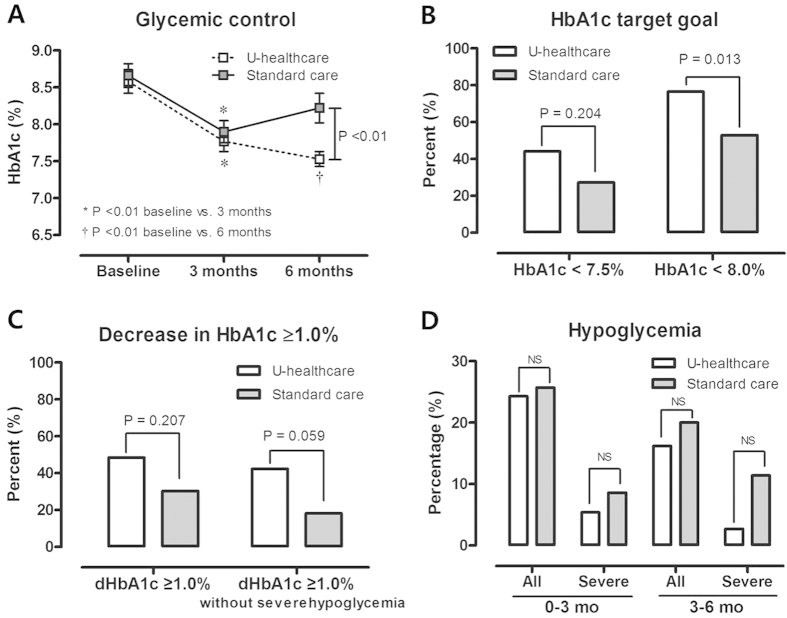
Figure 2 Comparison of glycemic control and hypoglycemia between the u-healthcare and standard care groups. (A) Changes in HbA1c levels over the 6 months of the study in the u-healthcare and standard care groups. The data were expressed as the mean ± SD. (B) Percentages of patients who achieved the target level of HbA1c ≤7.5% or ≤8.0% without hypoglycemia at 6 months. (C) Percentages of patients whose HbA1c decreased by ≥1% with and without severe hypoglycemia during the study period. (D) Percentages of patients experiencing all and severe hypoglycemic events during the 3 and 6 months.
Figure 3
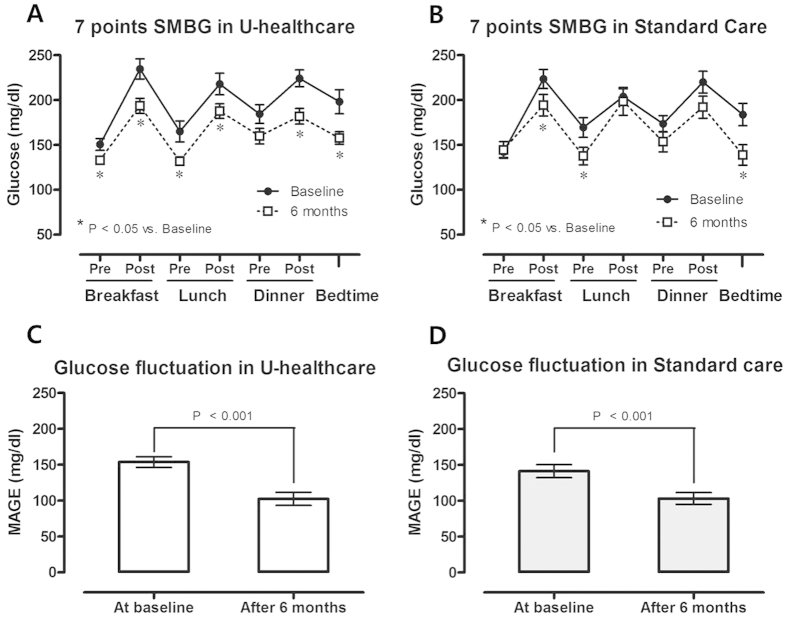
Figure 3 Seven-points SMBG for 3 days before and after the intervention (A,B) and glucose fluctuation assessed by the modified mean amplitude of glycemic excursion (MAGE) using the SMBG profiles. The data were expressed as the mean ± SD.

그림 출처: PubMed Central 공개 논문 (PMC4676004)

그 밖의 정보
출판 형태
Journal Article, Research Support, Non-U.S. Gov't
저널
Scientific reports · eISSN 2045-2322
전자 출판
2015-12-11
MeSH
Age Factors · Aged · Aged, 80 and over · Blood Glucose · Delivery of Health Care / methods · Diabetes Mellitus, Type 2 / diagnosis / epidemiology / therapy · Female · Glycated Hemoglobin · Humans · Male · Medical Informatics Applications* · Middle Aged · Monitoring, Physiologic / methods · Quality of Life · Randomized Controlled Trials as Topic · User-Computer Interface*
Substances
Blood Glucose · Glycated Hemoglobin
데이터
ClinicalTrials.gov: NCT01891474
참고문헌
33편