
Medicine (Baltimore). 2018;97(9):e0070.
Body mass index and the risk of low femoral artery puncture in coronary angiography under fluoroscopy guidance.
제1저자 김민석 · 교신저자 김학령
소속 (1)
- Division of Cardiology, Department of Internal Medicine, Seoul National University Bundang Hospital, Seongnam Seoul National University College of Medicine Division of Cardiology, Department of Internal Medicine, Boramae Medical Center, Seoul, Korea.
Abstract
The inferior border of the femoral head (IBFH) is widely used as a landmark in femoral artery puncture during invasive coronary angiography (ICA). However, application of this technique can be challenging especially in obese patients. This study was performed to investigate the association between body mass index (BMI) and the risk of low puncture in femoral artery puncture.A total of 464 patients (64.8 ± 11.1 years, 55.8% male) who underwent ICA via trans-femoral access were retrospectively reviewed. IBFH was used as a landmark for a skin nick and the femoral artery cannulation site was confirmed by femoral angiography. Cannulation at the bifurcation of the common femoral artery (CFA) or below were considered low puncture.Twenty-nine patients (5.8%) were identified as having an angiographically high CFA bifurcation and low femoral artery puncture occurred in 27 (93.1%) patients of them. Among patients with normal bifurcation (n = 464), low puncture occurred in 74 (15.9%) patients. Underweight (BMI < 18.5 kg/m) or obese (BMI ≥ 30 kg/m) patients were more common in the low puncture group than in the proper puncture group (36.5% vs. 5.9%, P < .001). Multivariable analysis showed underweight or obesity (odd ratio, 9.10; 95% confidential interval, 4.77-17.35; P < .001) was an independent risk factor of low puncture even after controlling for clinical covariates. The average distance from IBFH to the CFA puncture site was shorter in patients with underweight (1.74 ± 0.71 cm) or obesity (1.75 ± 0.60 cm) than in those with normal BMI or overweight (2.07 ± 0.83 cm) (P = .030). Trigonometric calculation showed that the average distance from IBFH to the CFA puncture site was 0.5 to 2.59 cm (mean = 1.32 cm) shorter in underweight patients compared with those of normal weight or overweight patients.In patients with normal CFA bifurcation, underweight or obesity were associated with increased risk of low puncture. The puncture site should be chosen about 1 finger width more proximal to IBFH for ICA in such patients.
Figures
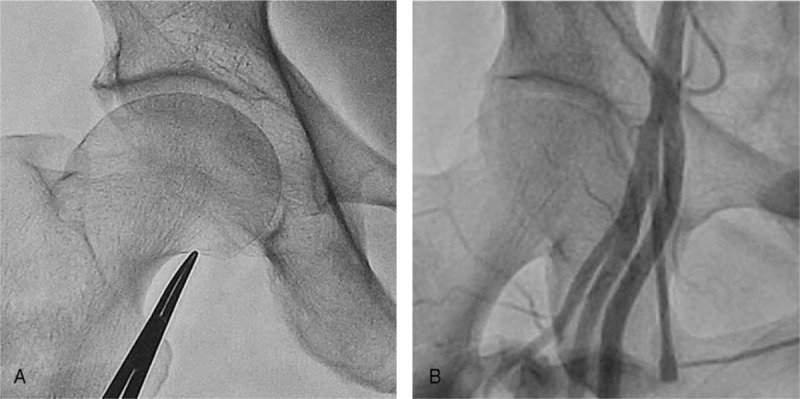
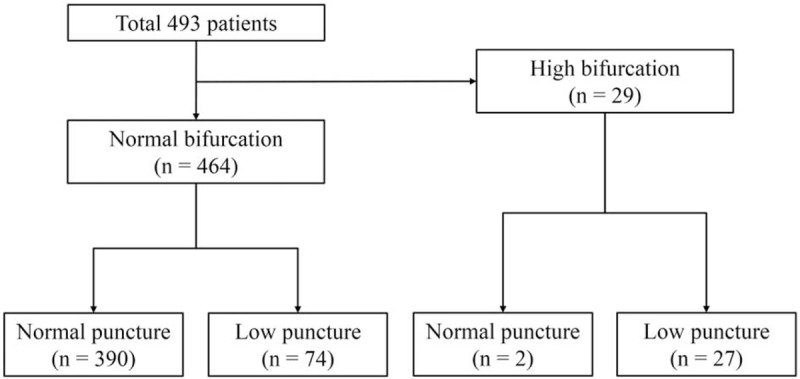
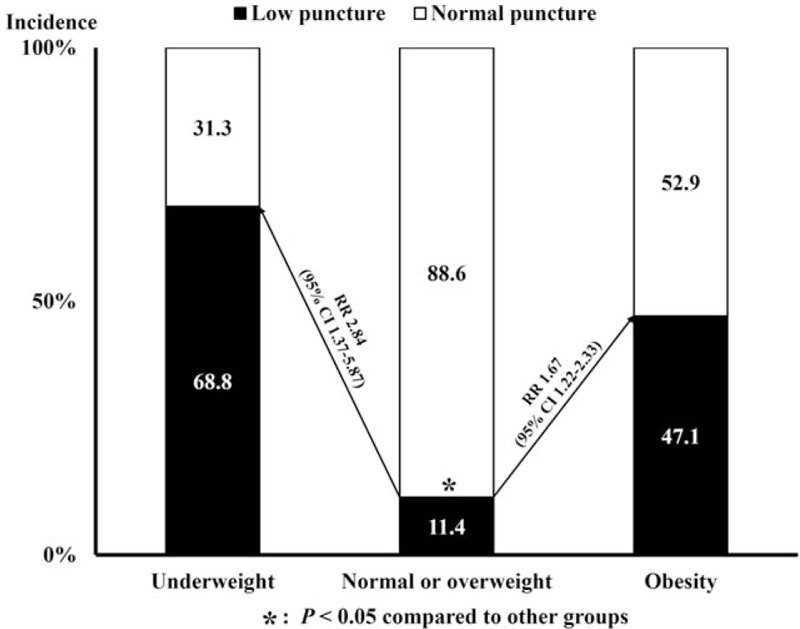
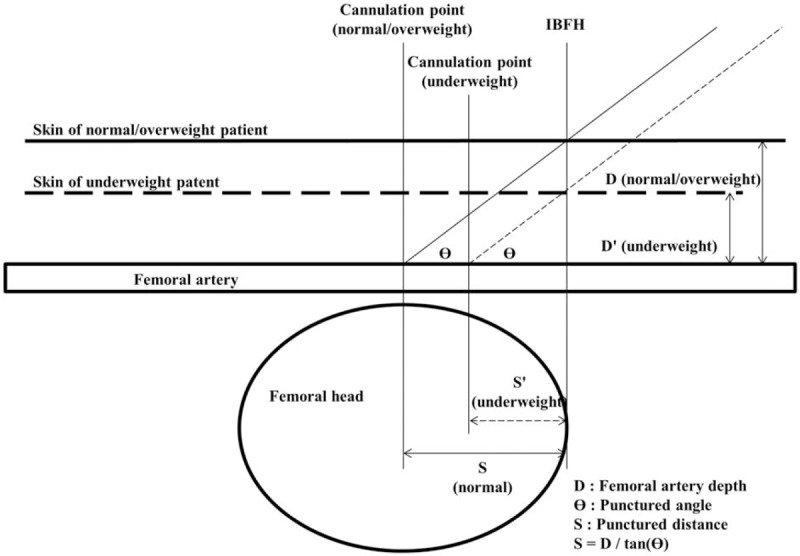
그림 출처: PubMed Central 공개 논문 (PMC5851760)
Conflict of interest statement
The authors have no funding and conflicts of interest to disclose.
그 밖의 정보
- 출판 형태
- Journal Article
- 저널
- Medicine · eISSN 1536-5964
- MeSH
- Aged · Body Mass Index* · Catheterization, Peripheral / adverse effects · Coronary Angiography / adverse effects · Female · Femoral Artery / injuries · Fluoroscopy · Humans · Male · Middle Aged · Overweight · Retrospective Studies · Risk Factors · Thinness · Vascular System Injuries / etiology
- 참고문헌
- 26편