
PLoS One. 2013;8(1):e55323.
Early referral to a nephrologist improved patient survival: prospective cohort study for end-stage renal disease in Korea.
제1저자 김도형 · 교신저자 이정표
소속 (1)
- Department of Internal Medicine, Seoul National University College of Medicine, Seoul, Korea.
Abstract
The timing of referral to a nephrologist may influence the outcome of chronic kidney disease patients, but its impact has not been evaluated thoroughly. The results of a recent study showing an association between early referral and patient survival are still being debated. A total of 1028 patients newly diagnosed as end-stage renal disease (ESRD) from July 2008 to October 2011 were enrolled. Early referral (ER) was defined as patients meeting with a nephrologist more than a year before dialysis and dialysis education were provided, and all others were considered late referral (LR). The relationship of referral pattern with mortality in ESRD patients was explored using a Cox proportional hazards regression models. Time from referral to dialysis was significantly longer in 599 ER patients than in 429 LR patients (62.3 ± 58.9 versus 2.9 ± 3.4 months, P<0.001). Emergency HD using a temporary vascular catheter was required in 485 (47.2%) out of all patients and in 262 (43.7%) of ER compared with 223 (52.0%) of LR (P = 0.009). After 2 years of follow-up, the survival rate in ER was better than that in LR (hazard ratio [HR] 2.38, 95% confidence interval [CI] 1.27-4.45, P = 0.007). In patients with diabetes nephropathy, patient survival was also significantly higher in ER than in LR (HR 4.74, 95% CI 1.73-13.00, P = 0.002). With increasing age, HR also increased. Timely referral to a nephrologist in the predialytic stage is associated with reduced mortality.
Figures

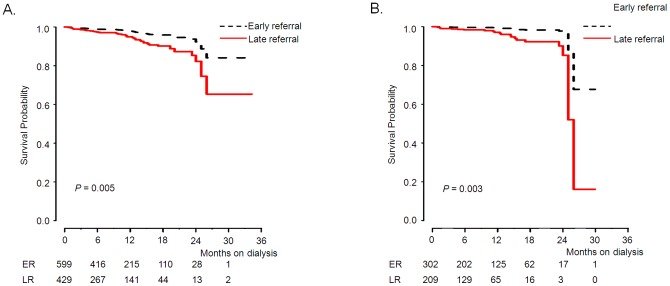
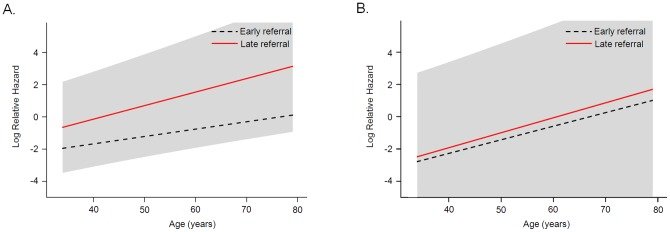
그림 출처: PubMed Central 공개 논문 (PMC3555934)
Conflict of interest statement
Competing Interests:The authors have declared that no competing interests exist.
그 밖의 정보
- 출판 형태
- Journal Article, Research Support, Non-U.S. Gov't
- 저널
- PloS one · eISSN 1932-6203
- 전자 출판
- 2013-01-25
- MeSH
- Adult · Age Factors · Aged · Cause of Death · Female · Humans · Kidney Failure, Chronic / mortality · Male · Middle Aged · Nephrology* · Prognosis · Prospective Studies · Referral and Consultation* · Republic of Korea · Risk Factors · Specialization* · Surveys and Questionnaires · Time Factors
- 참고문헌
- 29편