
Front Cardiovasc Med. 2024;11:1423336.
Association between changes in renal function and clinical outcomes in anticoagulated atrial fibrillation patients with marginal renal function. A nationwide observational cohort study.
제1저자 이소령, 이경연 · 교신저자 최의근
소속 (6)
- Department of Internal Medicine, Seoul National University Hospital, Seoul, Republic of Korea.
- Department of Internal Medicine, Seoul National University College of Medicine, Seoul, Republic of Korea.
- Division of Cardiology, Department of Internal Medicine, Boramae Medical Center, Seoul National University College of Medicine, Seoul, Republic of Korea.
- Statistics and Actuarial Science, Soongsil University, Seoul, Republic of Korea.
- Liverpool Centre for Cardiovascular Science at University of Liverpool, Liverpool John Moores University and Liverpool Chest & Heart Hospital, Liverpool, United Kingdom.
- Danish Center for Health Services Research, Department of Clinical Medicine, Aalborg University, Aalborg, Denmark.
Abstract
BACKGROUND Renal function is one of the crucial components for determining the dose and type of oral anticoagulants in atrial fibrillation (AF) patients, and is also closely associated with the risks of stroke and bleeding. This study aimed to assess renal function changes and their impact on clinical outcomes in anticoagulated AF patients with marginal renal function.
METHODS From a Korean claims database, patients with AF on anticoagulants and a baseline eGFR of 45 to <60 ml/min/1.73 m2 were studied. Patients were grouped by changes in renal function over two years-maintained, improved (eGFR >60 ml/min/1.73 m2), or worsened (eGFR <45 ml/min/1.73 m2)-the study analyzed outcomes including ischemic stroke, major bleeding, end-stage renal disease (ESRD), all-cause death, and a composite of clinical outcomes.
RESULTS A total of 5,126 patients were included in the study: 2,170 (42.3%) in the maintained group, 2,276 (44.4%) in the improved group, and 680 (13.1%) in the group with worsened renal function. The worsened group was older and had more prevalent comorbidities than other groups. After multivariable adjustment, the worsened group was associated with significantly higher risks of major bleeding (adjusted hazard ratio, 95% confidence interval; 1.46, 1.03-2.07, p = 0.035), ESRD (1.49, 1.24-1.80, p < 0.001), all-cause death (9.29, 4.92-17.6, p < 0.001), and the composite outcome (1.57, 1.36-1.83, p < 0.001).
CONCLUSIONS In anticoagulated AF patients with marginal renal function, a substantial proportion of patients experienced renal function decline below eGFR 45 ml/min/1.73 m2 within 2 years. Renal function decline was associated with higher risks of major bleeding, ESRD, all-cause death, and the composite outcome compared to those who maintained their baseline renal function.
© 2024 Lee, Lee, Choi, Choi, Ahn, Kwon, Kim, Han, Oh and Lip.
Keywords
anticoagulationatrial fibrillationmarginal renal functionrenal dysfunctionrenal function change
Figures
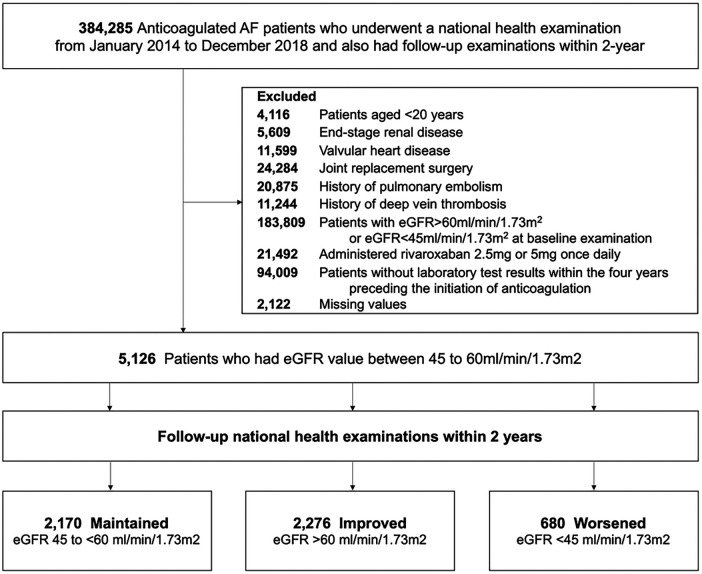
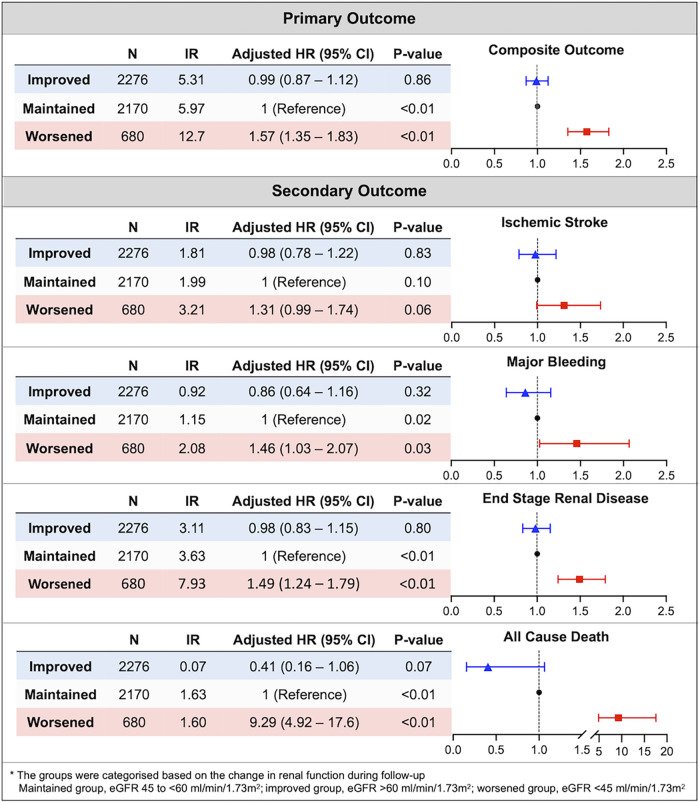
그림 출처: PubMed Central 공개 논문 (PMC11188773)
Conflict of interest statement
GL is consultant and speaker for BMS/Pfizer, Boehringer Ingelheim, Anthos, and Daiichi-Sankyo. The remaining authors declare that the research was conducted in the absence of any commercial or financial relationships that could be construed as a potential conflict of interest.
그 밖의 정보
- 출판 형태
- Journal Article
- 저널
- Frontiers in cardiovascular medicine · ISSN 2297-055X
- 전자 출판
- 2024-06-06
- 연구비
- NIEHS NIH HHS 27302C0028
- 참고문헌
- 50편