
Sci Rep. 2018;8(1):821.
Relationship between brachial-ankle and heart-femoral pulse wave velocities and the rapid decline of kidney function.
제1저자 이성우 · 교신저자 오국환
소속 (9)
- Department of Internal Medicine, Seoul National University Postgraduate School, Seoul, Korea.
- Department of Internal Medicine, Eulji University, Eulji General Hospital, Seoul, Korea.
- Department of Internal Medicine, Yonsei University College of Medicine, Seoul, Korea.
- Department of Internal Medicine, Gachon University, Gil Hospital, Incheon, Korea.
- Department of Preventive Medicine, Seoul National University College of Medicine, Seoul, Korea.
- Cancer Research Institute, Seoul National University, Seoul, Korea.
- Department of Biomedical Science, Seoul National University Graduate School, Seoul, Korea.
- Department of Internal Medicine, Seoul National University College of Medicine, Seoul, Korea.
- Department of Internal Medicine, Seoul National University College of Medicine, Seoul, Korea. ohchris@hanmail.net.
Abstract
The impact of brachial-ankle pulse wave velocity (baPWV) and heart-femoral pulse wave velocity (hfPWV) on rapid decline of estimated glomerular filtration rate (eGFR) has been inconclusive. The database of a multicenter prospective study of 2238 patients in Korea enrolled from 2011 to 2016 was reviewed. After excluding patients with missing baPWV (n = 257) and eGFR change (n = 180), the study included 1801 non-dialysis chronic kidney disease (CKD) patients. The eGFR change <-5ml/min/1.73 m2/year was defined as rapid decline. During a mean of 2.2 years, the mean eGFR change was -3.6 ml/min/1.73 m2/year, and 31.6% of patients were classified as having rapid decline. Older age, causes of CKD, increased heart rate, systolic blood pressures, and proteinuria were associated with the highest baPWV quintile. In multivariate logistic regression analyses, the odds of a rapid decline in eGFR was 1.9 times higher in the fifth quintile than in the first quintile (P = 0.013). In a subset with baPWV and hfPWV (n = 1182), high baPWV was associated with rapid eGFR decline only when accompanied by a high hfPWV. These findings suggest that central and peripheral PWVs may simultaneously affect rapid eGFR decline.
Figures
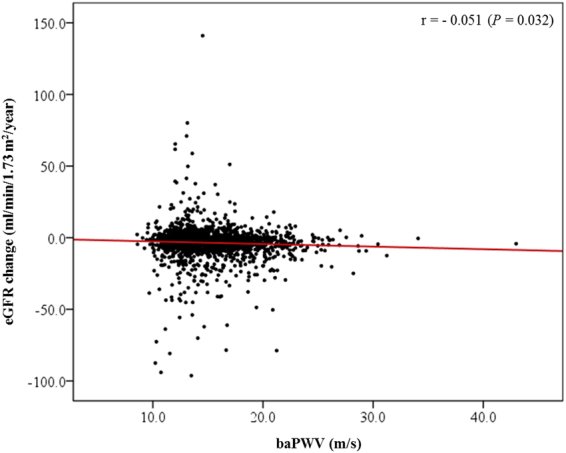
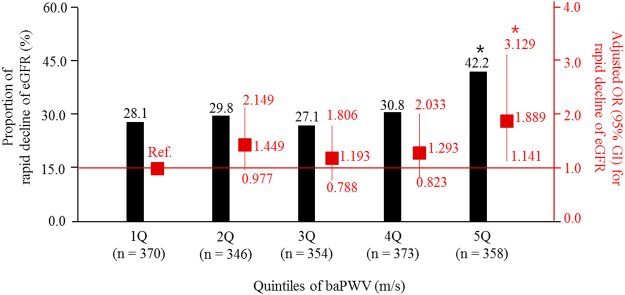
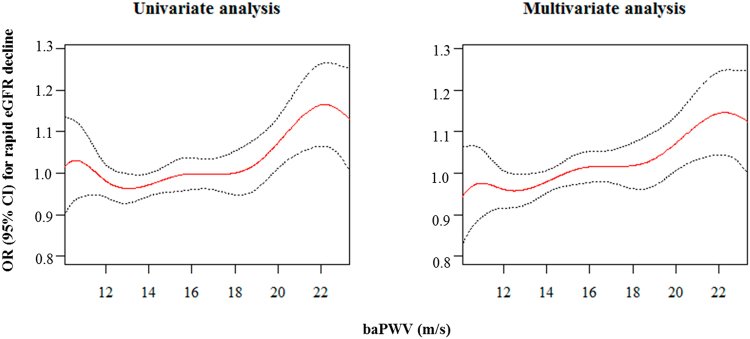
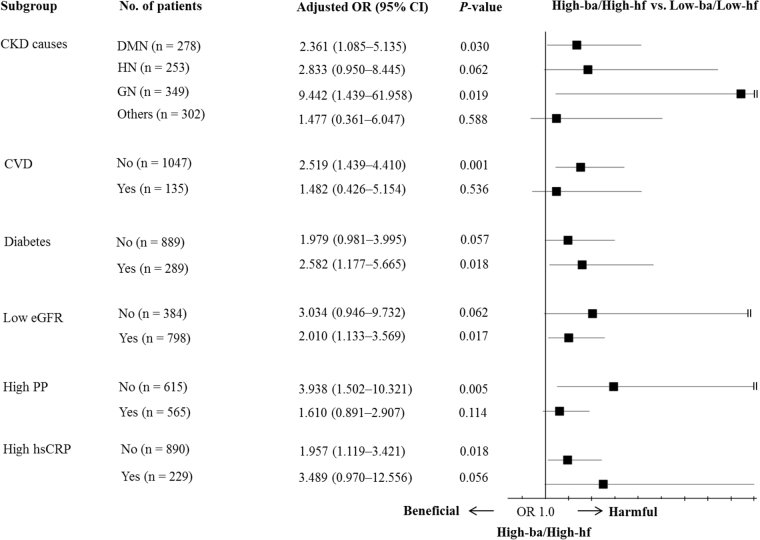
그림 출처: PubMed Central 공개 논문 (PMC5770427)
Conflict of interest statement
The authors declare that they have no competing interests.
그 밖의 정보
- 출판 형태
- Journal Article, Research Support, Non-U.S. Gov't
- 저널
- Scientific reports · eISSN 2045-2322
- 전자 출판
- 2018-01-16
- MeSH
- Adult · Aged · Brachial Artery* · Chronic Disease · Disease Progression · Female · Femoral Artery* · Glomerular Filtration Rate · Humans · Kidney Diseases / pathology · Korea · Male · Middle Aged · Prospective Studies · Pulse Wave Analysis*
- 참고문헌
- 39편