
J Clin Endocrinol Metab. 2020;105(3):e381-9.
Estimated Association Between Cytokines and the Progression to Diabetes: 10-year Follow-Up From a Community-Based Cohort.
제1저자 조남한, 구유정 · 교신저자 김윤지, 최성희
소속 (6)
- Department of Preventive Medicine, Ajou University School of Medicine, Suwon, Republic of Korea.
- Department of Internal Medicine, Chungbuk National University Hospital and Chungbuk National University College of Medicine, Cheongju, Republic of Korea.
- Department of Internal Medicine, Nowon Eulji Medical Center, Eulji Hospital, Seoul, Republic of Korea.
- Department of Internal Medicine, Seoul National University College of Medicine, Seoul, Republic of Korea.
- Department of Internal Medicine, Seoul National University Bundang Hospital, Seongnam, Republic of Korea.
- Department of Internal Medicine, Mediplex Sejong Hospital, Incheon, Republic of Korea.
Abstract
CONTEXT The long-term association between multiple cytokines and progression to diabetes is still uncertain.
OBJECTIVE To identify which cytokines could predict progression to prediabetes and type 2 diabetes over 10 years.
METHODS The study included 912 participants aged 40 to 69 years at baseline from the Ansung cohort, part of the Korea Genome Epidemiology Study. At baseline, a 75-g oral glucose tolerance test and 8 cytokines were measured: plasminogen activator inhibitor 1 (PAI-1), resistin, interleukin 6, leptin, monocyte chemoattractant protein 1, tumor necrosis factor alpha, retinol binding protein 4 (RBP4), and adiponectin. People with normal glucose tolerance (NGT, n = 241) and prediabetes (n = 330) were followed-up biennially for 10 years. Multinomial logistic regression analysis was used to evaluate the predictability of cytokines on the new-onset prediabetes and type 2 diabetes.
RESULTS At 10 years, 38 (15.8%) and 82 (34.0%) of those with NGT had converted to prediabetes and type 2 diabetes, respectively. Of those with prediabetes, 228 (69.1%) had converted to type 2 diabetes. In people with NGT or prediabetes at baseline, the highest tertile of RBP4 was associated with a 5.48-fold and 2.43-fold higher risk of progression to type 2 diabetes, respectively. The odds for converting from NGT to prediabetes in the highest tertile of PAI-1 and the lowest tertile of adiponectin were 3.23 and 3.37, respectively. In people with prediabetes at baseline, those in the highest tertile of resistin were 2.94 time more likely to develop type 2 diabetes (all P < 0.05).
CONCLUSIONS In this 10-year prospective study, NGT with higher serum RBP4 and PAI-1, and with lower adiponectin were associated with new-onset prediabetes and type 2 diabetes.
© Endocrine Society 2019.
Keywords
adipokinebiomarkercohort studycytokinediabetesprediabetes
Figures
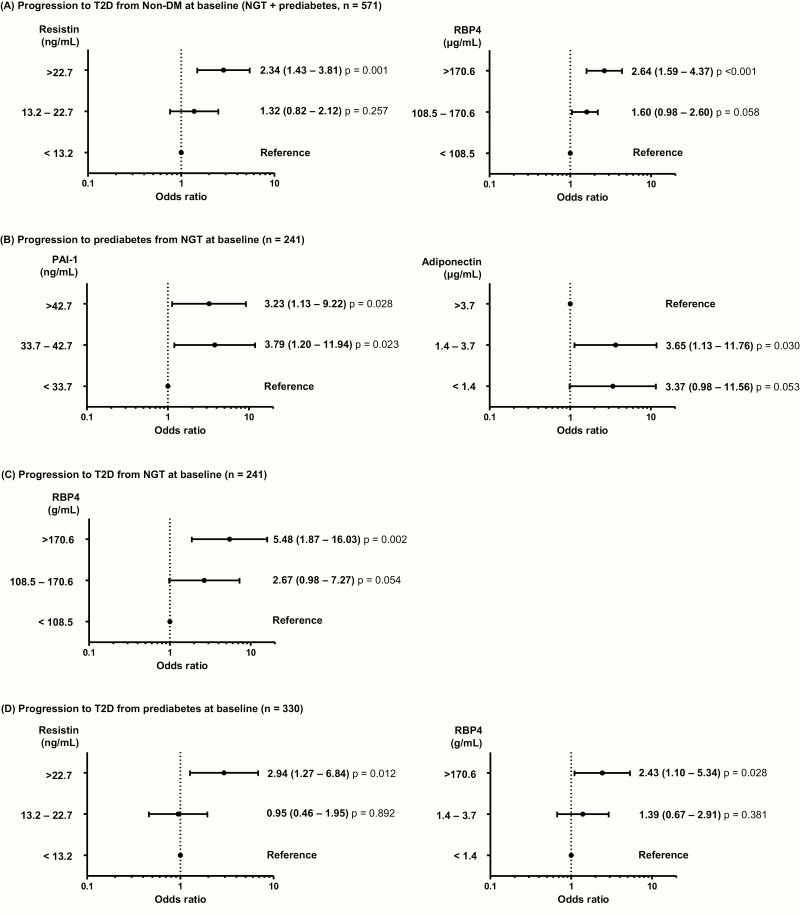
그림 출처: PubMed Central 공개 논문 (PMC7069551)
Comment · 정정
그 밖의 정보
- 출판 형태
- Journal Article, Research Support, Non-U.S. Gov't
- 저널
- The Journal of clinical endocrinology and metabolism · eISSN 1945-7197
- MeSH
- Adult · Aged · Cytokines / blood · Diabetes Mellitus, Type 2 / blood / epidemiology · Disease Progression · Female · Follow-Up Studies · Glucose Tolerance Test · Humans · Male · Middle Aged · Prediabetic State / blood · Prospective Studies · Republic of Korea / epidemiology
- Substances
- Cytokines
- 참고문헌
- 31편