
Medicine (Baltimore). 2022;101(50):e32085.
Endoscopic submucosal dissection for papillary early gastric carcinoma: Insights from a large-scale analysis of post-gastrectomy pathology specimens.
제1저자 이정환 · 교신저자 조수정
소속 (3)
- Center for Gastric Cancer, National Cancer Center, Goyang, Korea.
- Department of Hospital Medicine, Inha University Hospital, Inha University School of Medicine, Incheon, Korea.
- Division of Gastroenterology, Department of Internal Medicine and Liver Research Institute, Seoul National University, Seoul, Korea.
Abstract
Gastric papillary adenocarcinoma is considered a differentiated adenocarcinoma in the current endoscopic submucosal dissection indication guidelines. However, the safety of endoscopic submucosal dissection remains controversial. Currently, data regarding which papillary early gastric cancer should be considered for endoscopic submucosal dissection are unavailable. Thus, the aim of this study was to investigate lymph node metastasis and the safety of endoscopic submucosal dissection in patients with papillary early gastric cancer. This observational study recruited 4264 consecutive patients with early gastric cancer who underwent curative gastrectomy between October 2000 and December 2017 at the National Cancer Center, Korea. Of these, 45 had pathologically confirmed papillary early gastric cancer, 2106 had differentiated non-papillary early gastric cancer, and 2113 had undifferentiated early gastric cancer. Logistic regression analysis was performed to identify risk factors for lymph node metastasis. Mucosal tumors were less common in papillary early gastric cancer (37.9%) than in differentiated non-papillary early gastric cancer (48.8%) and undifferentiated early gastric cancer (60.4%) (both P < .001). Lymph node metastasis was more common in papillary early gastric cancer (20.0%) than in differentiated non-papillary early gastric cancer (9.2%) and undifferentiated early gastric cancer (11.7%; both P < .001). In multivariate analysis, non-mixed-type papillary early gastric cancer showed marginally increased odds of lymph node metastasis than differentiated early gastric cancer (odds ratio [OR]: 2.5, 95% confidence interval [CI]: 1.0-6.3). Rates of lymph node metastasis (1/10, 10%) and angiolymphatic invasion (2/10, 20%) for papillary early gastric cancer meeting expanded criteria were higher than those for other histology types meeting endoscopic submucosal dissection absolute or expanded criteria (P = .03 and P < .001, respectively). Endoscopic submucosal dissection should be considered carefully for papillary early gastric cancer, especially if it meets expanded endoscopic submucosal dissection indications since it is associated with high rates of submucosal invasion and lymph node metastasis.
Copyright © 2022 the Author(s). Published by Wolters Kluwer Health, Inc.
Figures
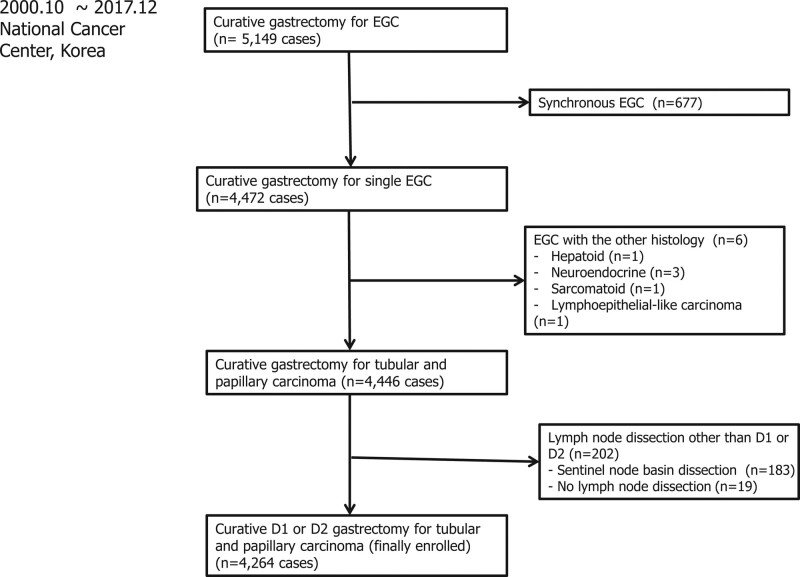
그림 출처: PubMed Central 공개 논문 (PMC9771273)
Conflict of interest statement
The authors have no conflicts of interest to disclose.
그 밖의 정보
- 출판 형태
- Observational Study, Journal Article
- 저널
- Medicine · eISSN 1536-5964
- MeSH
- Humans · Stomach Neoplasms* / pathology · Endoscopic Mucosal Resection* · Lymphatic Metastasis / pathology · Gastrectomy / adverse effects · Adenocarcinoma* / pathology · Risk Factors · Retrospective Studies · Gastric Mucosa / surgery / pathology · Lymph Node Excision
- 참고문헌
- 28편