
PLoS One. 2015;10(9):e0138304.
A Novel Geriatric Screening Tool in Older Patients with Cancer: The Korean Cancer Study Group Geriatric Score (KG)-7.
제1저자 김진원 · 교신저자 김지현
소속 (2)
- Division of Hematology and Medical Oncology, Department of Internal Medicine, Seoul National University Bundang Hospital, Seoul National University College of Medicine, Seongnam, Republic of Korea.
- Division of Geriatrics, Department of Internal Medicine, Seoul National University Bundang Hospital, Seoul National University College of Medicine, Seongnam, Republic of Korea.
Abstract
Geriatric assessment (GA) is resource-consuming, necessitating screening tools to select appropriate patients who need full GA. The objective of this study is to design a novel geriatric screening tool with easy-to-answer questions and high performance objectively selected from a large dataset to represent each domain of GA. A development cohort was constructed from 1284 patients who received GA from May 2004 to April 2007. Items representing each domain of functional status, cognitive function, nutritional status, and psychological status in GA were selected according to sensitivity (SE) and specificity (SP). Of the selected items, the final questions were chosen by a panel of oncologists and geriatricians to encompass most domains evenly and also by feasibility and use with cancer patients. The selected screening questions were validated in a separate cohort of 98 cancer patients. The novel screening tool, the Korean Cancer Study Group Geriatric Score (KG)-7, consisted of 7 items representing each domain of GA. KG-7 had a maximal area under the curve (AUC) of 0.93 (95% confidence interval (CI) 0.92-0.95) in the prediction of abnormal GA, which was higher than that of G-8 (0.87, 95% CI 0.85-0.89) within the development cohort. The cut-off value was decided at ≤ 5 points, with a SE of 95.0%, SP of 59.2%, positive predictive value (PPV) of 85.3%, and negative predictive value (NPV) of 82.6%. In the validation cohort, the AUC was 0.82 (95% CI 0.73-0.90), and the SE, SP, PPV, and NPV were 89.5%, 48.6%, 77.3%, and 75.0%, respectively. Furthermore, patients with higher KG-7 scores showed significantly longer overall survival (OS) in the development and validation cohorts. In conclusions, the KG-7 showed high SE and NPV to predict abnormal GA. The KG-7 also predicted OS. Given the results of our studies, the KG-7 could be used effectively in countries with high patient burden and low resources to select patients in need of full GA and intervention.
Figures

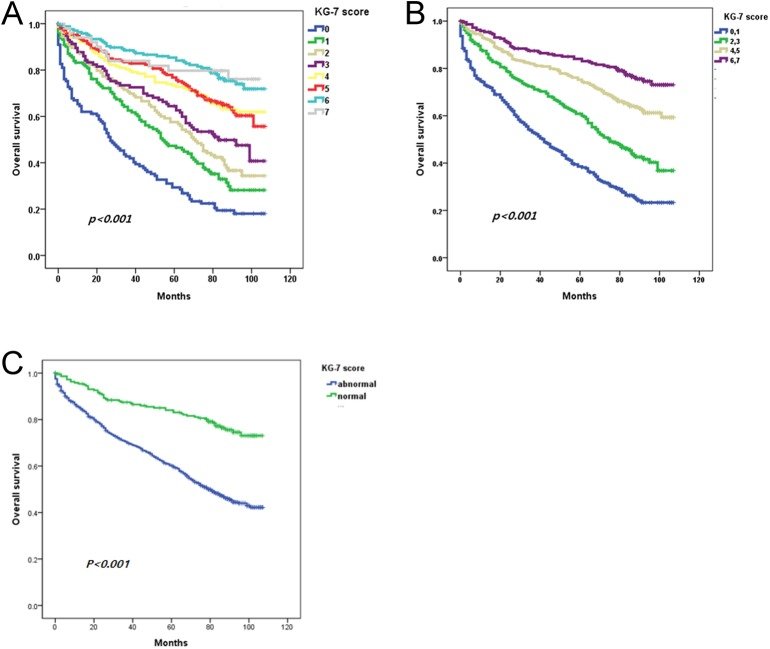
그림 출처: PubMed Central 공개 논문 (PMC4581840)
Conflict of interest statement
Competing Interests:The authors have declared that no competing interests exist.
그 밖의 정보
- 출판 형태
- Journal Article, Research Support, Non-U.S. Gov't
- 저널
- PloS one · eISSN 1932-6203
- 전자 출판
- 2015-09-24
- MeSH
- Adult · Aged · Aged, 80 and over · Cohort Studies · Comorbidity · Female · Geriatric Assessment* · Humans · Male · Mass Screening / methods / standards · Middle Aged · Neoplasms / epidemiology / mortality · Reference Values · Reproducibility of Results · Republic of Korea · Sensitivity and Specificity
- 참고문헌
- 27편