
PLoS One. 2015;10(7):e0132826.
Circulating Tumor Necrosis Factor α Receptors Predict the Outcomes of Human IgA Nephropathy: A Prospective Cohort Study.
제1저자 오윤정, 안정남 · 교신저자 이정표
소속 (7)
- Department of Internal Medicine, Cheju Halla General Hospital, Jeju, Korea.
- Department of Internal Medicine, Seoul National University Boramae Medical Center, Seoul, Korea; Department of Internal Medicine, Seoul National University College of Medicine, Seoul, Korea.
- Graduate School of Public Health, Seoul National University, Seoul, Korea.
- Kidney Research Institute, Seoul National University, Seoul, Korea.
- Department of Internal Medicine, Seoul National University College of Medicine, Seoul, Korea.
- Department of Pathology, Seoul National University College of Medicine, Seoul, Korea.
- Department of Internal Medicine, Severance Biomedical Science Institute, Yonsei University College of Medicine, Seoul, Korea.
Abstract
The circulating tumor necrosis factor receptors (TNFRs) could predict the long-term renal outcome in diabetes, but the role of circulating TNFRs in other chronic kidney disease has not been reported. Here, we investigated the correlation between circulating TNFRs and renal histologic findings on kidney biopsy in IgA nephropathy (IgAN) and assessed the notion that the circulating TNFRs could predict the clinical outcome. 347 consecutive biopsy-proven IgAN patients between 2006 and 2012 were prospectively enrolled. Concentrations of circulating TNFRs were measured using serum samples stored at the time of biopsy. The primary clinical endpoint was the decline of estimated glomerular filtration rate (eGFR; ≥ 30% decline compared to baseline). Mean eGFR decreased and proteinuria worsened proportionally as circulating TNFR1 and TNFR2 increased (P < 0.001). Tubulointerstitial lesions such as interstitial fibrosis and tubular atrophy were significantly more severe as concentrations of circulating TNFRs increased, regardless of eGFR levels. The risks of reaching the primary endpoint were significantly higher in the highest quartile of TNFRs compared with other quartiles by the Cox proportional hazards model (TNFR1; hazard ratio 7.48, P < 0.001, TNFR2; hazard ratio 2.51, P = 0.021). In stratified analysis according to initial renal function classified by the eGFR levels of 60 mL/min/1.73 m2, TNFR1 and TNFR2 were significant predictors of renal progression in both subgroups. In conclusion, circulating TNFRs reflect the histology and clinical severity of IgAN. Moreover, elevated concentrations of circulating TNFRs at baseline are early biomarkers for subsequent renal progression in IgAN patients.
Figures

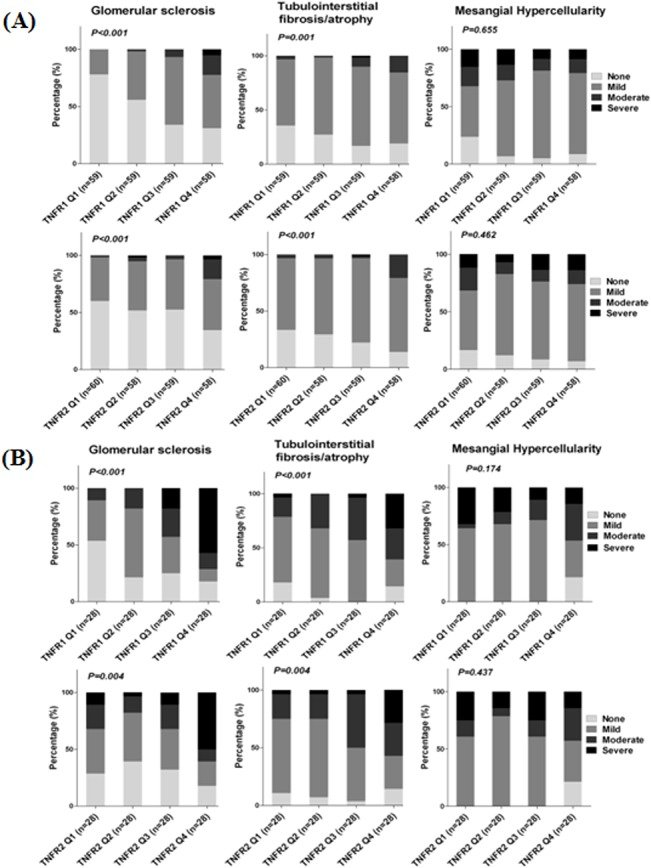


그림 출처: PubMed Central 공개 논문 (PMC4503615)
Conflict of interest statement
Competing Interests:The authors have declared that no competing interests exist.
그 밖의 정보
- 출판 형태
- Journal Article, Research Support, Non-U.S. Gov't
- 저널
- PloS one · eISSN 1932-6203
- 전자 출판
- 2015-07-15
- MeSH
- Adult · Biomarkers / blood · Disease Progression · Female · Glomerulonephritis, IGA / blood / mortality / therapy · Humans · Male · Middle Aged · Multivariate Analysis · Proportional Hazards Models · Prospective Studies · Receptors, Tumor Necrosis Factor, Type I / blood · Receptors, Tumor Necrosis Factor, Type II / blood · Treatment Outcome
- Substances
- Biomarkers · Receptors, Tumor Necrosis Factor, Type I · Receptors, Tumor Necrosis Factor, Type II
- 참고문헌
- 53편