
PLoS One. 2015;10(6):e0129477.
Four-Year Durability of Initial Combination Therapy with Sitagliptin and Metformin in Patients with Type 2 Diabetes in Clinical Practice; COSMIC Study.
제1저자 구유정 · 교신저자 임수
소속 (4)
- Department of Internal Medicine, Seoul National University College of Medicine, Seoul, Republic of Korea; Department of Internal Medicine, Chungbuk National University Hospital, Cheongju, Republic of Korea.
- Department of Internal Medicine, Seoul National University College of Medicine, Seoul, Republic of Korea; Department of Internal Medicine, Seoul National University Bundang Hospital, Seongnam, Republic of Korea.
- Department of Internal Medicine, Seoul National University College of Medicine, Seoul, Republic of Korea.
- Department of Clinical Sciences, Lund University, Lund, Sweden.
Abstract
OBJECTIVES We investigated the efficacy of initial combination therapy with sitagliptin and metformin in patients with type 2 diabetes for 4 years in clinical practice.
METHODS Between 2009 and 2010, we reviewed 1,178 patients with type 2 diabetes (HbA1c ≥7.5% or 58 mmol/mol) prescribed initial combination therapy with sitagliptin and metformin. After excluding 288 patients without a second follow-up, 890 individuals (age, 58.0 ± 12.5 years; BMI, 25.4 ± 3.5 kg/m2; HbA1c, 8.6 ± 1.1%) were followed up with every 3-6 months for 4 years. Homeostasis model assessments for insulin resistance and β-cell function (HOMA-β) were recorded at baseline. The response criterion was HbA1c reduction by ≥0.8% from baseline or attainment of the target HbA1c (≤7.0% or 53 mmol/mol). At the end of every year of treatment, changes in HbA1c from the baseline were assessed.
RESULTS After 1 year, 72.2% of patients with initial combination therapy had responded, defined as HbA1c reduction ≥0.8% or attainment of the target HbA1c ≤7.0%. After 4 years, 35.4% of the patients still showed a response, with an HbA1c level of 7.0 ± 0.9%. A high HbA1c level at baseline was the most significant independent predictor of the long-term response (P<0.001). In addition, low HOMA-β was a significant predictor of a greater reduction in HbA1c. This treatment was generally well tolerated over the 4-year follow-up period, without any serious adverse events.
CONCLUSIONS This real-world follow-up study shows a persistent glucose-reducing effect of initial combination therapy with sitagliptin and metformin for up to 4 years.
Figures
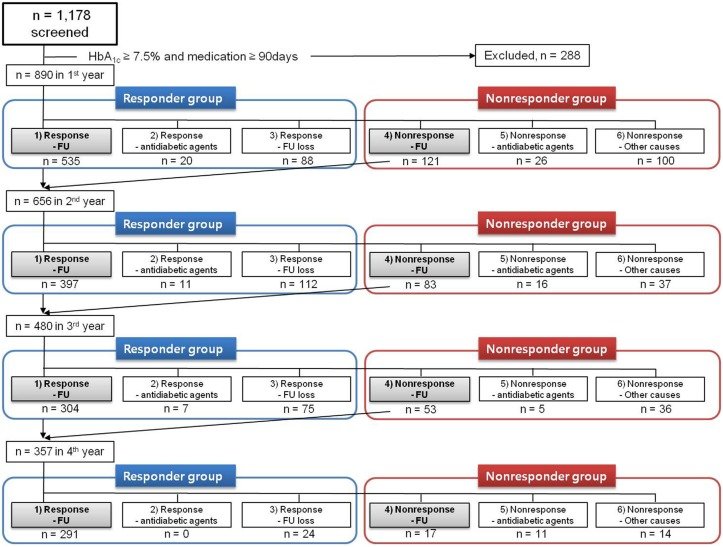
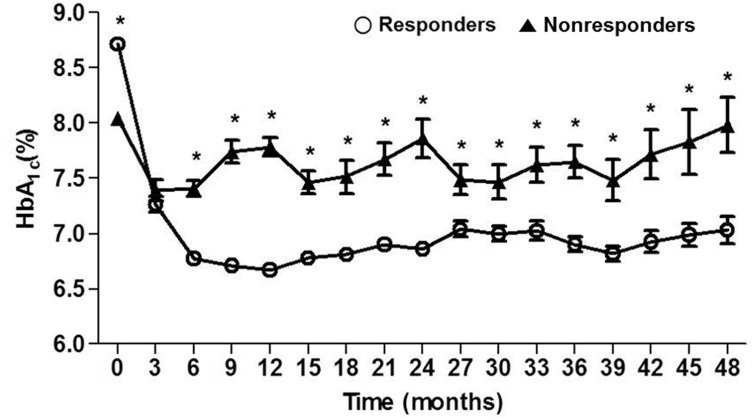
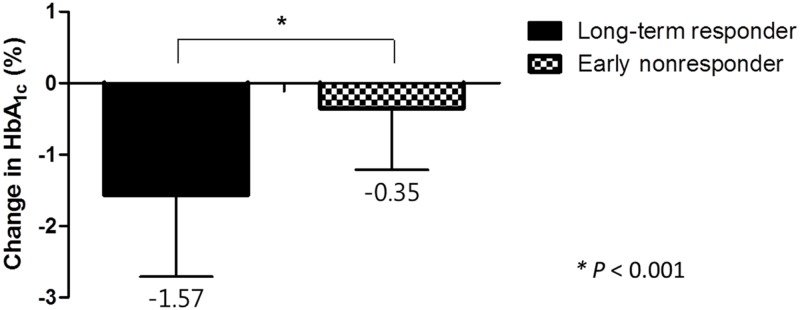
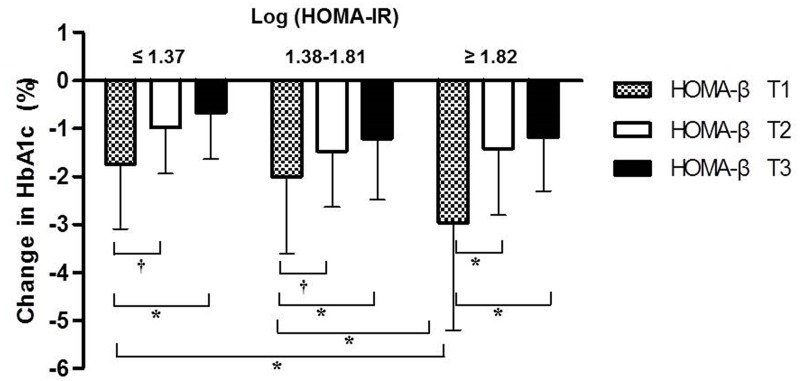
그림 출처: PubMed Central 공개 논문 (PMC4466580)
Conflict of interest statement
Competing Interests:B.A. has consulted for and/or received lecture fees from Novartis A/S, GlaxoSmithKline, Merck, Sanofi, Boehringer Ingelheim, Bristol-Myers Squibb/AstraZeneca, Takeda, and Novo Nordisk. Y.M.C. received a lecture fee or consultation fee from MSD, Lilly, Novartis, AstraZeneca, and Boehringer Ingelheim. Other authors have no conflicts of interests to disclose. This does not alter the authors’ adherence to PLOS ONE policies on sharing data and materials.
그 밖의 정보
- 출판 형태
- Journal Article, Observational Study
- 저널
- PloS one · eISSN 1932-6203
- 전자 출판
- 2015-06-12
- MeSH
- Adult · Aged · Diabetes Mellitus, Type 2 / drug therapy · Drug Therapy, Combination · Female · Hemoglobin A / metabolism · Humans · Hypoglycemic Agents / administration & dosage / adverse effects / therapeutic use · Male · Metformin / administration & dosage / adverse effects / therapeutic use · Middle Aged · Sitagliptin Phosphate / administration & dosage / adverse effects / therapeutic use
- Substances
- Hypoglycemic Agents · Hemoglobin A · Metformin · Sitagliptin Phosphate
- 참고문헌
- 38편