
PLoS One. 2013;8(5):e63468.
Development of biomarkers for screening hepatocellular carcinoma using global data mining and multiple reaction monitoring.
제1저자 김현수, 김경곤 · 교신저자 윤정환
소속 (1)
- Department of Biomedical Engineering, Seoul National University College of Medicine, Seoul, Republic of Korea.
Abstract
Hepatocellular carcinoma (HCC) is one of the most common and aggressive cancers and is associated with a poor survival rate. Clinically, the level of alpha-fetoprotein (AFP) has been used as a biomarker for the diagnosis of HCC. The discovery of useful biomarkers for HCC, focused solely on the proteome, has been difficult; thus, wide-ranging global data mining of genomic and proteomic databases from previous reports would be valuable in screening biomarker candidates. Further, multiple reaction monitoring (MRM), based on triple quadrupole mass spectrometry, has been effective with regard to high-throughput verification, complementing antibody-based verification pipelines. In this study, global data mining was performed using 5 types of HCC data to screen for candidate biomarker proteins: cDNA microarray, copy number variation, somatic mutation, epigenetic, and quantitative proteomics data. Next, we applied MRM to verify HCC candidate biomarkers in individual serum samples from 3 groups: a healthy control group, patients who have been diagnosed with HCC (Before HCC treatment group), and HCC patients who underwent locoregional therapy (After HCC treatment group). After determining the relative quantities of the candidate proteins by MRM, we compared their expression levels between the 3 groups, identifying 4 potential biomarkers: the actin-binding protein anillin (ANLN), filamin-B (FLNB), complementary C4-A (C4A), and AFP. The combination of 2 markers (ANLN, FLNB) improved the discrimination of the before HCC treatment group from the healthy control group compared with AFP. We conclude that the combination of global data mining and MRM verification enhances the screening and verification of potential HCC biomarkers. This efficacious integrative strategy is applicable to the development of markers for cancer and other diseases.
Figures
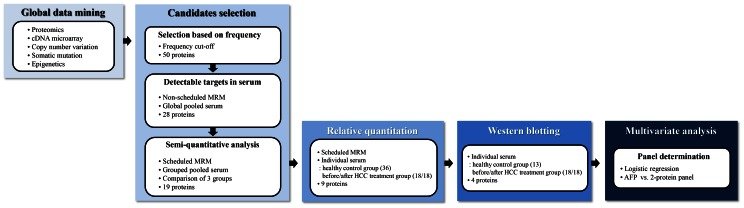
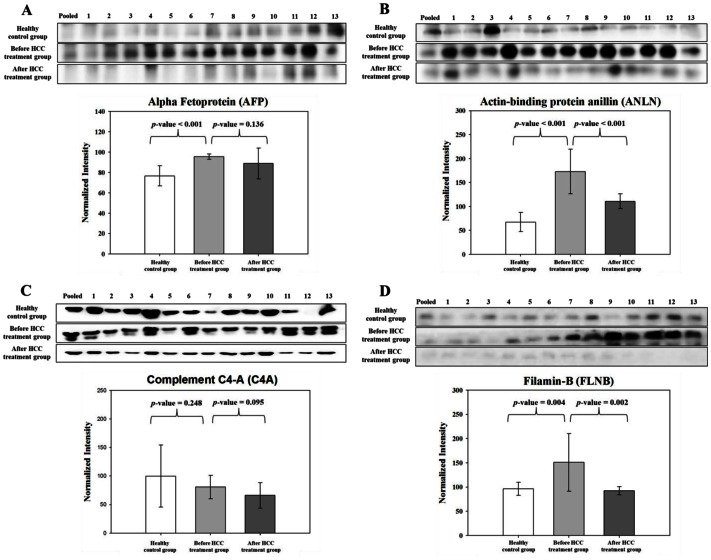
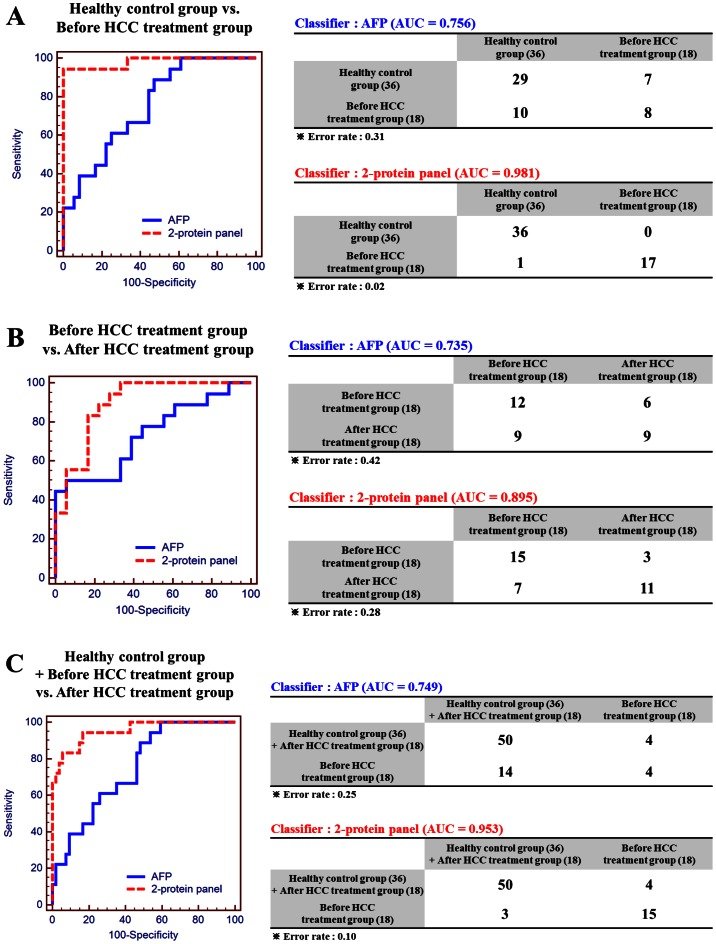
그림 출처: PubMed Central 공개 논문 (PMC3661589)
Conflict of interest statement
Competing Interests:The authors have declared that no competing interests exist.
그 밖의 정보
- 출판 형태
- Journal Article, Research Support, Non-U.S. Gov't
- 저널
- PloS one · eISSN 1932-6203
- 전자 출판
- 2013-05-22
- MeSH
- Aged · Aged, 80 and over · Biomarkers, Tumor / blood / genetics / metabolism · Carcinoma, Hepatocellular / blood / diagnosis / genetics / metabolism · Complement C4a / genetics / metabolism · Contractile Proteins / blood / genetics / metabolism · DNA Copy Number Variations / genetics · Data Mining / methods · Epigenomics / methods · Female · Filamins / genetics / metabolism · Humans · Liver Neoplasms / blood / diagnosis / genetics / metabolism · Male · Microfilament Proteins / blood / genetics / metabolism · Middle Aged · Mutation / genetics · Oligonucleotide Array Sequence Analysis / methods · Proteome / immunology · Proteomics / methods · alpha-Fetoproteins / genetics / metabolism
- Substances
- AFP protein, human · Biomarkers, Tumor · Contractile Proteins · FLNB protein, human · Filamins · Microfilament Proteins · Proteome · alpha-Fetoproteins · anillin · Complement C4a
- 참고문헌
- 48편