
Gut Liver. 2016;10(4):595-603.
Disease Phenotype, Activity and Clinical Course Prediction Based on C-Reactive Protein Levels at Diagnosis in Patients with Crohn's Disease: Results from the CONNECT Study.
제1저자 권지혜 · 교신저자 임종필
소속 (10)
- Department of Internal Medicine and Liver Research Institute, Seoul National University College of Medicine, Seoul, Korea.
- Department of Internal Medicine, Asan Medical Center, University of Ulsan College of Medicine, Seoul, Korea.
- Department of Internal Medicine and Institute of Gastroenterology, Yonsei University College of Medicine, Seoul, Korea.
- Department of Internal Medicine, Hallym University Dongtan Sacred Heart Hospital, Hwaseong, Korea.
- Department of Internal Medicine, St. Vincent's Hospital, The Catholic University of Korea College of Medicine, Suwon, Korea.
- Department of Internal Medicine, Inje University College of Medicine, Seoul, Korea.
- Department of Internal Medicine, Chonbuk National University Medical School, Jeonju, Korea.
- Department of Internal Medicine, Sungkyunkwan University School of Medicine, Seoul, Korea.
- Department of Internal Medicine, Pusan National University School of Medicine, Busan, Korea.
- Department of Internal Medicine, Hanyang University Guri Hospital, Guri, Korea.
Abstract
BACKGROUND/AIMS C-reactive protein (CRP) is an easily measured index of disease activity, but its ability to predict clinical course is controversial. We therefore designed a study to determine whether the CRP level at Crohn's disease (CD) diagnosis is a valuable indicator of the disease phenotype, activity, and clinical course.
METHODS We retrospectively analyzed 705 CD patients from 32 institutions. The patients were classified into two groups according to CRP level. The patients' demographic and clinical characteristics and their use of immunosuppressive or biological agents were recorded. Disease location and behavior, hospitalization, and surgery were analyzed.
RESULTS A high CRP was associated with younger age, steroid use, colonic or ileocolonic location, high CD activity index, and active inflammation at colonoscopy (p<0.001). As the disease progressed, patients with high CRP were more likely to exhibit strictures (p=0.027). There were significant differences in the use of 5-aminosalicylic acid, antibiotics, corticosteroids, azathioprine, and infliximab (p<0.001, p<0.001, p<0.001, p<0.001, and p=0.023, respectively). Hospitalization was also more frequent in patients with high CRP.
CONCLUSIONS The CRP level at diagnosis is useful for evaluating the phenotype, activity, and clinical course of CD. Closer follow-up strategies, with early aggressive treatment, could be considered for patients with high CRP.
Keywords
C-reactive proteinClinical courseCrohn disease
Figures
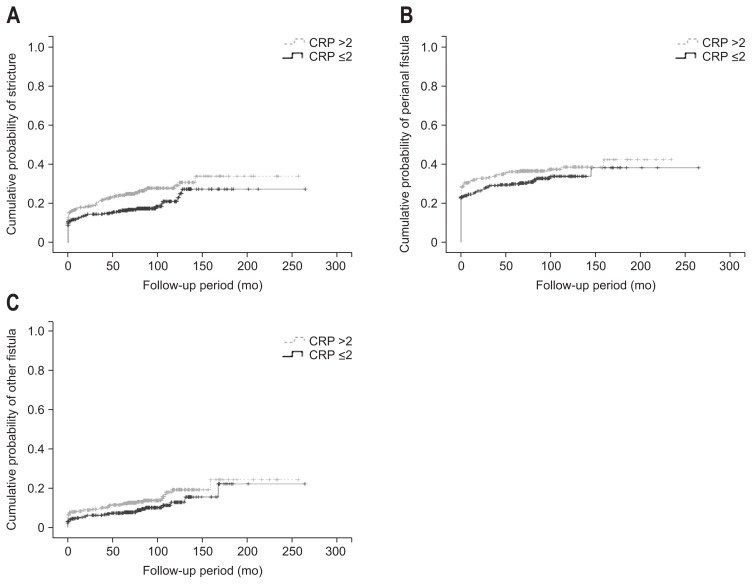
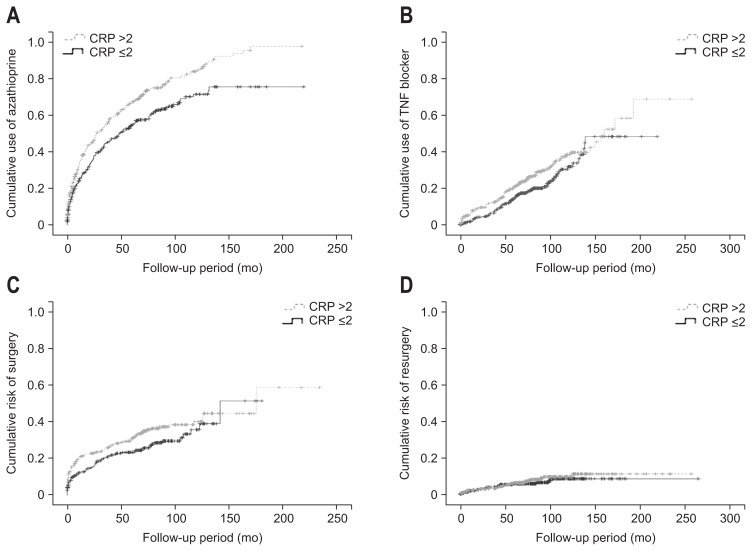
그림 출처: PubMed Central 공개 논문 (PMC4933421)
그 밖의 정보
- 출판 형태
- Evaluation Study, Journal Article
- 저널
- Gut and liver · eISSN 2005-1212
- MeSH
- Adolescent · Adult · Anti-Inflammatory Agents, Non-Steroidal / therapeutic use · Biomarkers / blood · C-Reactive Protein / analysis · Colon / pathology · Colonoscopy · Constriction, Pathologic · Crohn Disease / blood / drug therapy / pathology · Disease Progression · Female · Hospitalization / statistics & numerical data · Humans · Ileum / pathology · Immunosuppressive Agents / therapeutic use · Male · Phenotype · Predictive Value of Tests · Prognosis · Retrospective Studies · Severity of Illness Index* · Young Adult
- Substances
- Anti-Inflammatory Agents, Non-Steroidal · Biomarkers · Immunosuppressive Agents · C-Reactive Protein
- 참고문헌
- 33편