
PLoS One. 2015;10(3):e0121684.
Gender difference in ventricular response to aortic stenosis: insight from cardiovascular magnetic resonance.
제1저자 이주명, 박성지 · 교신저자 이승표
소속 (3)
- Cardiovascular Center, Sungkyunkwan University School of Medicine, Seoul, Korea; Department of Internal Medicine, Sungkyunkwan University School of Medicine, Seoul, Korea.
- Cardiovascular Imaging Center, Samsung Medical Center, Sungkyunkwan University School of Medicine, Seoul, Korea.
- Department of Radiology, Seoul National University Hospital, Sungkyunkwan University School of Medicine, Seoul, Korea.
Abstract
BACKGROUND Although left ventricular hypertrophy (LVH) and remodeling is associated with cardiac mortality and morbidity, little is known about the impact of gender on the ventricular response in aortic stenosis (AS) patients. This study aimed to analyze the differential effect of gender on ventricular remodeling in moderate to severe AS patients.
METHODS AND RESULTS A total of 118 consecutive patients (67±9 years; 63 males) with moderate or severe AS (severe 81.4%) underwent transthoracic echocardiography and cardiovascular magnetic resonance (CMR) within a 1-month period in this two-center prospective registry. The pattern of LV remodeling was assessed using the LV mass index (LVMI) and LV remodeling index (LVRI; LV mass/LV end-diastolic volume) by CMR. Although there were no differences in AS severity parameters nor baseline characteristics between genders, males showed a significantly higher LVMI (102.6±29.1 g/m2 vs. 86.1±29.2 g/m2, p=0.003) and LVRI (1.1±0.2 vs. 1.0±0.3, p=0.018), regardless of AS severity. The LVMI was significantly associated with aortic valve area (AVA) index and valvuloarterial impedance in females, whereas it was not in males, resulting in significant interaction between genders (PInteraction=0.007/0.014 for AVA index/valvuloarterial impedance, respectively). Similarly, the LVRI also showed a significantly different association between male and female subjects with the change in AS severity parameters (PInteraction=0.033/<0.001/0.029 for AVA index/transaortic mean pressure gradient/valvuloarterial impedance, respectively).
CONCLUSION Males are associated with greater degree of LVH and higher LVRI compared to females at moderate to severe AS. However, females showed a more exaggerated LV remodeling response, with increased severity of AS and hemodynamic loads, than males.
Figures

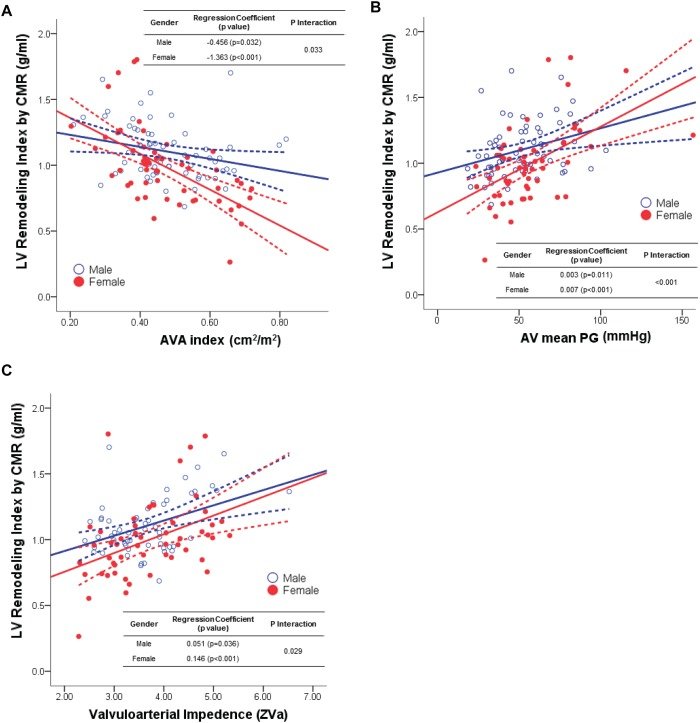
그림 출처: PubMed Central 공개 논문 (PMC4374835)
Conflict of interest statement
Competing Interests:The authors declare that they have no competing interests.
그 밖의 정보
- 출판 형태
- Journal Article, Research Support, Non-U.S. Gov't
- 저널
- PloS one · eISSN 1932-6203
- 전자 출판
- 2015-03-26
- MeSH
- Aged · Aortic Valve Stenosis / diagnostic imaging / pathology / physiopathology · Echocardiography · Female · Heart Ventricles / pathology / physiopathology · Hemodynamics · Humans · Hypertrophy, Left Ventricular / diagnosis / physiopathology · Magnetic Resonance Angiography* / methods · Male · Middle Aged · Risk Factors · Severity of Illness Index · Sex Factors · Ventricular Remodeling
- 참고문헌
- 26편