
Gut Liver. 2016;10(2):228-36.
Risk Factors for Metachronous Gastric Neoplasms in Patients Who Underwent Endoscopic Resection of a Gastric Neoplasm.
제1저자 윤혁 · 교신저자 김나영
소속 (5)
- Department of Internal Medicine, Seoul National University Bundang Hospital, Seongnam, Korea.
- Department of Internal Medicine and Liver Research Institute, Seoul National University College of Medicine, Seoul, Korea.
- Department of Pathology, Seoul National University Bundang Hospital, Seongnam, Korea.
- Department of Pathology, Laboratory of Epigenetics, Cancer Research Institute, Seoul National University College of Medicine, Seoul, Korea.
- Department of Microbiology, Hanyang University College of Medicine, Seoul, Korea.
Abstract
BACKGROUND/AIMS To identify the risk factors for metachronous gastric neoplasms in patients who underwent an endoscopic resection of a gastric neoplasm.
METHODS We prospectively collected clinicopathologic data and measured the methylation levels of HAND1, THBD, APC, and MOS in the gastric mucosa by methylation-specific real-time polymerase chain reaction in patients who underwent endoscopic resection of gastric neoplasms.
RESULTS A total of 257 patients with gastric neoplasms (113 low-grade dysplasias, 25 highgrade dysplasias, and 119 early gastric cancers) were enrolled. Metachronous gastric neoplasm developed in 7.4% of patients during a mean follow-up of 52 months. The 5-year cumulative incidence of metachronous gastric neoplasm was 4.8%. Multivariate analysis showed that moderate/severe corpus intestinal metaplasia and family history of gastric cancer were independent risk factors for metachronous gastric neoplasm development; the hazard ratios were 4.12 (95% confidence interval [CI], 1.23 to 13.87; p=0.022) and 3.52 (95% CI, 1.09 to 11.40; p=0.036), respectively. The methylation level of MOS was significantly elevated in patients with metachronous gastric neoplasms compared age- and sex-matched patients without metachronous gastric neoplasms (p=0.020).
CONCLUSIONS In patients who underwent endoscopic resection of gastric neoplasms, moderate/severe corpus intestinal metaplasia and a family history of gastric cancer were independent risk factors for metachronous gastric neoplasm, and MOS was significantly hypermethylated in patients with metachronous gastric neoplasms.
Keywords
MetastasisRisk factorsStomach neoplasmsTherapeutics
Figures
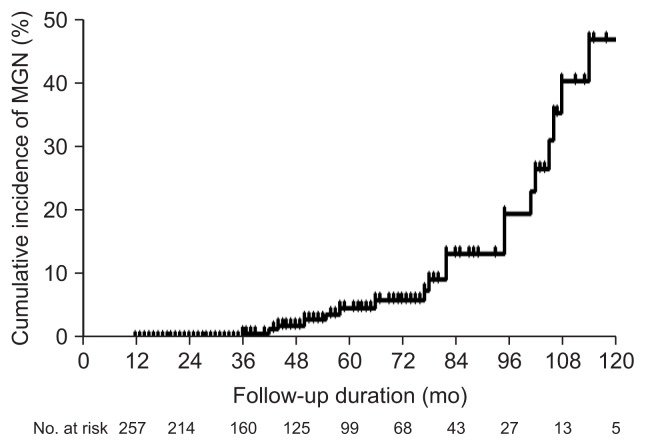
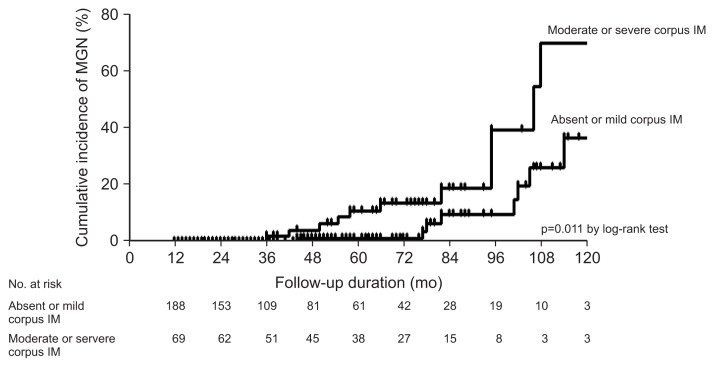
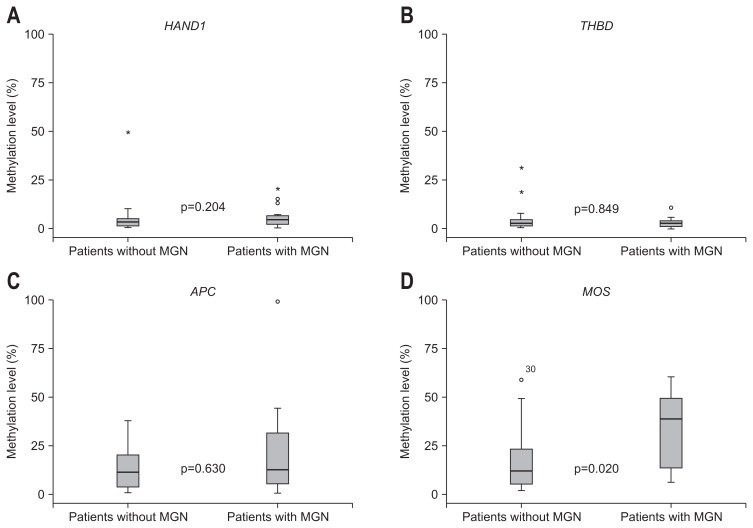
그림 출처: PubMed Central 공개 논문 (PMC4780452)
그 밖의 정보
- 출판 형태
- Journal Article, Research Support, Non-U.S. Gov't
- 저널
- Gut and liver · eISSN 2005-1212
- MeSH
- Aged · Basic Helix-Loop-Helix Proteins / genetics · DNA Methylation · Female · Gastrectomy / methods · Genes, APC / physiology · Genes, mos / genetics · Humans · Incidence · Male · Middle Aged · Multivariate Analysis · Neoplasms, Second Primary / epidemiology / genetics / pathology · Proportional Hazards Models · Risk Factors · Stomach Neoplasms / genetics / pathology / surgery · Thrombomodulin / genetics
- Substances
- Basic Helix-Loop-Helix Proteins · Thrombomodulin · THBD protein, human · helix-loop-helix protein, eHAND
- 참고문헌
- 35편