
BMJ Open. 2020;10(2):e031608.
Impact of sex and myocardial function on association of obesity with mortality in Asian patients with acute heart failure: a retrospective analysis from the STRATS-AHF registry.
제1저자 박찬순, 박준빈 · 교신저자 조구영
소속 (6)
- Graduate school of Medical Science and Engineering, Korea Advanced Institute of Science and Technology, Daejeon, Republic of Korea.
- Department of Internal Medicine, Seoul National University College of Medicine, Seoul, Republic of Korea.
- Cardiovascular Center, Seoul National University Hospital, Seoul, Republic of Korea.
- Cardiovascular Center, Department of Internal Medicine, Seoul National University Bundang Hospital, Seongnam, Republic of Korea.
- Department of Cardiology in Internal Medicine, Chungnam National University Hospital, Chungnam National University College of Medicine, Daejeon, Republic of Korea.
- Department of Internal Medicine, Seoul National University College of Medicine, Seoul, Republic of Korea cardioch@snu.ac.kr.
Abstract
OBJECTIVES Impact of sex and myocardial function on the obesity paradox in heart failure (HF) is unknown. We explored whether sex, myocardial function, and left ventricular (LV) geometry explains the protective association of body mass index (BMI) with mortality, and investigated whether metabolic health status affects this association.
DESIGN A multicentre cohort study with patients with acute HF admitted from January 2009 to December 2016 with a median follow-up of 33.7 months.
SETTING Three tertiary hospitals.
PARTICIPANTS A total of 2021 overweight-to-obese (OW) and 1543 normal-weight (NW) patients with acute HF.
MEASUREMENTS The primary outcome was all-cause mortality. Patients were categorised as either OW (BMI≥23kg/m2) or NW (BMI<23kg/m2). BMI was used as both categorical and continuous variables. Clinical, laboratory and echocardiographic measures, including LV global longitudinal strain (LV-GLS), LV-ejection fraction, LV geometry, were obtained.
RESULTS During the follow-up period, 1392 patients died (685 OW and 707 NW). BMI was significantly associated with mortality in univariate (HR=0.929 per kg/m2, p<0.001) and multivariate analyses (HR=0.954 per kg/m2, p<0.001). In multivariable fractional polynomials, higher BMIs were associated with lower mortality overall and in subgroups by sex, LV-GLS and LV geometry, with a steeper association in men (p-interaction <0.001). In women, there were significant interactions of BMI with LV-GLS (p-interaction=0.044) and age (p-interaction=0.040) for mortality; the protective association of BMI with mortality was confined to subgroups with high LV-GLS (>10.1%) or elderly patients (≥75 years). In men, this association was found in all subgroups without significant interaction. Metabolically healthy obese patients had better survival than metabolically unhealthy obese patients (log-rank p<0.001).
CONCLUSIONS In women, a significant interaction was observed between BMI and age or LV-GLS in association with mortality, suggesting that sex, ageing and myocardial dysfunction can affect the magnitude of the obesity paradox in HF. Metabolic health status provides prognostic information beyond obesity status.
TRIAL REGISTRATION NUMBER Registry: ClinicalTrials.gov Number: NCT03513653 (https://clinicaltrials.gov/ct2/show/NCT03513653).
© Author(s) (or their employer(s)) 2020. Re-use permitted under CC BY-NC. No commercial re-use. See rights and permissions. Published by BMJ.
Keywords
Heart failureleft ventricular geometrymetabolic health statusmyocardial functionobesity paradoxsex-related difference
Figures
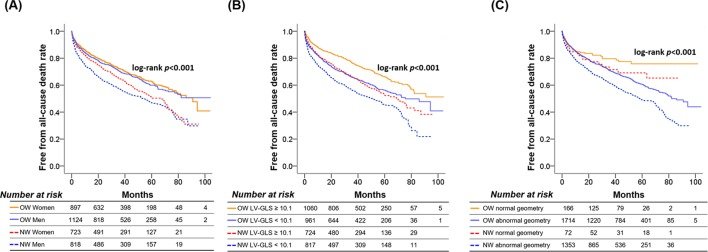
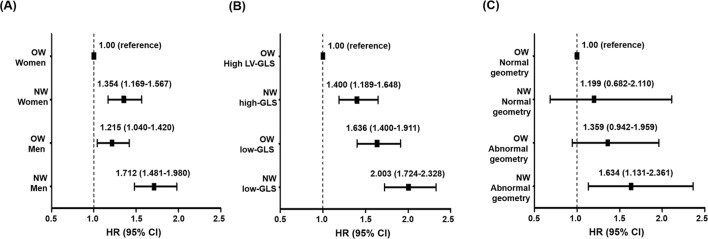
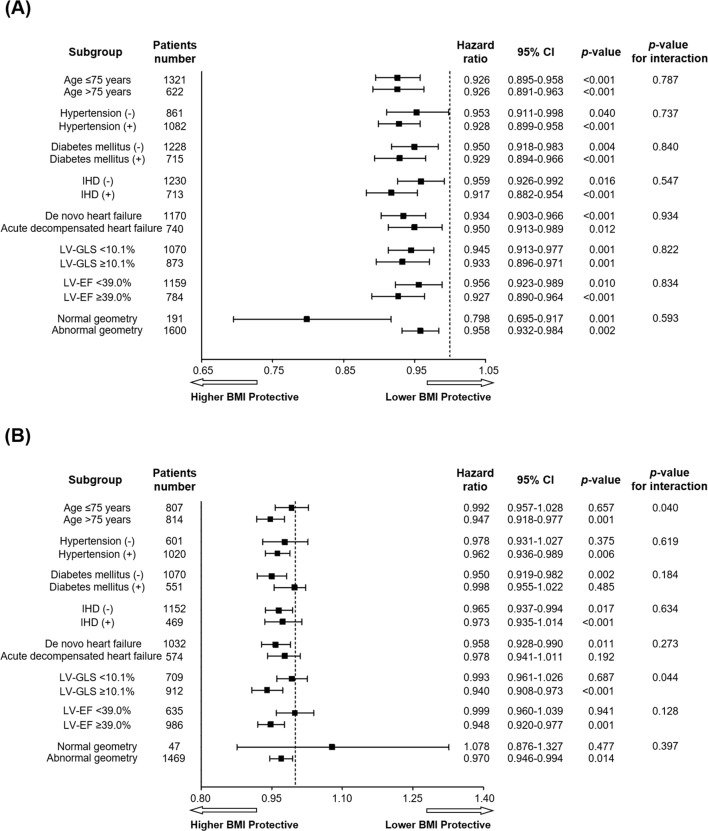
그림 출처: PubMed Central 공개 논문 (PMC7045129)
Conflict of interest statement
Competing interests: None declared.
그 밖의 정보
- 출판 형태
- Journal Article, Observational Study
- 저널
- BMJ open · eISSN 2044-6055
- 전자 출판
- 2020-02-10
- MeSH
- Age Factors · Aged · Body Mass Index · Echocardiography / methods · Female · Heart Failure* / complications / diagnosis / mortality / physiopathology · Heart Ventricles* / pathology / physiopathology · Humans · Male · Middle Aged · Obesity* / complications / diagnosis / physiopathology · Prognosis · Registries · Republic of Korea / epidemiology · Risk Assessment / methods · Risk Factors · Sex Factors · Stroke Volume · Ventricular Function, Left*
- 데이터
- ClinicalTrials.gov: NCT03513653
- 참고문헌
- 31편