
PLoS One. 2015;10(12):e0144526.
Clinical Correlates of Mass Effect in Autosomal Dominant Polycystic Kidney Disease.
제1저자 김현숙 · 교신저자 안규리
소속 (12)
- Department of Internal Medicine, Seoul National University Hospital, Seoul, Korea.
- Department of Internal Medicine, Armed Forces Capital Hospital, Seongnam-si, Gyeonggi-do, Korea.
- Nephrology Clinic, National Cancer Center, Goyang-si, Gyeonggi-do, Korea.
- Department of Internal Medicine, Asan Medical Center, University of Ulsan, Seoul, Korea.
- Division of Hepatology, Seoul National University Hospital, Seoul, Korea.
- Department of Radiology, Seoul National University Hospital, Seoul, Korea.
- Department of Pediatrics, Seoul National University Children's Hospital, Seoul, Korea.
- Research Coordination Center for Rare Diseases, Seoul National University Hospital, Seoul, Korea.
- Department of Internal Medicine, Kangbuk Samsung Medical Center, Seoul, Korea.
- Department of Biological Science, Sookmyoung Women's University, Seoul, Korea.
- Division of Nephrology, Department of Internal Medicine, University Health Network and University of Toronto, Ontario, Canada.
- Department of Internal Medicine, Eulji General Hospital, Seoul, Korea.
Abstract
Mass effect from polycystic kidney and liver enlargement can result in significant clinical complications and symptoms in autosomal dominant polycystic kidney disease (ADPKD). In this single-center study, we examined the correlation of height-adjusted total liver volume (htTLV) and total kidney volume (htTKV) by CT imaging with hepatic complications (n = 461) and abdominal symptoms (n = 253) in patients with ADPKD. "Mass-effect" complications were assessed by review of medical records and abdominal symptoms, by a standardized research questionnaire. Overall, 91.8% of patients had 4 or more liver cysts on CT scans. Polycystic liver disease (PLD) was classified as none or mild (htTLV < 1,600 mL/m); moderate (1,600 ≤ htTLV <3,200 mL/m); and severe (htTLV ≥ 3,200 mL/m). The prevalence of moderate and severe PLD in our patient cohort was 11.7% (n = 54/461) and 4.8% (n = 22/461), respectively, with a female predominance in both the moderate (61.1%) and severe (95.5%) PLD groups. Pressure-related complications such as leg edema (20.4%), ascites (16.6%), and hernia (3.6%) were common, and patients with moderate to severe PLD exhibited a 6-fold increased risk (compared to no or mild PLD) for these complications in multivariate analysis. Similarly, abdominal symptoms including back pain (58.8%), flank pain (53.1%), abdominal fullness (46.5%), and dyspnea/chest-discomfort (44.3%) were very common, and patients with moderate to severe PLD exhibited a 5-fold increased risk for these symptoms. Moderate to severe PLD is a common and clinically important problem in ~16% of patients with ADPKD who may benefit from referral to specialized centers for further management.
Figures

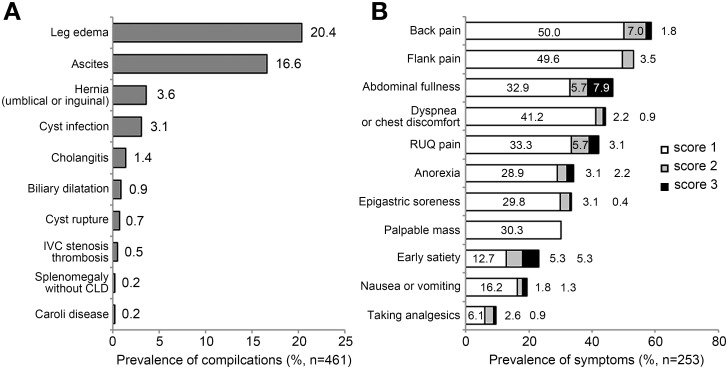

그림 출처: PubMed Central 공개 논문 (PMC4671651)
Conflict of interest statement
Competing Interests:The authors have declared that no competing interests exist.
그 밖의 정보
- 출판 형태
- Journal Article, Research Support, Non-U.S. Gov't
- 저널
- PloS one · eISSN 1932-6203
- 전자 출판
- 2015-12-07
- MeSH
- Cysts / complications / epidemiology / pathology · Female · Follow-Up Studies · Humans · Liver Diseases / complications / epidemiology / pathology · Male · Middle Aged · Organ Size · Polycystic Kidney, Autosomal Dominant / epidemiology / etiology / pathology · Prevalence · Prognosis · Republic of Korea / epidemiology · Retrospective Studies
- 참고문헌
- 27편