
PLoS Negl Trop Dis. 2016;10(12):e0005264.
Severe Fever with Thrombocytopenia Syndrome in South Korea, 2013-2015.
제1저자 최승진, 박상원 · 교신저자 오명돈
소속 (17)
- Department of Internal Medicine, Seoul National University College of Medicine, Seoul, Republic of Korea.
- Department of Internal Medicine, Boramae Medical Center, Seoul, Republic of Korea.
- Department of Internal Medicine, Gyeongsang National University School of Medicine, Jinju, Republic of Korea.
- Department of Infectious Diseases, Asan Medical Center, University of Ulsan College of Medicine, Seoul, Republic of Korea.
- Department of Internal Medicine, Keimyung University Dongsan Medical Center, Daegu, Republic of Korea.
- Department of Infectious Diseases, Chonnam National University Medical School, Gwangju, Republic of Korea.
- Department of Internal Medicine, Yeungnam University College of Medicine, Daegu, Republic of Korea.
- Department of Internal Medicine, Ulsan University Hospital, University of Ulsan College of Medicine, Ulsan, Republic of Korea.
- Department of Internal Medicine, Hallym University Sacred Heart Hospital, Anyang, Republic of Korea.
- Department of Internal Medicine, Kyungpook National University School of Medicine, Daegu, Republic of Korea.
- Department of Internal Medicine, Yonsei University Wonju College of Medicine, Wonju, Republic of Korea.
- Department of Laboratory Medicine, Pusan National University Hospital, Busan, Republic of Korea.
- Department of Internal Medicine, Pusan National University Hospital, Busan, Republic of Korea.
- Department of Internal Medicine, Chonbuk National University Medical School, Jeonju, Republic of Korea.
- Department of Internal Medicine, Chungnam National University School of Medicine, Daejeon, Republic of Korea.
- Department of Internal Medicine, Chungbuk National University College of Medicine, Cheongju, Republic of Korea.
- Department of Internal Medicine, Seoul National University Bundang Hospital, Seongnam, Republic of Korea.
Abstract
BACKGROUND Severe fever with thrombocytopenia syndrome (SFTS) is an emerging infectious disease that was recently identified in China, South Korea and Japan. The objective of the study was to evaluate the epidemiologic and clinical characteristics of SFTS in South Korea.
METHODS/PRINCIPAL FINDINGS SFTS is a reportable disease in South Korea. We included all SFTS cases reported to the Korea Centers for Disease Control and Prevention (KCDC) from January 2013 to December 2015. Clinical information was gathered by reviewing medical records, and epidemiologic characteristics were analyzed using both KCDC surveillance data and patient medical records. Risk factors for mortality in patients with SFTS were assessed. A total of 172 SFTS cases were reported during the study period. SFTS occurred throughout the country, except in urban areas. Hilly areas in the eastern and southeastern regions and Jeju island (incidence, 1.26 cases /105 person-years) were the main endemic areas. The yearly incidence increased from 36 cases in 2013 to 81 cases in 2015. Most cases occurred from May to October. The overall case fatality ratio was 32.6%. The clinical progression was similar to the 3 phases reported in China: fever, multi-organ dysfunction, and convalescence. Confusion, elevated C-reactive protein, and prolonged activated partial thromboplastin times were associated with mortality in patients with SFTS. Two outbreaks of nosocomial SFTS transmission were observed.
CONCLUSIONS SFTS is an endemic disease in South Korea, with a nationwide distribution and a high case-fatality ratio. Confusion, elevated levels of C-reactive protein, and prolonged activated partial thromboplastin times were associated with mortality in patients with SFTS.
Figures

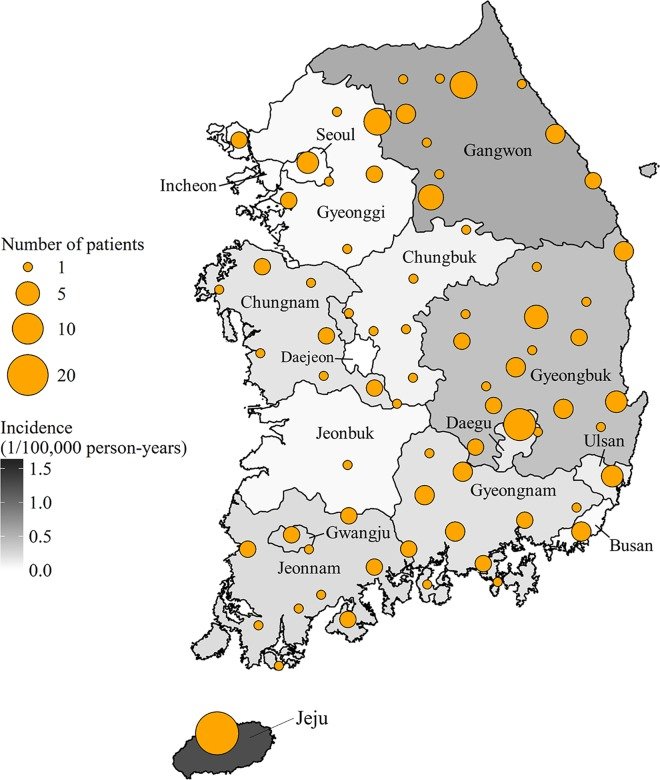
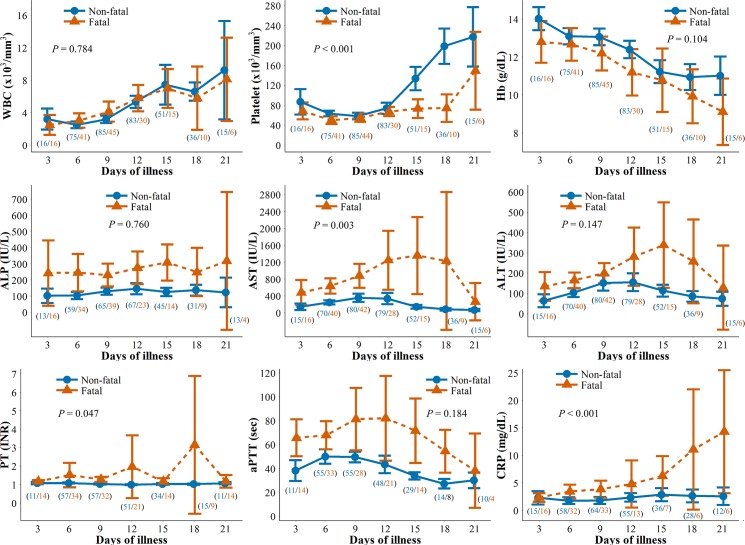
그림 출처: PubMed Central 공개 논문 (PMC5226827)
Conflict of interest statement
The authors have declared that no competing interests exist.
그 밖의 정보
- 출판 형태
- Journal Article, Research Support, Non-U.S. Gov't
- 저널
- PLoS neglected tropical diseases · eISSN 1935-2735
- 전자 출판
- 2016-12-29
- MeSH
- Aged · Animals · C-Reactive Protein / analysis · Cross Infection / epidemiology · Female · Fever / etiology · Humans · Incidence · Logistic Models · Male · Middle Aged · Multivariate Analysis · Phlebotomus Fever / mortality · Phlebovirus · Republic of Korea / epidemiology · Risk Factors · Seasons · Tick-Borne Diseases / mortality · Ticks / virology
- Substances
- C-Reactive Protein
- 참고문헌
- 45편