
J Am Heart Assoc. 2021;10(12):e020050.
Effect of Moderately but Persistently Elevated Lipid Levels on Risks of Stroke and Myocardial Infarction in Young Korean Adults.
제1저자 박준빈 · 교신저자 김형관, 한경도
소속 (6)
- Department of Internal Medicine Seoul National University College of Medicine Seoul Republic of Korea.
- Cardiovascular Center Seoul National University Hospital Seoul Republic of Korea.
- Department of Medical Statistics College of MedicineThe Catholic University of Korea Seoul Republic of Korea.
- Healthcare System Gangnam Center Seoul National University Hospital Seoul Republic of Korea.
- Department of Cardiology Cardiovascular CenterSeoul National University Bundang Hospital Seongnam Gyeonggi Republic of Korea.
- Department of Statistics and Actuarial Science Soongsil University Seoul Republic of Korea.
Abstract
Background Identifying predictive markers for future atherosclerotic cardiovascular diseases may be helpful to motivate young adults to promote healthy lifestyle. We sought to determine the association between persistently elevated low-density lipoprotein-cholesterol (LDL-C) and/or triglyceride levels and the atherosclerotic cardiovascular diseases risks in young adults. Methods and Results We conducted a nationwide population-based cohort study of 1 887 853 statin-naive adults aged 20 to 39 years, with LDL-C <190 mg/dL, using the Korean National Health Insurance Service database. Persistently elevated LDL-C and triglyceride levels were defined by ≥3 measurements of ≥160 and ≥175 mg/dL, respectively. The primary outcome was a composite of stroke and myocardial infarction. Among the study population, 11 121 (0.59%) and 167 373 (8.87%) had persistently elevated LDL-C and triglycerides, respectively. During a median follow-up of 5.2 years, 2170 and 1537 incidences of stroke (0.16%) and myocardial infarction (0.23%) occurred. Persistently elevated LDL-C levels were significantly associated with increased risks of the primary outcome, with an adjusted hazard ratio (HR) of 1.396 (95% CI, 1.005-1.940). This association was independent of high-density lipoprotein cholesterol. Persistently elevated triglycerides were significantly associated with increased risks of the primary outcome (HR, 1.120; 95% CI, 1.015-1.236), but attenuated after adjustment for high-density lipoprotein cholesterol. Conclusions Persistently elevated LDL-C and triglyceride levels were associated with atherosclerotic cardiovascular diseases risk in young Korean adults without severe hypercholesterolemia. These lipid abnormalities should be considered risk factors in young adults since their effects on lifetime atherosclerotic cardiovascular diseases risk may become more pronounced over the life course.
Keywords
myocardial infarctionpersistently elevated lipid levelsstrokeyoung adults
Figures

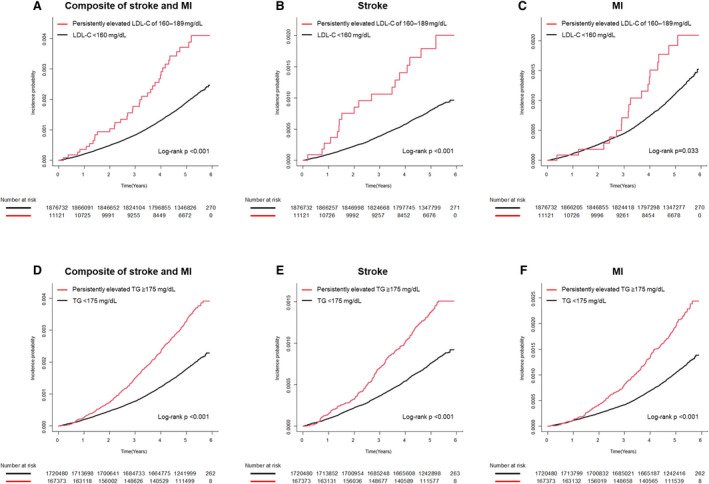

그림 출처: PubMed Central 공개 논문 (PMC8477895)
Conflict of interest statement
None.
그 밖의 정보
- 출판 형태
- Journal Article, Observational Study, Research Support, Non-U.S. Gov't
- 저널
- Journal of the American Heart Association · eISSN 2047-9980
- 전자 출판
- 2021-05-31
- MeSH
- Adult · Biomarkers / blood · Cholesterol, LDL / blood · Databases, Factual · Dyslipidemias / blood / diagnosis / epidemiology · Female · Humans · Incidence · Male · Myocardial Infarction / diagnosis / epidemiology · Prognosis · Republic of Korea / epidemiology · Retrospective Studies · Risk Assessment · Risk Factors · Stroke / diagnosis / epidemiology · Time Factors · Triglycerides / blood · Up-Regulation · Young Adult
- Substances
- Biomarkers · Cholesterol, LDL · Triglycerides
- 참고문헌
- 31편