
Sci Rep. 2020;10(1):6425.
Weaning Immunosuppressant in Patients with Failing Kidney Grafts and The Outcomes: A Single-Center Retrospective Cohort Study.
제1저자 류현진 · 교신저자 이하정
소속 (8)
- Department of Internal Medicine, Seoul National University Hospital, Seoul, Korea.
- Transplantation Center, Seoul National University Hospital, Seoul, Korea.
- Department of Laboratory Medicine, Seoul National University Hospital, Seoul, Korea.
- Departments of Surgery, Seoul National University Hospital, Seoul, Korea.
- Transplantation Research Institute, Seoul National University College of Medicine, Seoul, Korea.
- Kidney Research Institute, Seoul National University College of Medicine, Seoul, Korea.
- Department of Internal Medicine, Seoul National University Hospital, Seoul, Korea. mdhjlee@gmail.com.
- Kidney Research Institute, Seoul National University College of Medicine, Seoul, Korea. mdhjlee@gmail.com.
Abstract
An immunosuppressant weaning protocol in failing allografts has not yet been established. Maintaining immunosuppressants would preserve residual renal function (RRF) and prevent graft intolerance syndrome and sensitization but would increase the risks of infection and malignancy. In this study, graft failure cases after kidney transplantation in a single center were reviewed retrospectively. The outcome differences in all-cause mortality, infection-related hospitalization, cancer, graft intolerance syndrome, re-transplantation, and RRF duration between the immunosuppressant maintaining and weaning groups 6 months after graft failure were compared. Among the weaning group, the outcome differences according to low-dose steroid use were also compared at 6 and 12 months. In a total of 131 graft failure cases, 18 mortalities, 42 infection-related hospitalizations, 22 cancer cases, 11 graft intolerance syndrome cases, and 28 re-transplantations occurred during the 94-month follow-up. Immunosuppressant maintenance significantly decreased the patient survival rate 6 months after graft failure compared with weaning (log-rank P = 0.008) and was an independent risk factor for mortality, even after adjustments (hazard ratio, 3.01; P = 0.025). Infection-related hospitalization, graft intolerance syndrome development, and re-transplantation were not affected by the immunosuppressant weaning protocol. Among the immunosuppressant weaning group, low-dose steroid maintenance at 6 and 12 months helped preserved RRF (P = 0.008 and P = 0.003, respectively).
Figures
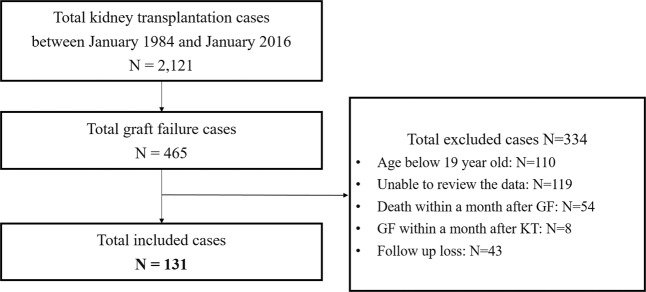
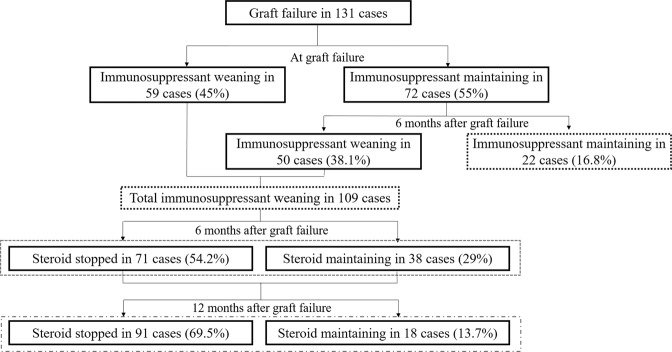
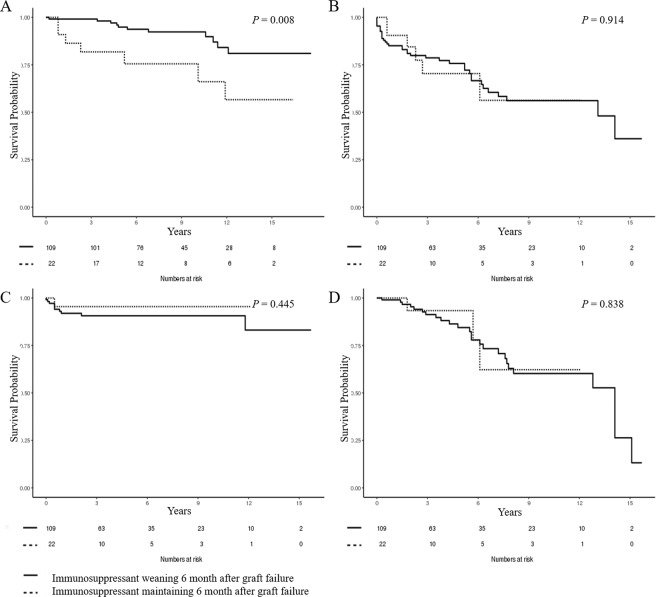
그림 출처: PubMed Central 공개 논문 (PMC7156393)
Conflict of interest statement
The authors declare no competing interests.
그 밖의 정보
- 출판 형태
- Journal Article, Research Support, Non-U.S. Gov't
- 저널
- Scientific reports · eISSN 2045-2322
- 전자 출판
- 2020-04-14
- MeSH
- Adult · Aged · Cohort Studies · Dose-Response Relationship, Drug · Female · Humans · Immunosuppressive Agents / therapeutic use · Kaplan-Meier Estimate · Kidney Failure, Chronic / etiology · Kidney Transplantation / adverse effects · Male · Middle Aged · Steroids / therapeutic use · Treatment Outcome · Young Adult
- Substances
- Immunosuppressive Agents · Steroids
- 참고문헌
- 26편