
Sci Rep. 2020;10(1):6762.
Impact of Hemoglobin Levels and Their Dynamic Changes on the Risk of Atrial Fibrillation: A Nationwide Population-Based Study.
제1저자 임우현 · 교신저자 최의근
소속 (4)
- Division of Cardiology, Department of Internal medicine, Seoul National University Boramae Medical Center, Seoul, Republic of Korea.
- Division of Cardiology, Department of Internal medicine, Seoul National University Hospital, Seoul, Republic of Korea. choiek17@snu.ac.kr.
- Department of Biostatistics, College of Medicine, The Catholic University of Korea, Seoul, Republic of Korea.
- Division of Cardiology, Department of Internal medicine, Seoul National University Hospital, Seoul, Republic of Korea.
Abstract
Anemia is a risk factor for cardiovascular disease, but its impact on new-onset atrial fibrillation (AF) is unclear. In this study, we investigated the effect of hemoglobin (Hb) levels and their changes on the risk of AF development in the general population of Korea. We retrospectively analyzed a cohort from the Korean National Health Insurance Service database and identified 9,686,314 subjects (49.8% male) without a history of AF, aged ≥40 years, and with Hb levels available for both first (2009-2010) and second (2011-2012) health checkups. These subjects were followed up until 2017 to determine AF development. The presence of anemia (Hb level <13 g/dL in men and <12 g/dL in women) was a significant risk factor for AF development. However, Hb levels showed a U-shaped association with incident AF after adjustment for cardiovascular risk factors. AF incidence was lowest at Hb levels of 14-14.9 g/dL in men and 12-12.9 g/dL in women. Among individuals with Hb levels within normal ranges (13-15.9 g/dL in men and 12-14.9 g/dL in women), both decrease and increase in Hb levels at the second measurement outside the normal ranges showed an elevation of AF risk by 11% and 21% for men and 3% and 36% for women, respectively, compared with those who maintained normal Hb levels. In conclusion, low or high Hb levels are associated with an increased risk of incident AF. This study suggests that maintaining Hb levels within the normal ranges confers a low risk of AF development.
Figures
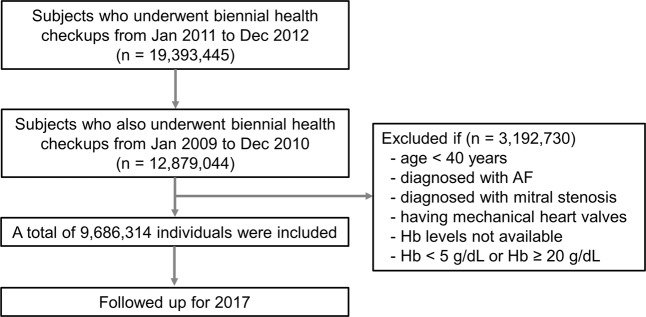
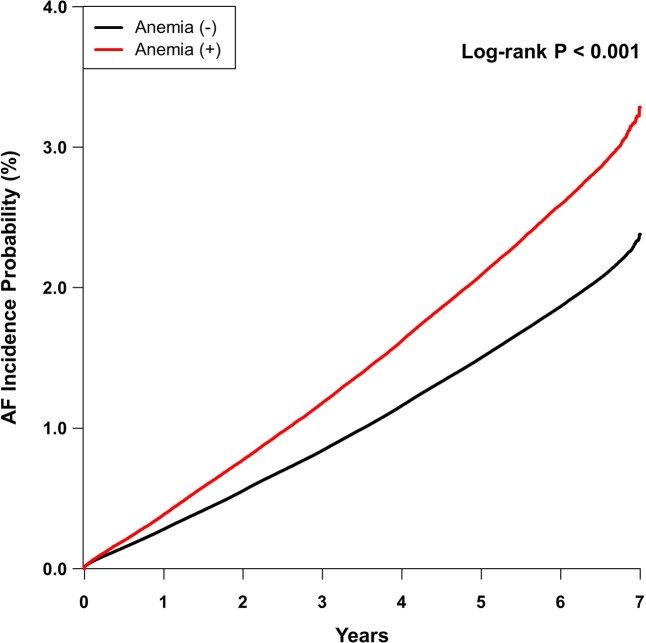
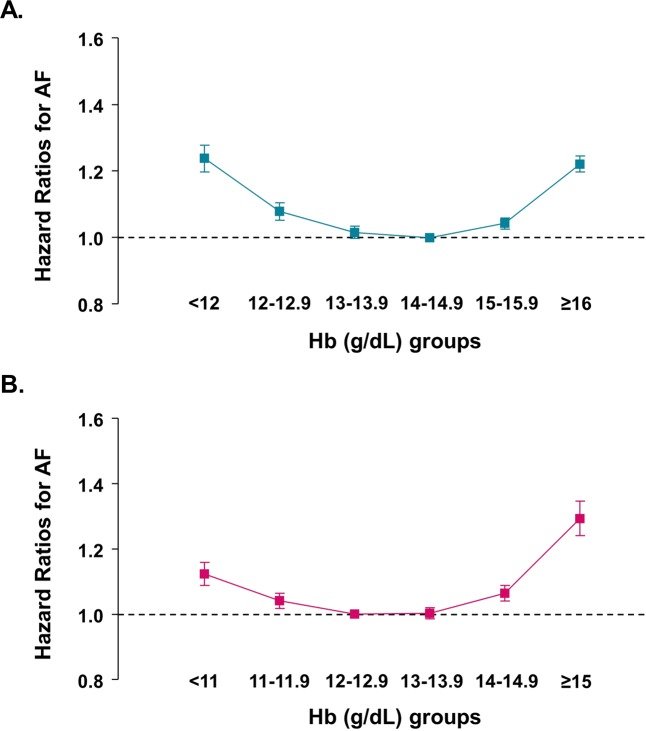
그림 출처: PubMed Central 공개 논문 (PMC7174343)
Conflict of interest statement
The authors declare no competing interests.
그 밖의 정보
- 출판 형태
- Journal Article, Research Support, Non-U.S. Gov't
- 저널
- Scientific reports · eISSN 2045-2322
- 전자 출판
- 2020-04-21
- MeSH
- Adult · Aged · Anemia / blood / complications / epidemiology / pathology · Atrial Fibrillation / blood / complications / epidemiology / pathology · Cardiovascular Diseases / blood / complications / epidemiology / pathology · Cohort Studies · Female · Hemoglobins / metabolism · Humans · Male · Middle Aged · Republic of Korea / epidemiology · Retrospective Studies · Risk Factors
- Substances
- Hemoglobins
- 참고문헌
- 27편