
Sci Rep. 2020;10(1):15872.
Chromosomal abnormalities and atrial fibrillation and ischemic stroke incidence: a nationwide population-based study.
제1저자 조준환 · 교신저자 최의근
소속 (5)
- Department of Internal Medicine, Seoul National University Hospital, 101 Daehak-ro, Jongno-gu, Seoul, 03080, Republic of Korea.
- Heart Research Institute, Cardiovascular-Arrhythmia Center, College of Medicine, Chung-Ang University Hospital, Seoul, Republic of Korea.
- Department of Internal Medicine, Seoul National University Hospital, 101 Daehak-ro, Jongno-gu, Seoul, 03080, Republic of Korea. choiek17@snu.ac.kr.
- Department of Biostatistics, College of Medicine, The Catholic University of Korea, Seoul, Republic of Korea.
- Department of Internal Medicine, Seoul National University Boramae Medical Center, Seoul, Republic of Korea.
Abstract
There is a paucity of information as to whether chromosomal abnormalities, including Down Syndrome, Turner Syndrome, and Klinefelter Syndrome, have an association with atrial fibrillation (AF) and ischemic stroke development. Data from 3660 patients with Down Syndrome, 2408 with Turner Syndrome, and 851 with Klinefelter Syndrome without a history of AF and ischemic stroke were collected from the Korean National Health Insurance Service (2007-2014). These patients were followed-up for new-onset AF and ischemic stroke. Age- and sex-matched control subjects (at a ratio of 1:10) were selected and compared with the patients with chromosomal abnormalities. Down Syndrome patients showed a higher incidence of AF and ischemic stroke than controls. Turner Syndrome and Klinefelter Syndrome patients showed a higher incidence of AF than did the control group, but not of stroke. Multivariate Cox regression analysis revealed that three chromosomal abnormalities were independent risk factors for AF, and Down Syndrome was independently associated with the risk of stroke. In conclusion, Down Syndrome, Turner Syndrome, and Klinefelter Syndrome showed an increased risk of AF. Down Syndrome patients only showed an increased risk of stroke. Therefore, AF surveillance and active stroke prevention would be beneficial in patients with these chromosomal abnormalities.
Figures
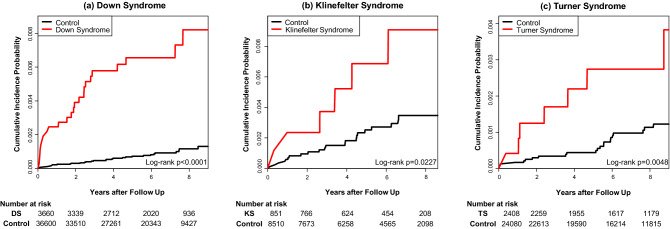
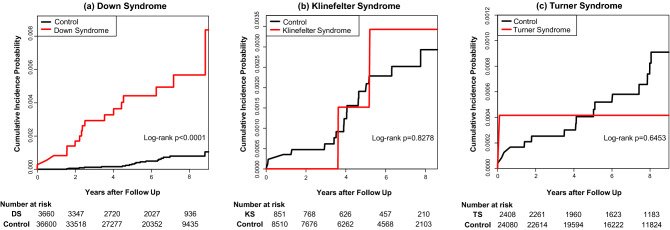
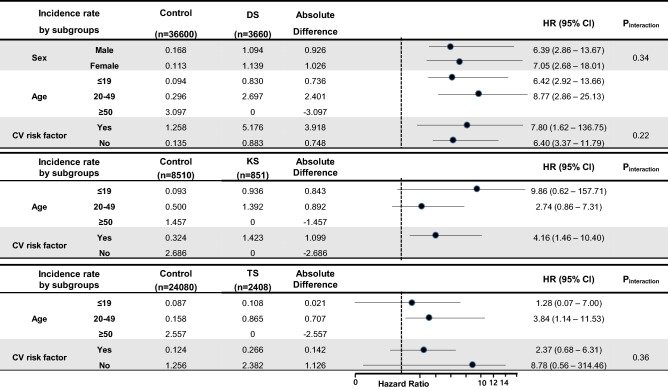
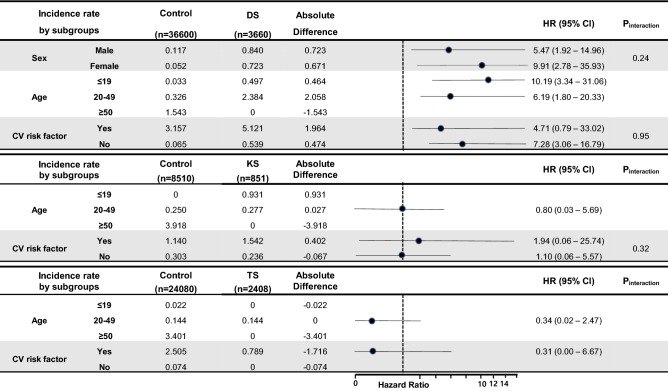
그림 출처: PubMed Central 공개 논문 (PMC7522243)
Conflict of interest statement
The authors declare no competing interests.
그 밖의 정보
- 출판 형태
- Journal Article, Research Support, Non-U.S. Gov't
- 저널
- Scientific reports · eISSN 2045-2322
- 전자 출판
- 2020-09-28
- MeSH
- Adolescent · Adult · Atrial Fibrillation / epidemiology / genetics · Child · Chromosome Aberrations* · Female · Genetic Predisposition to Disease / genetics · Humans · Incidence · Ischemic Stroke / epidemiology / genetics · Male · Middle Aged · Young Adult
- 참고문헌
- 49편