
Sci Rep. 2020;10(1):19015.
Validation of a wearable cuff-less wristwatch-type blood pressure monitoring device.
제1저자 문준호, 강명균 · 교신저자 임수
소속 (6)
- Department of Internal Medicine, Seoul National University College of Medicine, Seoul, South Korea.
- Department of Internal Medicine, Seoul National University Hospital, Seoul, South Korea.
- InBody Co., Ltd, Seoul, South Korea.
- Department of Internal Medicine, Seoul National University Bundang Hospital, Seongnam, South Korea.
- Department of Internal Medicine, Seoul National University College of Medicine, Seoul, South Korea. limsoo@snu.ac.kr.
- Department of Internal Medicine, Seoul National University Bundang Hospital, Seongnam, South Korea. limsoo@snu.ac.kr.
Abstract
Ambulatory blood pressure (BP) monitoring is recommended to improve the management of hypertension. Here, we investigated the accuracy of BP estimated using a wearable cuff-less device, InBodyWATCH, compared with BP measured using a manual sphygmomanometer. Thirty-five adults were enrolled (age 57.1 ± 17.9 years). The BP was estimated using InBodyWATCH with an individualized estimation based on a neural network model. Three paired sets of BPs from the two devices were compared using correlation analysis and Bland-Altman plots (n = 105 paired BP readings). The correlations for both systolic and diastolic BP (SBP and DBP) between the two devices were high (r = 0.964 and 0.939, both P < 0.001). The mean difference was 2.2 ± 6.1 mmHg for SBP and -0.2 ± 4.2 mmHg for DBP; these were not significant (P = 0.472 for SBP and P = 0.880 for DBP). The proportions of estimated SBP/DBP obtained from the InBodyWATCH within ± 5 mmHg of manual SBP/DBP were 71.4%/83.8%; within ± 10 mmHg they were 86.7%/98.1%; and within ± 15 mmHg they were 97.1%/99.0%. The estimated BP from this wearable cuff-less device correlated highly with the manual BP and showed good accuracy, suggesting its potential to be used in ambulatory BP monitoring.
Figures
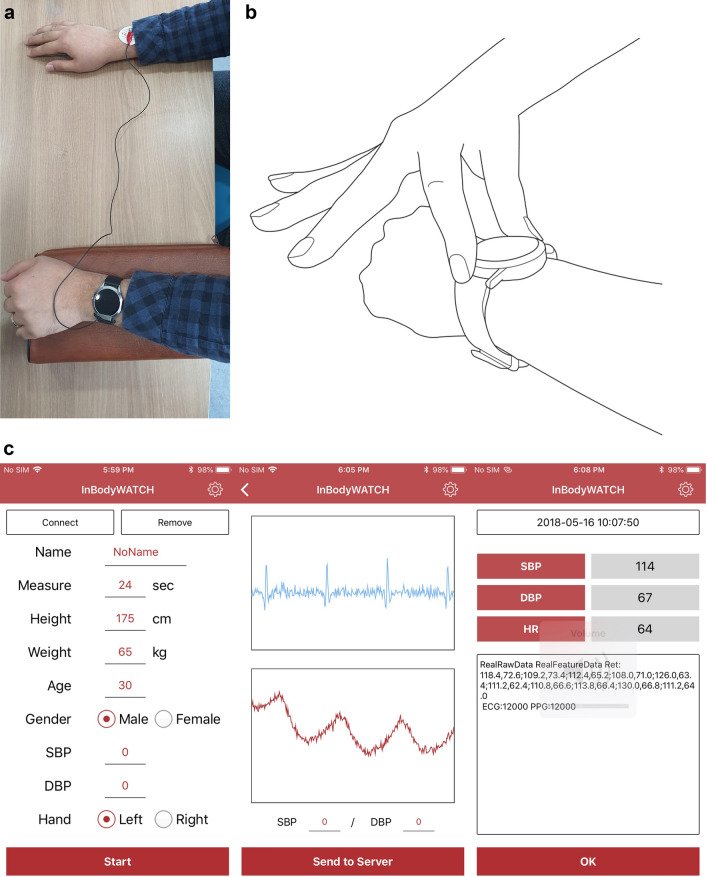
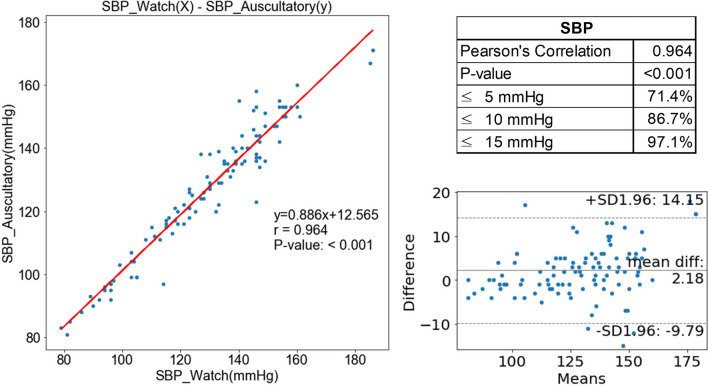
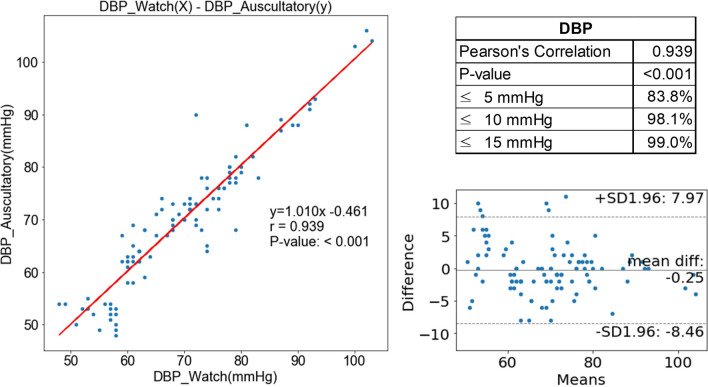
그림 출처: PubMed Central 공개 논문 (PMC7642418)
Conflict of interest statement
The authors declare no competing interests.
그 밖의 정보
- 출판 형태
- Journal Article, Research Support, Non-U.S. Gov't, Validation Study
- 저널
- Scientific reports · eISSN 2045-2322
- 전자 출판
- 2020-11-04
- MeSH
- Adult · Aged · Algorithms · Blood Pressure Monitoring, Ambulatory / instrumentation · Calibration · Electrocardiography · Female · Humans · Male · Middle Aged · Pulse Wave Analysis · Sphygmomanometers · Wearable Electronic Devices* · Wrist*
- 참고문헌
- 33편