
Sci Rep. 2020;10(1):16078.
Short course of voriconazole therapy as a risk factor for relapse of invasive pulmonary aspergillosis.
제1저자 신동훈, 유승진 · 교신저자 김형진, 강창경
소속 (6)
- Department of Internal Medicine, Seoul National University College of Medicine, Seoul, Republic of Korea.
- Department of Radiology, Seoul National University Hospital, Seoul, Republic of Korea.
- Department of Radiology, Seoul National University Hospital, Seoul, Republic of Korea. khj.snuh@gmail.com.
- Department of Internal Medicine, Seoul National University College of Medicine, Seoul, Republic of Korea. zeptemiger@hanmail.net.
- Department of Internal Medicine, Seoul National University Bundang Hospital, Seongnam, Republic of Korea.
- Department of Internal Medicine, Seoul Metropolitan Boramae Hospital, Seoul, Republic of Korea.
Abstract
To investigate associations of the duration of voriconazole treatment and radiological response with relapse of invasive pulmonary aspergillosis (IPA) in immunocompromised patients, we explored the risk factors for IPA relapse after successful initial treatment. All patients with proven or probable IPA who had finished voriconazole treatment between 2005 and 2019 in a tertiary-care hospital were reviewed. IPA relapse was defined as re-diagnosis of proven or probable IPA at the same site within 1 year after treatment termination. Short course of voriconazole treatment was defined as a treatment less than 9 weeks, which is a median of the recommended minimum duration of therapy from the Infectious Disease Society of America. The radiological response was defined as a reduction in IPA burden by more than 50% on chest computed tomography. Of 87 patients who had completed voriconazole treatment, 14 (16.1%) experienced IPA relapse. Multivariable Cox regression identified that short voriconazole treatment duration (adjusted hazard ratio [aHR], 3.7; 95% confidence interval [CI], 1.1-12.3; P = 0.033) and radiological non-response (aHR, 4.6; 95% CI, 1.2-17.5; P = 0.026) were independently associated with relapse of IPA after adjusting for several clinical risk factors. Longer duration of therapy should be considered for those at higher risk of relapse.
Figures
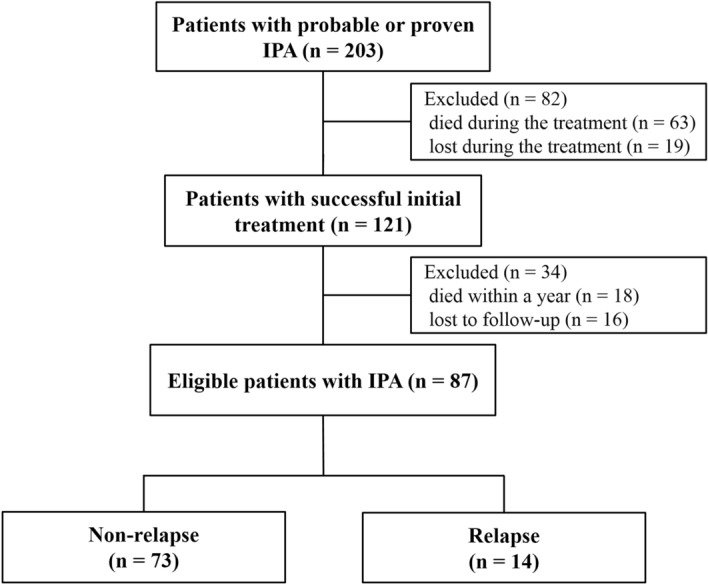
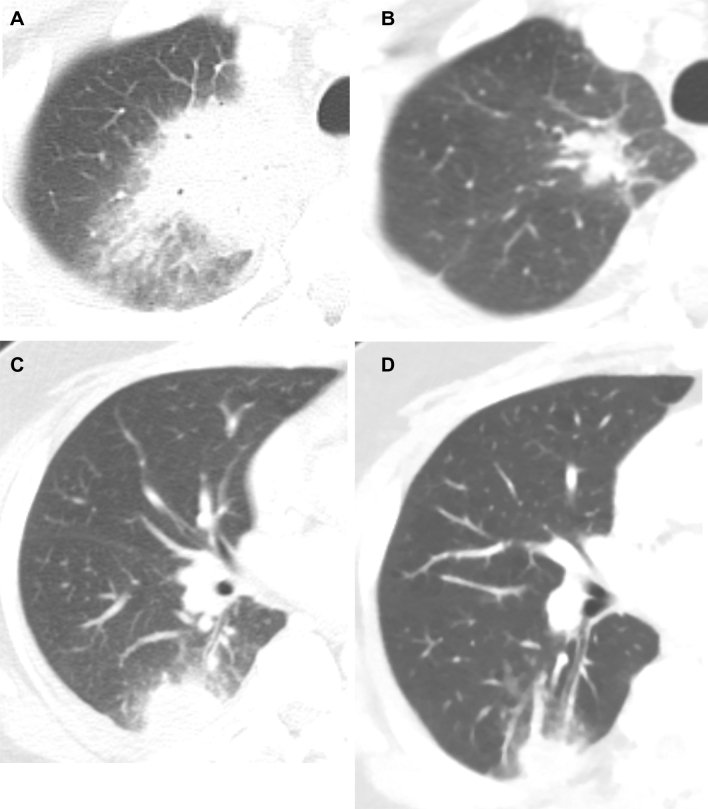
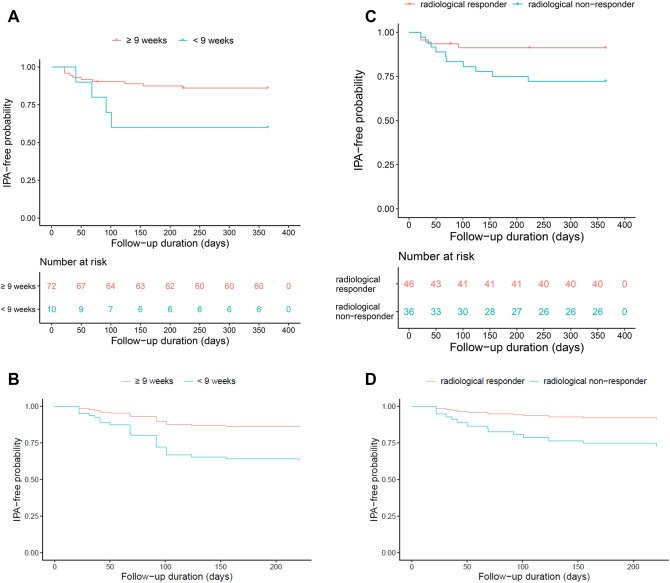
그림 출처: PubMed Central 공개 논문 (PMC7527978)
Conflict of interest statement
The authors declare no competing interests.
그 밖의 정보
- 출판 형태
- Journal Article
- 저널
- Scientific reports · eISSN 2045-2322
- 전자 출판
- 2020-09-30
- MeSH
- Aged · Antifungal Agents / administration & dosage / therapeutic use · Drug Administration Schedule · Female · Humans · Immunocompromised Host · Invasive Pulmonary Aspergillosis / diagnostic imaging / drug therapy · Male · Middle Aged · Recurrence · Republic of Korea · Retrospective Studies · Risk Factors · Time Factors · Tomography, X-Ray Computed · Voriconazole / administration & dosage / therapeutic use
- Substances
- Antifungal Agents · Voriconazole
- 참고문헌
- 31편