
Biomark Res. 2022;10(1):79.
The importance of critically short telomere in myelodysplastic syndrome.
제1저자 신동엽, 임규민 · 교신저자 윤성수, 이동순
소속 (11)
- Division of Hematology and Medical Oncology, Department of Internal Medicine, Seoul National University Hospital, 101 Daehag-ro, Seoul, Republic of Korea.
- Center for Medical Innovation, Biomedical Research Institute, Seoul National University Hospital, Seoul, Republic of Korea.
- Cancer Research Institute, Seoul National University College of Medicine, Seoul, Republic of Korea.
- Department of Laboratory Medicine, Chungbuk National University Hospital, Cheongju, Republic of Korea.
- Department of Electrical and Computer Engineering, Seoul National University, Seoul, Republic of Korea.
- Interdisciplinary Program in Bioengineering, Seoul National University, Seoul, Republic of Korea.
- Bio-MAX Institute, Seoul National University, Seoul, Republic of Korea.
- Division of Hematology and Medical Oncology, Department of Internal Medicine, Seoul National University Hospital, 101 Daehag-ro, Seoul, Republic of Korea. ssysmc@snu.ac.kr.
- Cancer Research Institute, Seoul National University College of Medicine, Seoul, Republic of Korea. ssysmc@snu.ac.kr.
- Cancer Research Institute, Seoul National University College of Medicine, Seoul, Republic of Korea. soonlee@snu.ac.kr.
- Department of Laboratory Medicine, Seoul National University College of Medicine, Seoul National University Hospital, 101 Daehag-ro, Seoul, 03080, Republic of Korea. soonlee@snu.ac.kr.
Abstract
A few critically short telomeres trigger genomic instability regardless of average telomere length (TL). Recently, the telomere shortest length assay (TeSLA) was developed to detect critically short telomeres and measure absolute telomeres. Using TeSLA with the internally labeled biotin probe, we measured the TL of bone marrow (BM) aspirates from 52 patients with myelodysplastic syndrome (MDS). A percentage of shortest telomeres (< 1.0 kb (ShTL1.0)) were calculated. ShTL1.0 was correlated to IPSS-R risk (spearman's rho = 0.35 and p = 0.0196), and ShTL1.0 and BM blast (2.61% in < 5% blast, 4.15% in 5-10% blast, and 6.80% in 10-20% blast, respectively, p = 0.0332). Interestingly, MDS patients with a shortest TL ≥ 0.787 kb at the time of diagnosis showed better overall survival (OS) and progression-free survival (PFS) than patients with a shortest TL < 0.787 kb in the multivariate analyses (HR = 0.13 and 0.30, p = 0.011 and 0.048 for OS and PFS, respectively). Our results clearly show the presence and abundance of critically short telomeres in MDS patients. These pathologic telomeres are associated with IPSS-R which is a validated prognostic scoring system in MDS. Furthermore, they are independent prognostic factors for OS in MDS patients. Future prospective studies are needed to validate our results.
© 2022. The Author(s).
Keywords
Myelodysplastic syndromeShort telomereTeSLA
Figures
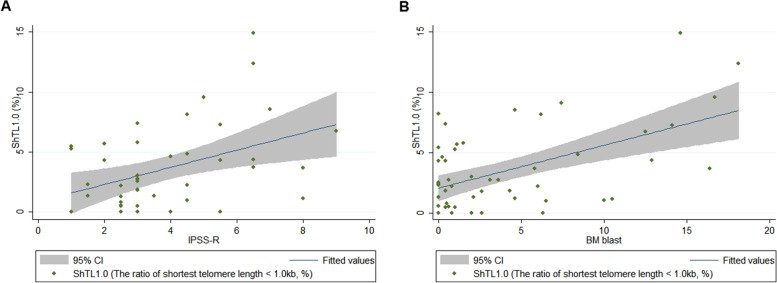
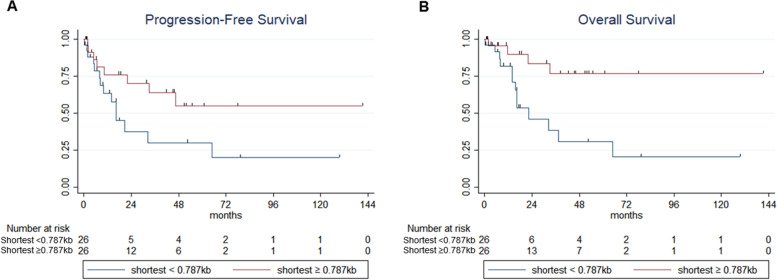
그림 출처: PubMed Central 공개 논문 (PMC9650883)
Conflict of interest statement
All authors declared no competing interests.
그 밖의 정보
- 출판 형태
- Letter
- 저널
- Biomarker research · ISSN 2050-7771
- 전자 출판
- 2022-11-10
- 연구비
- National Research Foundation of Korea NRF-2020R1A3B3079653
- 참고문헌
- 10편