
PLoS One. 2013;8(12):e84467.
Incident chronic kidney disease and newly developed complications related to renal dysfunction in an elderly population during 5 years: a community-based elderly population cohort study.
제1저자 안신영 · 교신저자 진호준
소속 (4)
- Department of Internal Medicine, Seoul National University Bundang Hopsital, Seong-Nam, Korea.
- Department of Internal Medicine, Seoul National University Bundang Hopsital, Seong-Nam, Korea ; Department of Internal Mecidine, Seoul National University College of Medicine, Seoul, Korea.
- Department of Neuropsychiatry, Seoul National University Bundang Hopsital, Seong-Nam, Korea.
- Department of Internal Medicine, Seoul National University Bundang Hopsital, Seong-Nam, Korea ; Department of Internal Mecidine, Seoul National University College of Medicine, Seoul, Korea ; Renal Institute, Clinical Research Center, Seoul National University College of Medicine, Seoul, Korea.
Abstract
BACKGROUND Few studies have evaluated the association between incident chronic kidney disease (CKD) and related complications, especially in elderly population. We attempted to verify the association between GFR and concurrent CKD complications and elucidate the temporal relationship between incident CKD and new CKD complications in a community-based prospective elderly cohort.
METHOD We analyzed the available data from 984 participants in the Korean Longitudinal Study on Health and Aging. Participants were categorized into 6 groups according to eGFR at baseline examination (≥90, 75-89, 60-74, 45-59, 30-44, and <30 ml/min/1.73 m(2)).
RESULT The mean age of study population was 76 ± 9.1 years and mean eGFR was 72.3 ± 17.0 ml/min/1.73 m(2). Compared to eGFR group 1, the odds ratio (OR) for hypertension was 2.363 (95% CI, 1.299-4.298) in group 4, 5.191 (2.074-12.995) in group 5, and 13.675 (1.611-115.806) in group 6; for anemia, 7.842 (2.265-27.153) in group 5 and 13.019 (2.920-58.047) in group 6; for acidosis, 69.580 (6.770-715.147) in group 6; and for hyperkalemia, 19.177 (1.798-204.474) in group 6. Over a 5-year observational period, CKD developed in 34 (9.6%) among 354 participants with GFR ≥ 60 ml/min/1.73 m(2) at basal examination. The estimated mean number of new complications according to analysis of co-variance was 0.52 (95% CI, 0.35-0.68) in subjects with incident CKD and 0.24 (0.19-0.29) in subjects without CKD (p = 0.002). Subjects with incident CKD had a 2.792-fold higher risk of developing new CKD complications. A GFR level of 52.4 ml/min/1.73 m(2) (p = 0.032) predicted the development of a new CKD complication with a 90% sensitivity.
CONCLUSION In an elderly prospective cohort, CKD diagnosed by current criteria is related to an increase in the number of concurrent CKD complications and the development of new CKD complications.
Figures

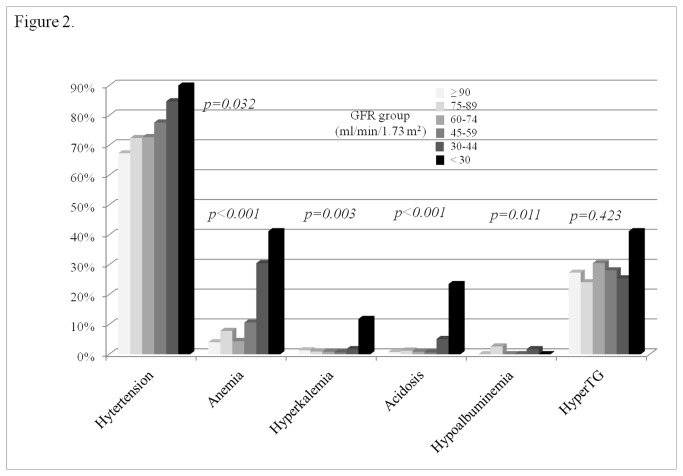
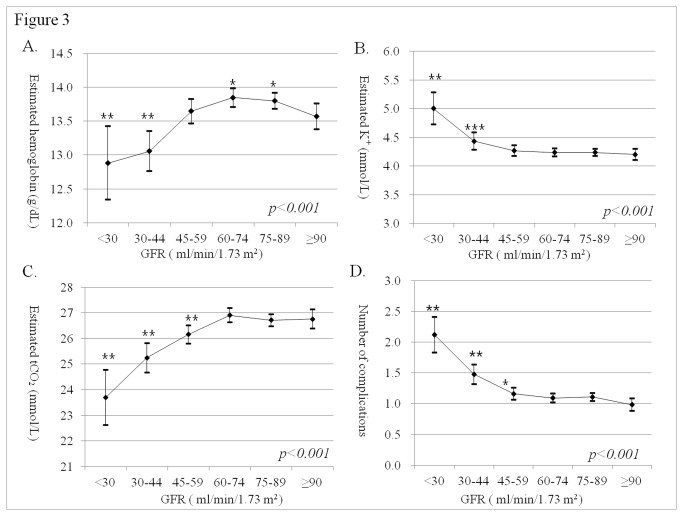
그림 출처: PubMed Central 공개 논문 (PMC3867482)
Conflict of interest statement
Competing Interests:This work was supported by an independent Research Grant (IRG) from Pfizer Global Pharmaceuticals (grant number. 06-05-039) and a Grant for developing Seongnam Health Promotion Program for the Elderly from Seongnam City Government in Korea (grant number 800-20050211). This does not alter our adherence to all the PLOS ONE policies on sharing data and materials.
그 밖의 정보
- 출판 형태
- Journal Article, Research Support, Non-U.S. Gov't
- 저널
- PloS one · eISSN 1932-6203
- 전자 출판
- 2013-12-18
- MeSH
- Aged · Aged, 80 and over · Cohort Studies · Glomerular Filtration Rate · Humans · Incidence · Kidney / physiopathology · Male · Prospective Studies · Renal Insufficiency, Chronic / complications / epidemiology / physiopathology · Republic of Korea / epidemiology · Residence Characteristics*
- 참고문헌
- 23편