
ESMO Open. 2025;10(1):104097.
Genomic profiling of intimal sarcoma reveals molecular subtypes with distinct tumor microenvironments and therapeutic implications.
제1저자 박창희, 김록현 · 교신저자 김미소, 최재용
소속 (7)
- Department of Internal Medicine, Seoul National University Hospital, Seoul, Korea; Cancer Research Institute, Seoul National University College of Medicine, Seoul, Korea.
- Department of Biomedical Sciences, Seoul National University College of Medicine, Seoul, Korea; Genomic Medicine Institute, Medical Research Center, Seoul National University, Seoul, Korea.
- Department of Pathology, Seoul National University Hospital, Seoul, Korea.
- Lunit Inc., Seoul, Korea.
- Cancer Research Institute, Seoul National University College of Medicine, Seoul, Korea; Department of Biomedical Sciences, Seoul National University College of Medicine, Seoul, Korea; Genomic Medicine Institute, Medical Research Center, Seoul National University, Seoul, Korea.
- Department of Biomedical Sciences, Seoul National University College of Medicine, Seoul, Korea; Genomic Medicine Institute, Medical Research Center, Seoul National University, Seoul, Korea. Electronic address: mesnger12@gmail.com.
- Department of Internal Medicine, Seoul National University Hospital, Seoul, Korea; Cancer Research Institute, Seoul National University College of Medicine, Seoul, Korea. Electronic address: misokim@snu.ac.kr.
Abstract
BACKGROUND Intimal sarcoma is a rare and aggressive soft-tissue sarcoma with limited treatment options. We explored genomic profiles of intimal sarcoma to uncover therapeutic implications.
MATERIALS AND METHODS We analyzed tumor tissues from patients with intimal sarcoma who visited the Seoul National University Hospital (SNUH) using whole-exome, whole-transcriptome, and clinical next-generation sequencing (NGS), integrated with intimal sarcoma NGS data from two public cohorts. We examined expression characteristics and tumor-infiltrating lymphocytes (TILs) according to molecular subtypes.
RESULTS Our study included 42 samples in total. Thirty-three patients showing copy number variation (CNV) enrichment with frequent CDK4/MDM2 amplifications were classified as the CNV-high (CNV-H) subtype. Five patients showing predominant MLH1 mutations or homozygous deletions were classified as the microsatellite instability-high-like (MSI-H-like) subtype. Hallmark pathways up-regulated in the CNV-H subtype included Wnt β-catenin and Hedgehog signaling. In the MSI-H-like subtype, interferon-γ response, tumor necrosis factor-α signaling via nuclear factor-κB, interferon-α response, inflammatory response, and interleukin-6-Jak-Stat3 signaling were up-regulated. CNV-H subtype samples predominantly showed an immune-desert phenotype, whereas MSI-H-like subtype samples predominantly showed an immune-inflamed phenotype. Two MSI-H-like subtype patients received pembrolizumab and experienced tumor shrinkage.
CONCLUSIONS We identified two intimal sarcoma molecular subtypes. Compared with CNV-H, MSI-H-like is enriched in pathways associated with tumor immune responses and TILs. Further efforts and clinical trials to better define these molecular subtypes are warranted to open new avenues for personalized treatment approaches and improve patient outcomes.
Copyright © 2024 The Authors. Published by Elsevier Ltd.. All rights reserved.
Keywords
genomicsintimal sarcomamicrosatellite instability-hightranscriptomicstumor-infiltrating lymphocytes
Figures
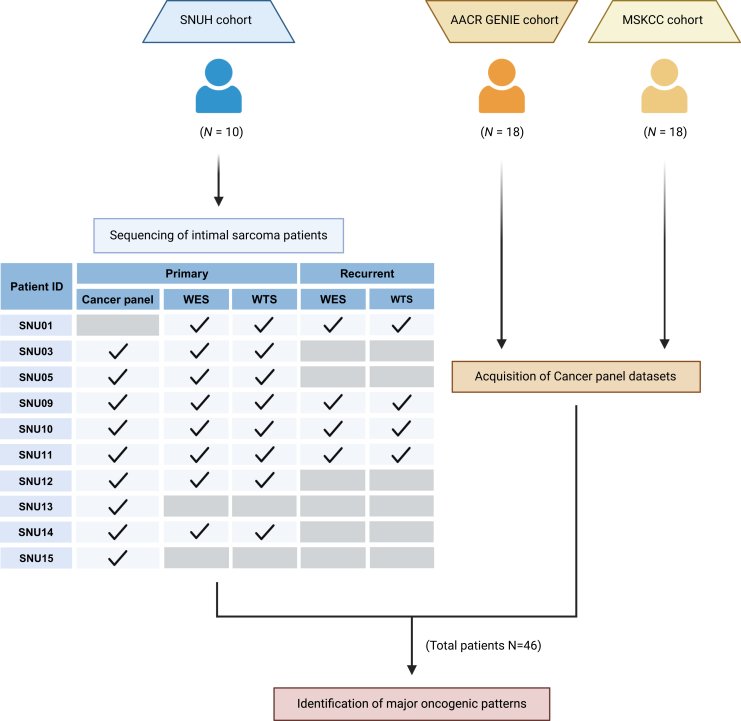
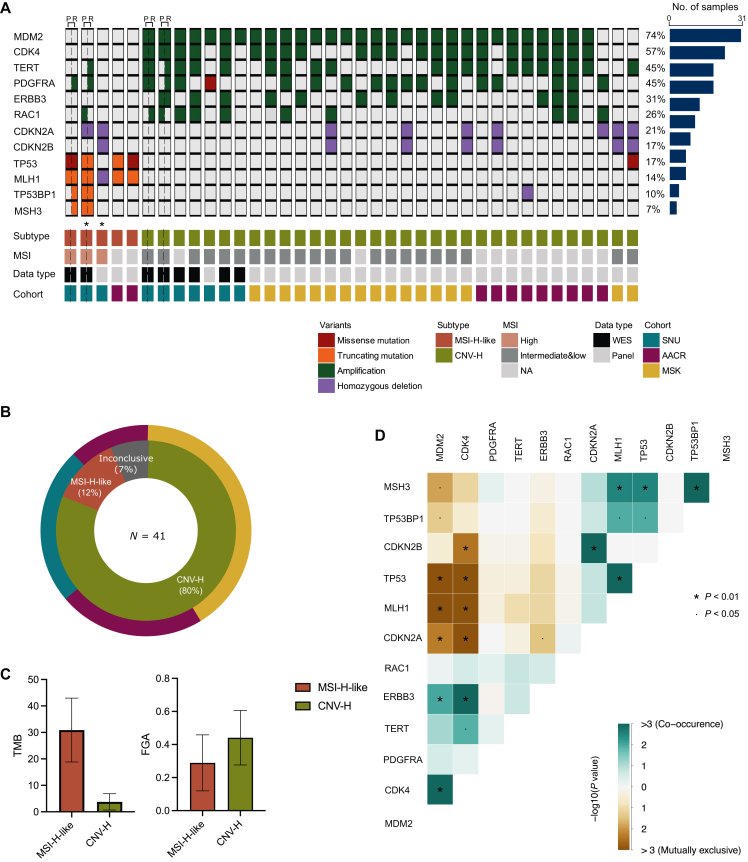
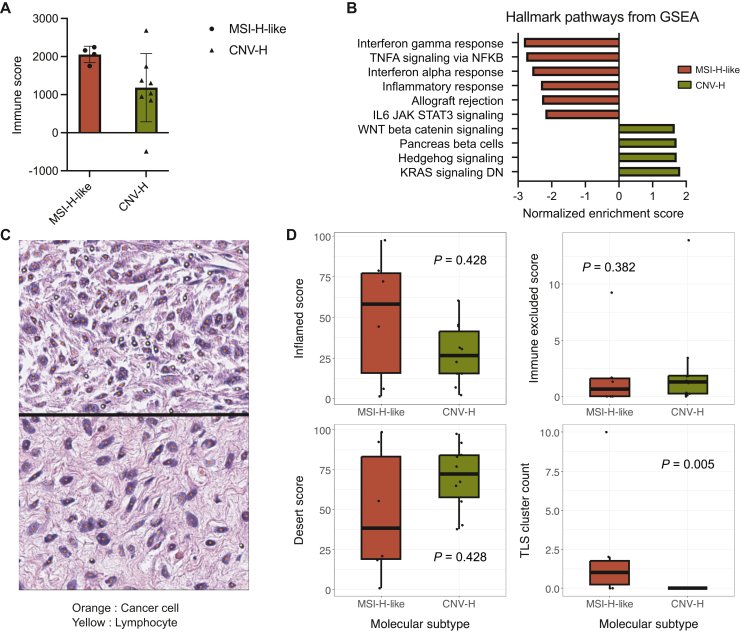
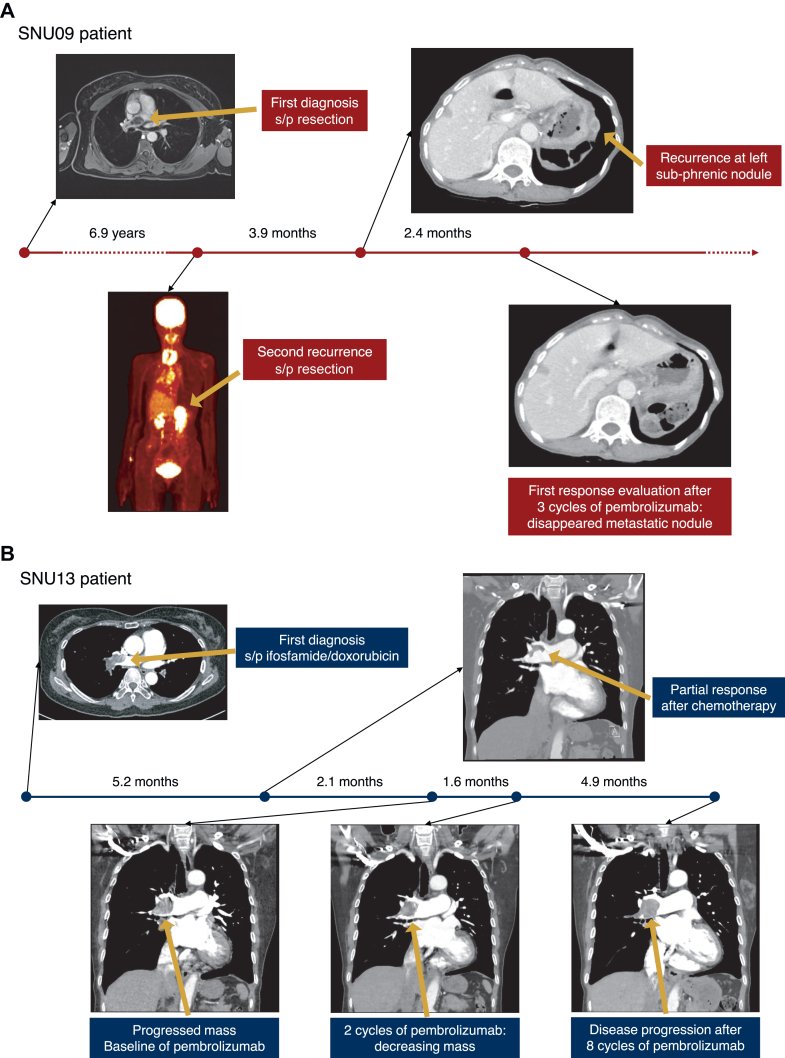
그림 출처: PubMed Central 공개 논문 (PMC11758979)
그 밖의 정보
- 출판 형태
- Journal Article
- 저널
- ESMO open · eISSN 2059-7029
- 전자 출판
- 2025-01-07
- MeSH
- Humans · Sarcoma* / genetics / pathology · Tumor Microenvironment* / genetics · Male · Female · Middle Aged · Aged · DNA Copy Number Variations · Adult · Genomics / methods
- 참고문헌
- 25편