
Int J Chron Obstruct Pulmon Dis. 2015;10:1819-27.
Lung function decline rates according to GOLD group in patients with chronic obstructive pulmonary disease.
제1저자 김주혜 · 교신저자 이창훈
소속 (8)
- Division of Pulmonary and Critical Care Medicine, Department of Internal Medicine, Seoul National University College of Medicine, Seoul National University Hospital, Seoul, Republic of Korea.
- Division of Pulmonary and Critical Care Medicine, Department of Internal Medicine, Seoul National University College of Medicine, Seoul National University Bundang Hospital, Seongnam, Republic of Korea.
- Department of Pulmonary and Critical Care Medicine and Clinical Research Center for Chronic Obstructive Airway Diseases, Asan Medical Center, University of Ulsan College of Medicine, Seoul, Republic of Korea.
- Division of Pulmonary and Critical Care Medicine, Department of Internal Medicine, Kangbuk Samsung Hospital, Sungkyunkwan University School of Medicine, Seoul, Republic of Korea.
- Department of Internal Medicine, CHA Bundang Medical Center, CHA University, Seongnam, Republic of Korea.
- Division of Pulmonology, Department of Internal Medicine, Hanyang University Guri Hospital, Hanyang University College of Medicine, Guri, Republic of Korea.
- Division of Respiratory and Critical Care Medicine, Department of Internal Medicine, College of Medicine, Korea University, Seoul, Republic of Korea.
- Department of Internal Medicine, Ewha Womans University Mokdong Hospital, College of Medicine, Ewha Womans University, Seoul, Republic of Korea.
Abstract
BACKGROUND Since the Global Initiative for Chronic Obstructive Lung Disease (GOLD) groups A-D were introduced, the lung function changes according to group have been evaluated rarely.
OBJECTIVE We investigated the rate of decline in annual lung function in patients categorized according to the 2014 GOLD guidelines.
METHODS Patients with COPD included in the Korean Obstructive Lung Disease (KOLD) prospective study, who underwent yearly postbronchodilator spirometry at least three times, were included. The main outcome was the annual decline in postbronchodilator forced expiratory volume in 1 second (FEV1), which was analyzed by random-slope and random-intercept mixed linear regression.
RESULTS A total 175 participants were included. No significant postbronchodilator FEV1 decline was observed between the groups (-34.4±7.9 [group A]; -26.2±9.4 [group B]; -22.7±16.0 [group C]; and -24.0±8.7 mL/year [group D]) (P=0.79). The group with less symptoms (-32.3±7.2 vs -25.0±6.5 mL/year) (P=0.44) and the low risk group (-31.0±6.1 vs -23.6±7.7 mL/year) (P=0.44) at baseline showed a more rapid decline in the postbronchodilator FEV1, but the trends were not statistically significant. However, GOLD stages classified by FEV1 were significantly related to the annual lung function decline.
CONCLUSION There was no significant difference in lung function decline rates according to the GOLD groups. Prior classification using postbronchodilator FEV1 predicts decline in lung function better than does the new classification.
Keywords
GOLD 2014annual lung function declinechronic obstructive pulmonary disease
Figures
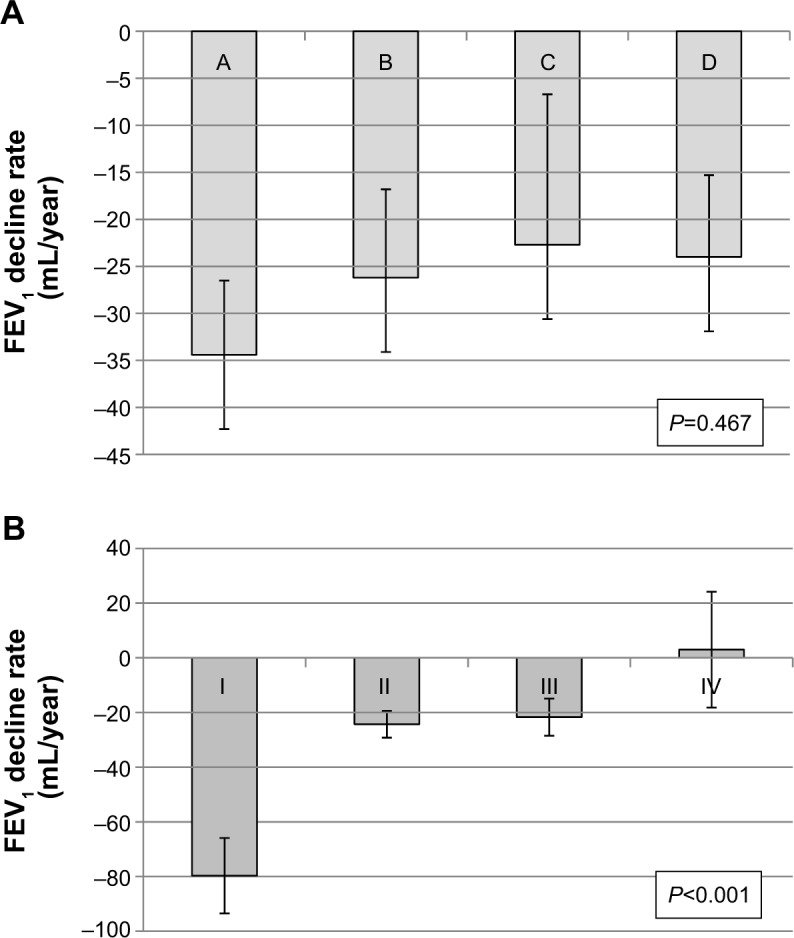
그림 출처: PubMed Central 공개 논문 (PMC4567243)
그 밖의 정보
- 출판 형태
- Journal Article
- 저널
- International journal of chronic obstructive pulmonary disease · eISSN 1178-2005
- 전자 출판
- 2015-09-07
- MeSH
- Aged · Disease Progression · Female · Forced Expiratory Volume / physiology · Humans · Lung / physiopathology · Male · Middle Aged · Prospective Studies · Pulmonary Disease, Chronic Obstructive / physiopathology · Severity of Illness Index · Spirometry / methods
- 참고문헌
- 23편