
Int J Chron Obstruct Pulmon Dis. 2015;10:2365-76.
The efficacy and safety of triple inhaled treatment in patients with chronic obstructive pulmonary disease: a systematic review and meta-analysis using Bayesian methods.
제1저자 곽민선 · 교신저자 이창훈
소속 (5)
- Department of Internal Medicine, Healthcare Research Institute, Healthcare System Gangnam Center, Seoul National University Hospital, Seoul, Republic of Korea.
- Department of Statistics, Kyungpook National University, Daegu, Republic of Korea.
- Department of Information Statistics, Andong National University, Andong, Republic of Korea.
- Department of Preventive Medicine, College of Medicine, Korea University, Seoul, Republic of Korea.
- Department of Internal Medicine, Division of Pulmonary and Critical Care Medicine, Seoul National University College of Medicine, Seoul National University Hospital, Seoul, Republic of Korea.
Abstract
PURPOSE Although tiotropium (TIO) and inhaled corticosteroid (ICS)/long-acting β-agonists are frequently prescribed together, the efficacy of "triple therapy" has not been scientifically demonstrated. We conducted a systematic review and meta-analysis using Bayesian methods to compare triple therapy and TIO monotherapy.
METHODS We searched the MEDLINE, EMBASE, and Cochrane Library databases for randomized controlled trials comparing the efficacy and safety of triple therapy and TIO monotherapy in patients with chronic obstructive pulmonary disease (COPD). We conducted a meta-analysis to compare the effectiveness and safety of triple therapy and TIO monotherapy using Bayesian random effects models.
RESULTS Seven trials were included, and the risk of bias in the majority of the studies was acceptable. There were no statistically significant differences in the incidence of death and acute exacerbation of disease in the triple therapy and TIO monotherapy groups. Triple therapy improved the prebronchodilator forced expiratory volume in 1 second (mean difference [MD], 63.68 mL; 95% credible interval [CrI], 45.29-82.73), and patients receiving triple therapy showed more improvement in St George Respiratory Questionnaire scores (MD, -3.11 points; 95% CrI, -6.00 to -0.80) than patients receiving TIO monotherapy. However, both of these differences were lower than the minimal clinically important difference (MCID). No excessive adverse effects were reported in triple therapy group.
CONCLUSION Triple therapy with TIO and ICSs/long-acting β-agonists was only slightly more efficacious than TIO monotherapy in treating patients with COPD. Further investigations into the efficacy of new inhaled drugs are needed.
Keywords
chronic obstructive pulmonary disease (COPD)inhaled corticosteroids (ICSs)inhaled long-acting muscarinic antagonists (LAMAs)inhaled long-acting β2-agonists (LABAs)
Figures
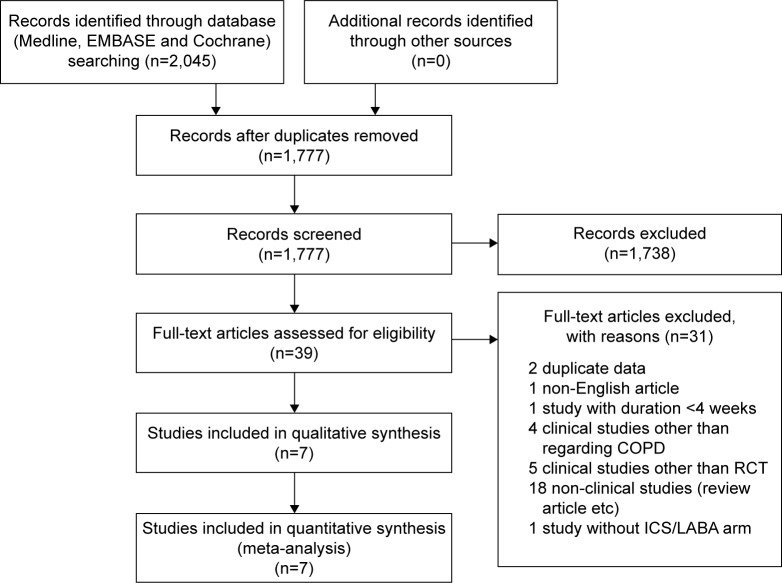
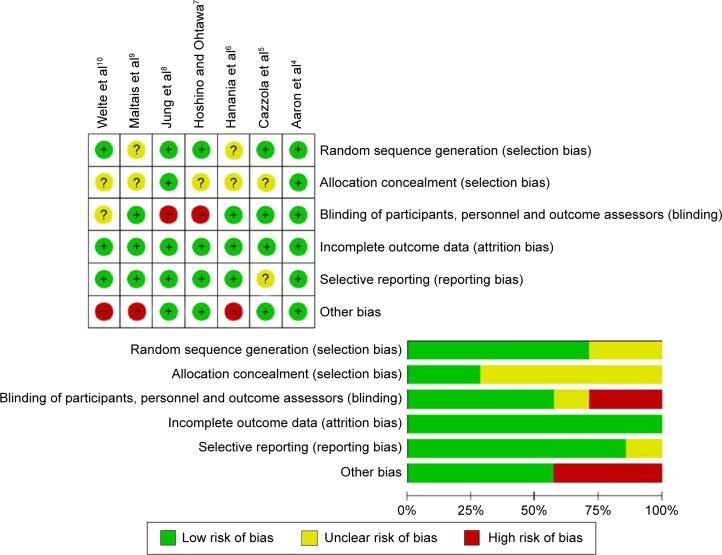
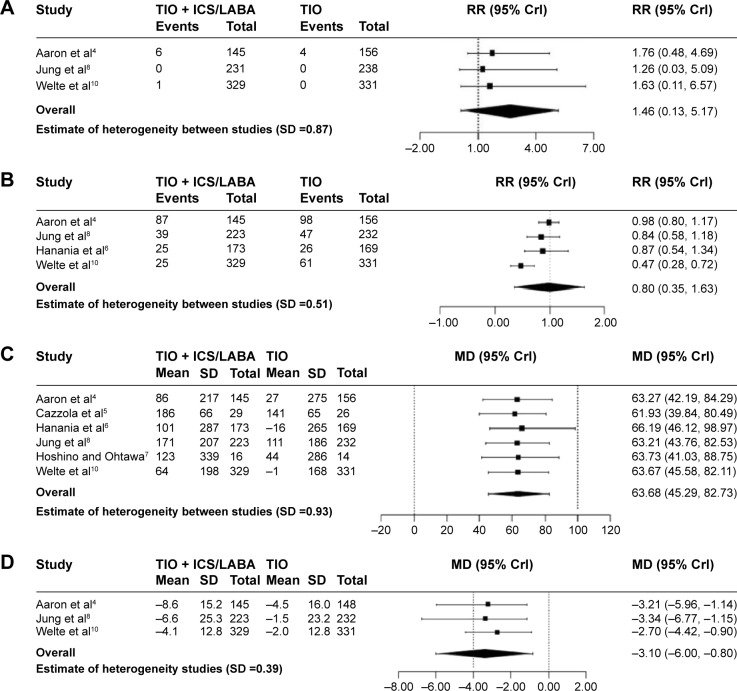
그림 출처: PubMed Central 공개 논문 (PMC4639518)
그 밖의 정보
- 출판 형태
- Journal Article, Meta-Analysis, Research Support, Non-U.S. Gov't, Systematic Review
- 저널
- International journal of chronic obstructive pulmonary disease · eISSN 1178-2005
- 전자 출판
- 2015-11-03
- MeSH
- Administration, Inhalation · Adrenal Cortex Hormones / administration & dosage / adverse effects · Adrenergic beta-2 Receptor Agonists / administration & dosage / adverse effects · Bayes Theorem · Bronchodilator Agents / administration & dosage / adverse effects · Cholinergic Antagonists / administration & dosage / adverse effects · Drug Combinations · Forced Expiratory Volume · Humans · Lung / drug effects / physiopathology · Odds Ratio · Pulmonary Disease, Chronic Obstructive / diagnosis / drug therapy / physiopathology · Recovery of Function · Surveys and Questionnaires · Tiotropium Bromide / administration & dosage / adverse effects · Treatment Outcome
- Substances
- Adrenal Cortex Hormones · Adrenergic beta-2 Receptor Agonists · Bronchodilator Agents · Cholinergic Antagonists · Drug Combinations · Tiotropium Bromide
- 참고문헌
- 46편