
Oncotarget. 2017;8(29):47555-47564.
Comparison of treatment outcome between living donor liver transplantation and sorafenib for patients with hepatocellular carcinoma beyond the Milan criteria.
제1저자 조유리 · 교신저자 이정훈
소속 (4)
- Department of Internal Medicine and Liver Research Institute, Seoul National University College of Medicine, Seoul, Republic of Korea.
- Department of Internal Medicine, CHA Gangnam Medical Center, CHA University, Seoul, Republic of Korea.
- Department of Internal Medicine, Seoul Metropolitan Government Seoul National University Boramae Medical Center, Seoul, Republic of Korea.
- Department of Surgery, Seoul National University College of Medicine, Seoul, Republic of Korea.
Abstract
For patients with advanced hepatocellular carcinoma (HCC), sorafenib is the only systemic treatment recommended by international guidelines. We recently reported that HCC patients with a low MoRAL (model to predict tumor recurrence after LDLT) score (≤ 314.8) have excellent treatment outcomes after living-donor liver transplantation (LDLT), even though they are beyond the Milan criteria. In the present study, we investigated whether LDLT offers a better treatment outcome than sorafenib for patients with HCC beyond the Milan criteria according to the MoRAL score. A retrospective cohort study of 325 consecutive patients who were treated with either LDLT (n = 122) or sorafenib (n = 203) for HCC beyond the Milan criteria from 2005 to 2014 at a tertiary hospital was performed. The primary and secondary endpoints were overall survival (OS) and time-to-progression. When baseline characteristics were balanced using inverse probability weighting, OS was significantly longer in the LDLT group than in the sorafenib group (5-year OS rate, 71.9% vs. 4.9%; HR=0.1; P < 0.001). The LDLT group exhibited a significantly lower risk of tumor progression (5-year recurrence rate, 34.7% vs. 96%; HR=0.14; P < 0.001) than the sorafenib group. The increase in OS with LDLT was predominantly among patients with a low MoRAL score (5-year OS rate, 81.1% vs. 5.8%; HR=0.06; P < 0.001) compared with those with a high MoRAL score (5-year OS rate, 28.3% vs. 4.3%; HR = 0.42; P = 0.047). Patients with a low MoRAL score and without extrahepatic metastasis or hepatic vein invasion might be good candidates for LDLT instead of sorafenib treatment if there is a willing living related donor.
Keywords
MoRAL scorehepatocellular carcinomaliving donor liver transplantationsorafenibsurvival
Figures

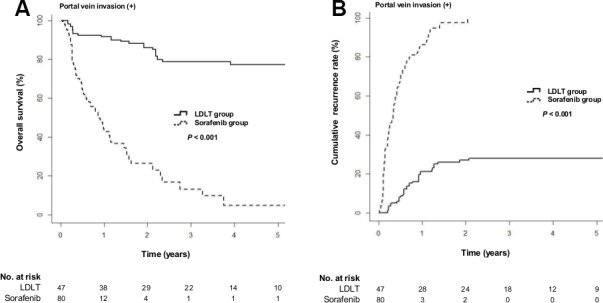


그림 출처: PubMed Central 공개 논문 (PMC5564586)
Conflict of interest statement
CONFLICTS OF INTEREST. The authors declare no conflicts of interest.
그 밖의 정보
- 출판 형태
- Comparative Study, Journal Article
- 저널
- Oncotarget · eISSN 1949-2553
- MeSH
- Adult · Aged · Aged, 80 and over · Antineoplastic Agents / administration & dosage / adverse effects / therapeutic use · Carcinoma, Hepatocellular / diagnosis / drug therapy / mortality / surgery · Disease Progression · Female · Humans · Liver Neoplasms / diagnosis / drug therapy / mortality / surgery · Liver Transplantation* / adverse effects / methods · Living Donors* · Male · Middle Aged · Neoplasm Staging · Niacinamide / administration & dosage / adverse effects / analogs & derivatives / therapeutic use · Phenylurea Compounds / administration & dosage / adverse effects / therapeutic use · Proportional Hazards Models · Protein Kinase Inhibitors / administration & dosage / adverse effects / therapeutic use · Sorafenib · Survival Analysis · Time Factors · Treatment Outcome
- Substances
- Antineoplastic Agents · Phenylurea Compounds · Protein Kinase Inhibitors · Niacinamide · Sorafenib
- 참고문헌
- 29편