
Gut Liver. 2015;9(4):478-85.
Efficacy of 7-Day and 14-Day Bismuth-Containing Quadruple Therapy and 7-Day and 14-Day Moxifloxacin-Based Triple Therapy as Second-Line Eradication for Helicobacter pylori Infection.
제1저자 이성태 · 교신저자 이동호
소속 (1)
- Division of Gastroenterology, Department of Internal Medicine, Seoul National University Bundang Hospital, Seongnam, Korea.
Abstract
BACKGROUND/AIMS Bismuth-containing quadruple and moxifloxacin-based triple regimens are recommended as second-line therapy for Helicobacter pylori infection. The aim of this study was to compare the efficacy of each regimen.
METHODS From August 2004 to October 2012, a total of 949 patients (mean age, 54.32±12.08 years; male, 49.4%) who failed H. pylori eradication with a standard triple regimen were included. Patients treated with a bismuth-containing quadruple regimen for 7 and 14 days were designated as 7-BMT and 14-BMT, respectively, and those treated with a moxifloxacin-based triple regimen for 7 and 14 days were designated as 7-MA and 14-MA, respectively. H. pylori eradication was confirmed using the (13)C-urea breath test, rapid urease test or histology.
RESULTS The eradication rates by 7-BMT, 14-BMT, 7-MA, and 14-MA were 66.4% (290/437), 71.1% (113/159), 53.1% (51/96), and 73.5% (189/257), respectively, by intention-to-treat analysis (ITT) and 76.5% (284/371), 83.8% (109/130), 55.6% (50/90), and 80.6% (187/232), respectively, by per-protocol analysis (PP). The eradication rates were higher in 14-BMT than 7-BMT by the ITT and PP analyses (p=0.277 and p=0.082, respectively). The 14-BMT and 14-MA treatments showed similar efficacies by ITT and PP (p=0.583 and p=0.443, respectively).
CONCLUSIONS The 7-BMT, 14-BMT, and 14-MA treatments showed similar and suboptimal efficacies. In both regimens, extending the duration of treatment may be reasonable considering the high level of antibiotic resistance in Korea.
Keywords
Bismuth-containing quadruple regimenHelicobacter pyloriMoxifloxacin-based triple regimenSecond-line therapy
Figures
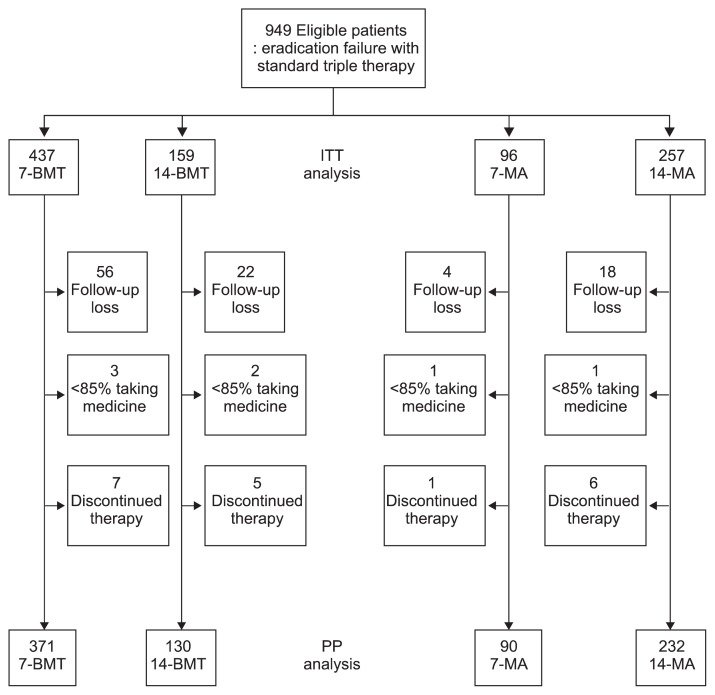
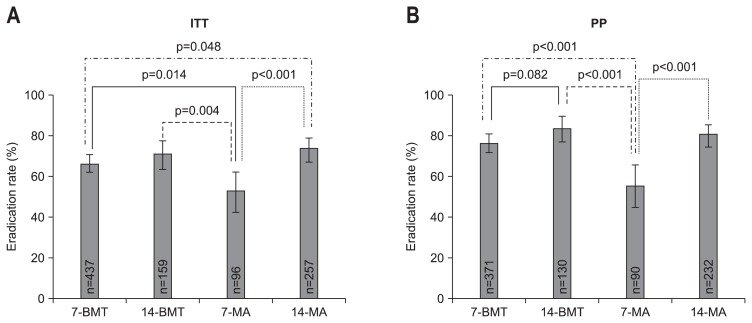
그림 출처: PubMed Central 공개 논문 (PMC4477991)
그 밖의 정보
- 출판 형태
- Comparative Study, Journal Article
- 저널
- Gut and liver · eISSN 2005-1212
- MeSH
- Adult · Aged · Amoxicillin / administration & dosage · Antacids / administration & dosage · Anti-Infective Agents / administration & dosage · Bismuth / administration & dosage · Drug Administration Schedule · Drug Therapy, Combination / methods · Female · Fluoroquinolones / administration & dosage · Helicobacter Infections / drug therapy · Helicobacter pylori* · Humans · Intention to Treat Analysis · Male · Metronidazole / administration & dosage · Middle Aged · Moxifloxacin · Proton Pump Inhibitors / administration & dosage · Retrospective Studies · Tetracycline / administration & dosage · Treatment Outcome
- Substances
- Antacids · Anti-Infective Agents · Fluoroquinolones · Proton Pump Inhibitors · Metronidazole · Amoxicillin · Tetracycline · Bismuth · Moxifloxacin
- 참고문헌
- 46편