
Cancer Res Treat. 2016;48(1):28-36.
Phase I Study of CKD-516, a Novel Vascular Disrupting Agent, in Patients with Advanced Solid Tumors.
제1저자 오도연 · 교신저자 방영주
소속 (5)
- Department of Internal Medicine, Seoul National University Hospital, Seoul, Korea ; Cancer Research Institute, Seoul National University College of Medicine, Seoul, Korea.
- Department of Internal Medicine, Seoul National University Hospital, Seoul, Korea ; Department of Internal Medicine, Korea Cancer Center Hospital, Korea Institute of Radiological and Medical Sciences, Seoul, Korea.
- Department of Internal Medicine, Seoul National University Hospital, Seoul, Korea ; Department of Internal Medicine, Kangbuk Samsung Medical Center, Seoul, Korea.
- Department of Internal Medicine, Seoul National University Bundang Hospital, Seongnam, Korea.
- Department of Clinical Pharmacology and Therapeutics, Seoul National University Hospital, Seoul, Korea.
Abstract
PURPOSE CKD-516 is a newly developed vascular disrupting agent. This phase I dose-escalation study of CKD-516 was conducted to determine maximum-tolerated dose (MTD), safety, pharmacokinetics, and preliminary antitumor efficacy in patients with advanced solid tumors.
MATERIALS AND METHODS Patients received CKD-516 intravenously on D1 and D8 every 3 weeks, in a standard 3+3 design. Safety was evaluated by National Cancer Institute Common Terminology Criteria for Adverse Events ver. 4.02 and response was assessed by Response Evaluation Criteria in Solid Tumor ver. 1.1.
RESULTS Twenty-three patients were treated with CKD-516 at seven dosing levels: 1 mg/m(2)/day (n=3), 2 mg/m(2)/day (n=3), 3.3 mg/m(2)/day (n=3), 5 mg/m(2)/day (n=3), 7 mg/m(2)/day (n=3), 9 mg/m(2)/day (n=6), and 12 mg/m(2)/day (n=2). Mean age was 54 and 56.5% of patients were male. Two dose-limiting toxicities, which were both grade 3 hypertension, were observed in two patients at 12 mg/m(2)/day. The MTD was determined as 12 mg/m(2)/day. Most common adverse events were gastrointestinal adverse events (diarrhea, 34.8% [30.4% grade 1/2, 13.0% grade 3]; nausea, 21.7% [all grade 1/2]; vomiting, 21.7% [all grade 1/2]), myalgia (17.4%, all grade 1/2), and abdominal pain (21.7% [21.7% grade 1/2, 4.3% grade 3]). The pharmacokinetic study showed the dose-linearity of all dosing levels. Among 23 patients, six patients (26.1%) showed stable disease. Median progression-free survival was 39 days (95% confidence interval, 37 to 41 days).
CONCLUSION This study demonstrates feasibility of CKD-516, novel vascular disrupting agent, in patients with advanced solid tumor. MTD of CKD-516 was defined as 12 mg/m(2)/day on D1 and D8 every 3 weeks.
Keywords
CKD-516Phase I clinical trialSolid tumorVascular disrupting agent
Figures
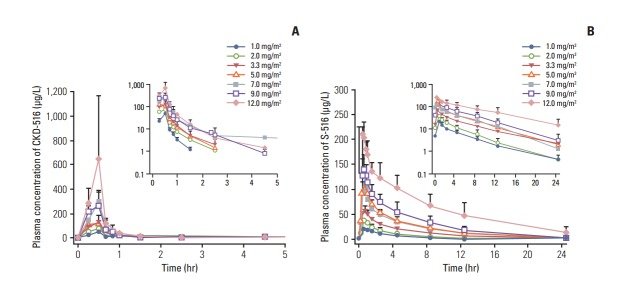
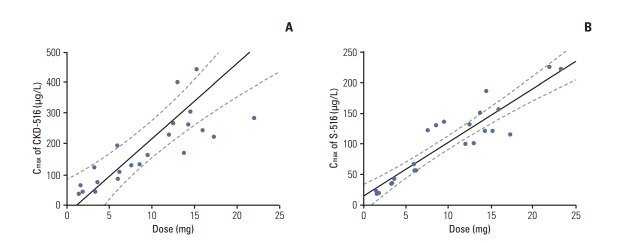
그림 출처: PubMed Central 공개 논문 (PMC4720091)
Conflict of interest statement
Conflict of interest relevant to this article was not reported.
그 밖의 정보
- 출판 형태
- Clinical Trial, Phase I, Journal Article
- 저널
- Cancer research and treatment · eISSN 2005-9256
- 전자 출판
- 2015-02-23
- MeSH
- Adult · Aged · Antineoplastic Agents / administration & dosage / adverse effects / therapeutic use · Benzophenones / administration & dosage / adverse effects / therapeutic use · Blood Vessels / drug effects · Dose-Response Relationship, Drug · Female · Humans · Male · Maximum Tolerated Dose · Middle Aged · Neoplasms / blood supply / drug therapy · Valine / administration & dosage / adverse effects / analogs & derivatives / therapeutic use
- Substances
- Antineoplastic Agents · Benzophenones · N-(4-(3-(1H-1,2,4-triazol-1-yl)-4-(3,4,5-trimethoxybenzoyl)phenyl)thiazol-2-yl)-2-amino-3-methylbutanamide · Valine
- 참고문헌
- 19편