Laboratory of Infection and Immunology, Graduate School of Medicine, Korea University, Seoul, Korea.
Department of Biochemistry & Molecular Biology, College of Medicine, Korea University, Seoul, Korea.
Division of Oncology, Department of Internal Medicine, College of Medicine, Korea University, Seoul, Korea.
Department of Internal Medicine, Seoul National University College of Medicine, Seoul, Korea.
Department of Physiology, Seoul National University, College of Medicine, Seoul, Korea.
Abstract
The fusion between anaplastic lymphoma kinase (ALK) and echinoderm microtubule-associated protein-like 4 (EML4) is a causative factor in a unique subset of patients with non-small cell lung carcinoma (NSCLC). Although the inhibitor crizotinib, as it blocks the kinase activity of the resulting EML4-ALK fusion protein, displays remarkable initial responses, a fraction of NSCLC cases eventually become resistant to crizotinib by acquiring mutations in the ALK domain or activating bypass pathways via EGFR, KIT, or KRAS. Cancer stem cell (CSC) theory provides a plausible explanation for acquisition of tumorigenesis and resistance. However, the question as to whether EML4-ALK-driven tumorigenesis is linked with the stem-like property and whether the stemness is an effective target in controlling EML4-ALK+ NSCLC including crizotinib-resistant NSCLC cells has not been addressed. Here, we report that stem-like properties stem from ALK activity in EML4-ALK+ NSCLC cells. Notably, treatment with rapamycin, a CSC targeting agent, attenuates stem-like phenotypes of the EML4-ALK+ cells, which increased capability of tumor formation and higher expression of stemness-associated molecules such as ALDH, NANOG, and OCT4. Importantly, combinational treatment with rapamycin and crizotinib leads to synergistic anti-tumor effects on EML4-ALK+ NSCLC cells as well as on those resistant to crizotinib. Thus, we provide a proof of principle that targeting stemness would be a novel strategy to control intractable EML4-ALK+ NSCLC.
Keywords
EML4-ALKNSCLCrapamycinresistancestemness factor
Figures
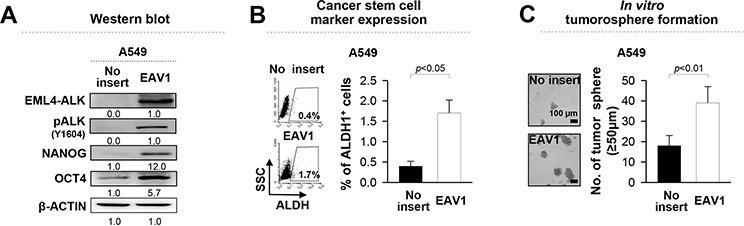
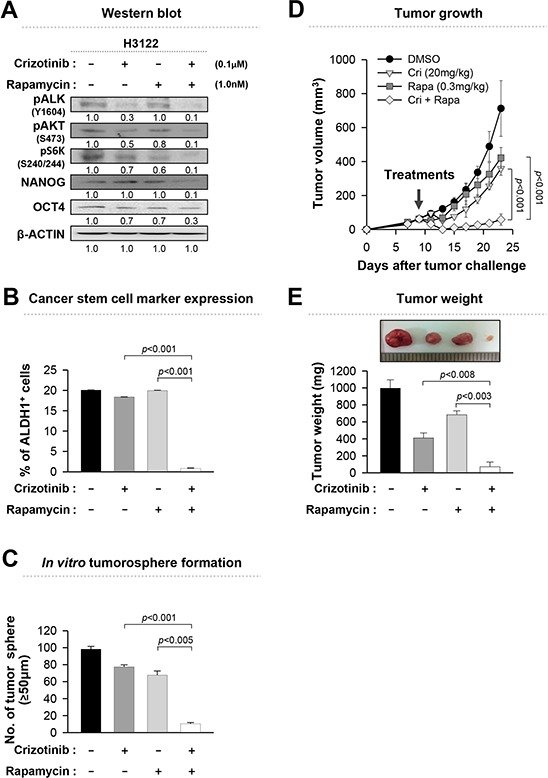
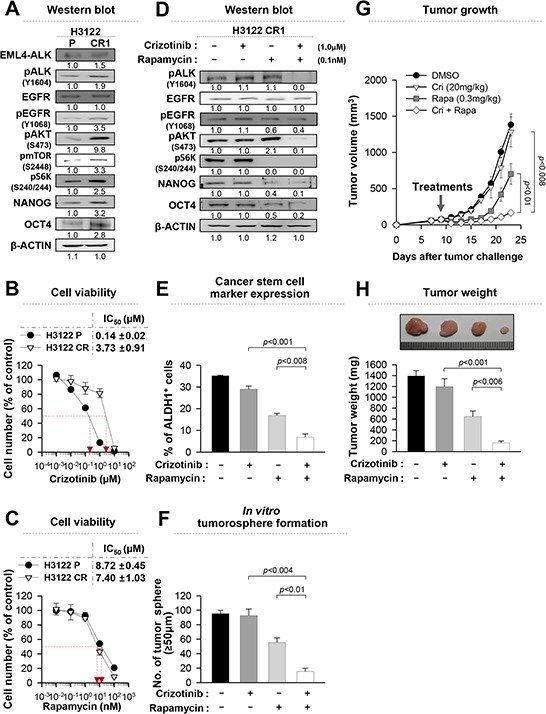
Figure 1EML4-ALK increases the stem-like properties and tumorigenicity of EML4-ALK-driven NSCLC cells in vitro and in vivoA. Sphere-forming capacity of BEAS-2B, A549, H3122 and H2228 cells in a low-density suspension culture. Original magnification, x40. B. ALK, pALK, NANOG, OCT4, SOX2, KLF4, c-MYC and β-ACTIN expression in BEAS-2B, A549, H3122 and H2228 cells in a low-density suspension culture. Original magnification, x40. (B) ALK, pALK, NANOG, OCT4, SOX2, KLF4, c-MYC and β-ACTIN expression in BEAS-2B, A549, H3122 and H2228 cells was visualized by western blot analysis with lysates from the monolayer cultured cells. (C) H3122 and H2228 cells were treated with siGFP (control) or siALK and the levels of ALK, NANOG, OCT4, SOX2, KLF4, and c-MYC proteins were analyzed. β-ACTIN was used as an internal loading control. Numbers below blots indicate expression as measured by fold change. D. Flow cytometry analysis of the frequency of ALDH1+ cells in H3122 and H2228 cells treated with siALK or siGFP (control). E. Sphere-forming capacity of H3122 and H2228 cells treated with siGFP or siALK in a low-density suspension culture. Original magnification, × 40. F. Tumorigenicity of siGFP-versus siALK-treated H3122 cells inoculated at indicated doses into 5 NOD/SCID mice per group. G. Tumors were extracted at 20 days after injection of 105siGFP- or siALK-treated H3122 cells. Error bars represent mean ± SD. Individual data analysis was performed using two-tailed Student's t-test.Figure 2 Ectopic expression of EML4-ALK enhances the stem-like properties and tumorigenicity of EML4-ALK negative cells A. A549 cells were transfected with an empty vector or EML4-ALK variant 1 (EAV1) cDNA and the levels of ALK, pALK, NANOG, and OCT4 were analyzed. β-ACTIN was used as an internal loading control. Numbers below blots indicate expression as measured by fold change. B. Flow cytometry analysis of the frequency of ALDH1+ cells in A549 cells transfected with EAV1 or empty vector. C. Sphere-forming capacity of EAV1 versus empty vector-transfected A549 cells in a low-density suspension culture. Original magnification, × 40. Error bars represent mean ± SD. Individual data analysis was performed using two-tailed Student's t-test.Figure 3 Crizotinib, an ALK inhibitor, reduces the stem-like properties of EML4-ALK positive cells in a dose-dependent manner H3122 cells were treated with crizotinib at the indicated concentration. A. ALK, pALK, NANOG, OCT4, and β-ACTIN expression in H3122 cells treated with crizotinib or DMSO (control) for 24 hr was visualized by western blot analysis. Numbers below blots indicate expression as measured by fold change. B. Flow cytometry analysis of the frequency of ALDH+ cells in H3122 cells treated with crizotinib or DMSO (control) for 24 hr. C. Sphere-forming capacity of H3122 cells treated with crizotinib or DMSO (control) in a low-density suspension culture. Original magnification, × 40. Error bars represent mean ± SD. Individual data analysis was performed using two-tailed Student's t-test.Figure 4 Rapamycin is the most suitable drug that decreases the stem-like properties of EML4-ALK-driven NSCLC cells H3122 cells were treated with rapamycin, salinomycin, and metformin at the indicated concentrations. A. H3122 cells were treated with DMSO, rapamycin, salinomycin, or metformin for 24 hr, and the levels of NANOG, OCT4, and β-ACTIN protein were analyzed. Numbers below blots indicate expression as measured by fold change. B. Flow cytometry analysis of the frequency of ALDH+ cells in H3122 cells treated as in (A). C. Quantification of tumorsphere formation with H3122 cells treated with the indicated drugs in a low-density suspension culture. Original magnification, × 40. Error bars represent mean ± SD. Individual data analysis was performed using two-tailed Student's t-test.Figure 5 Inhibition of EML4-ALK-mediated stem-like properties enhances the anti-tumor effect A. Western blot analysis using antibodies specific to the proteins in lysates from H3122 cells that treated with the indicated drugs for 24 hr. Numbers below blots indicate expression as measured by fold change. B. Flow cytometry analysis of the frequency of ALDH+ cells in H3122 cells treated as in (A). C. Quantification of tumorsphere-formation with H3122 cells treated with the indicated drugs in a low-density suspension culture. Original magnification, × 40. D. Tumor growth in mice inoculated with H3122 cells. Nude mice were inoculated subcutaneously with 1 × 10⁶ cells/mouse. Nine days following tumor challenge, the CH containing the indicated drug or both drugs was injected intratumorally. E. Tumor weight in mice at 23 days after the challenge. Error bars represent mean ± SD. Individual data analysis was performed using two-tailed Student's t-test.Figure 6 Rapamycin can effectively reduce the stem-like properties of crizotinib-resistant cells A. Western blot analysis using antibodies specific to the proteins in lysates from H3122 cells or H3122 CR1 cells. Numbers below blots indicate expression as measured by fold change. B. and C. Dose-response curves for the viability of control H3122 cells and H3122 CR1 cells treated with crizotinib or rapamycin for 72 hr. D. Western blot analysis using antibodies specific to the proteins in lysates from H3122 CR1 cells that treated with the indicated drugs for 24 hr. Numbers below blots indicate expression as measured by fold change. E. Flow cytometry analysis of the frequency of ALDH+ cells in H3122 CR1 cells treated as in (D). F. Quantification of tumorsphere-formation with H3122 CR1 cells treated with the indicated drugs in a low-density suspension culture. Original magnification, × 40. G. Tumor growth in mice inoculated with H3122 CR1 cells. Nude mice were inoculated subcutaneously with 1 × 10⁶ cells/mouse. Nine days following tumor challenge, the CH containing the indicated drug or both drugs was injected intratumorally. H. Tumor weight in mice at 23 days after challenge. Error bars represent mean ± SD. Individual data analysis was performed using two-tailed Student's t-test.
그림 출처: PubMed Central 공개 논문 (PMC4741893)
Conflict of interest statement
CONFLICTS OF INTEREST. No potential conflicts of interest were disclosed.