
Sci Rep. 2018;8(1):12919.
Frequent patient retraining at home reduces the risks of peritoneal dialysis-related infections: A randomised study.
제1저자 장제현,오지은 · 교신저자 오국환
소속 (9)
- Department of Internal Medicine, Gachon University Gil Medical Center, Gachon University School of Medicine, Namdong Gu, Incheon, 21565, Korea.
- Department of Internal Medicine, Kangdong Sacred Heart Hospital, Hallym Kidney Research Institute, Hallym University, Kangdong Gu, Seoul, 05355, Korea.
- Department of Preventive Medicine, Seoul National University College of Medicine, Seoul, Korea.
- Department of Biomedical Science, Seoul National University College of Medicine, Seoul, Korea.
- Cancer Research Institute, Seoul National University, Chongno Gu, Seoul, 03080, Korea.
- Department of Internal Medicine, Hallym University Sacred Heart Hospital, Dongan Gu, Anyang, Gyeonggi-do, 14068, Korea.
- Department of Internal Medicine, Eulji University College of Medicine, Hangeul Biseok Ro, Seoul, 01830, Korea.
- Department of Internal Medicine, Yonsei University College of Medicine, Gangnam Severance Hospital, Kangnam Gu, Seoul, 06273, Korea.
- Department of Internal Medicine, Seoul National University College of Medicine, Seoul, 03080, Korea. ohchris@hanmail.net.
Abstract
The present study, entitled Trial on Education And Clinical outcomes for Home PD patients (TEACH), investigated the effect of frequent retraining at home on the outcomes of peritoneal dialysis (PD). TEACH is a multicentre, open-label, randomised, controlled trial with parallel arms. Patients starting PD were randomized into either the conventional retraining group (CG) or the frequent retraining group (FG). Patients in the FG were given more frequent home visits for retraining. The primary endpoint was exit site infection (ESI). Secondary endpoints were peritonitis, any PD-related infections, hospitalization, technique failure, and patient survival. A generalised estimating equations (GEE) approach was employed for the adjusted effect of training level on the outcomes. Cox regression was employed for peritonitis and other secondary outcomes. The subjects were randomised to either the FG (n = 51) or the CG (n = 53). Although the time of initial training did not differ between the 2 groups, the total time of training was longer and the frequency of training visits was higher in the FG. In the GEE model, the p-values for interactions between groups and time were significant for both ESI and any PD-related infections, suggesting that the event rates of the two groups significantly changed over time. The event rates for the FG decreased over time, and the event rates for the CG increased after month 12. In the older subgroup (age ≥ 60), frequent retraining had a significant effect in the risk reduction of the first episode of peritonitis (adjusted HR 0.01 [0.001-0.35], p = 0.01). Frequent retraining at home reduced the risk of PD-related infections.
Figures
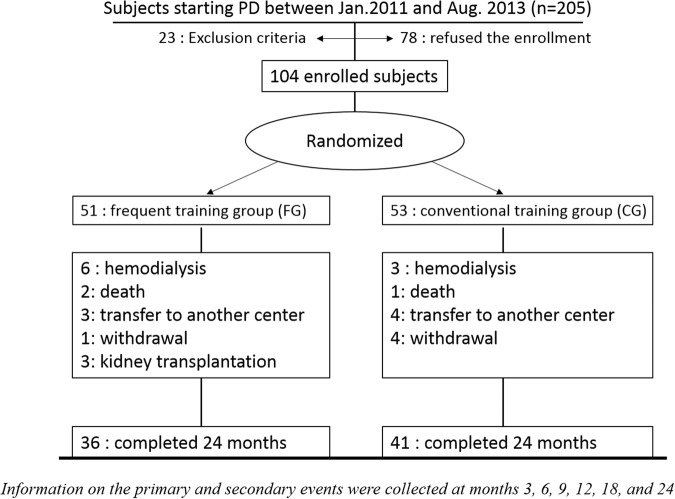
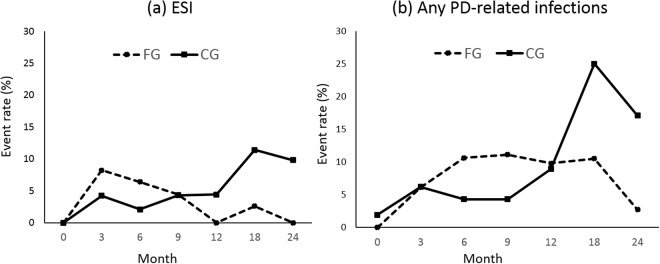
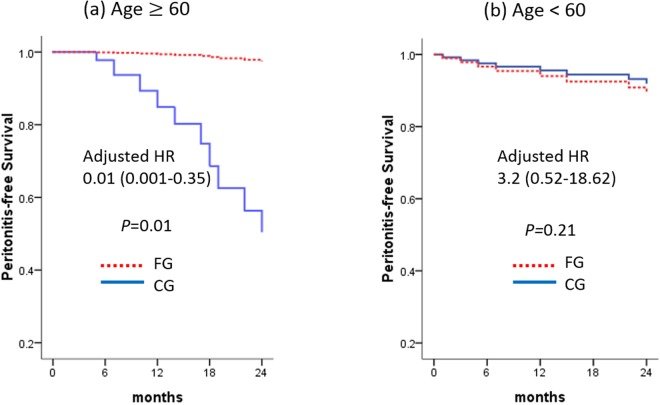
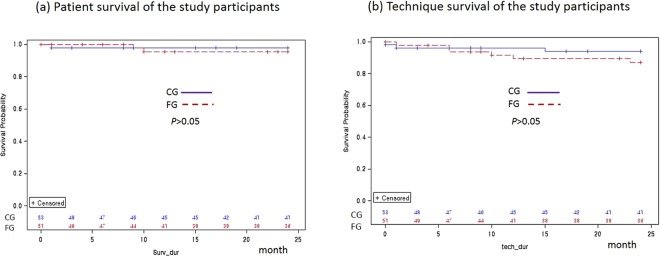
그림 출처: PubMed Central 공개 논문 (PMC6110747)
Conflict of interest statement
The authors declare no competing interests.
그 밖의 정보
- 출판 형태
- Journal Article, Research Support, Non-U.S. Gov't
- 저널
- Scientific reports · eISSN 2045-2322
- 전자 출판
- 2018-08-27
- MeSH
- Adult · Female · Hospitalization / statistics & numerical data · Humans · Male · Middle Aged · Peritoneal Dialysis / methods · Proportional Hazards Models · Quality of Life · Renal Dialysis / methods
- 참고문헌
- 25편