
Sci Rep. 2018;8(1):9378.
The relationship between metabolic syndrome and asthma in the elderly.
제1저자 박상신 · 교신저자 이창훈
소속 (5)
- Center for International Health Research, Rhode Island Hospital, The Warren Alpert Medical School of Brown University, Providence, Rhode Island, United States.
- Department of Pediatrics, The Warren Alpert Medical School of Brown University, Providence, Rhode Island, United States.
- Department of Health Convergence, Ewha Womans University, Seoul, Republic of Korea.
- Division of Allergy and Pulmonology, Department of Internal Medicine, Catholic University of Korea Daejeon St. Mary's Hospital, Daejeon, Republic of Korea.
- Division of Pulmonary and Critical Care Medicine, Department of Internal Medicine, Seoul National University Hospital, Seoul, Republic of Korea. kauri670@empal.com.
Abstract
The burden of asthma in the elderly is increasing, but the etiology of asthma in the elderly is not clearly understood. Recent studies have reported the epidemiological link between metabolic syndrome (MS) and asthma, but it has rarely been studied in the elderly. This study investigated the association between MS and asthma and the contribution of insulin resistance (IR) and systemic inflammation to this MS-asthma association in the elderly. Our study analyzed 4,060 elderly participants (≥65 years old) from a cross-sectional survey, the Korean National Health and Nutritional Examination Survey 2007-2012. Mediation analyses were performed to examine whether IR and systemic inflammation mediates the MS-asthma association. Participants with MS had significantly higher prevalence of asthma (adjusted odds ratio = 1.34; 95% confidence interval = 1.09-1.64), and those who had greater waist circumference and lower HDL-C were especially likely to have asthma. Participants with IR and systemic inflammation were associated with higher prevalence of asthma. Prevalence of IR and systemic inflammation were higher in participants with MS or with each MS component. The MS-asthma association was substantially mediated by IR and systemic inflammation. Our study showed a significant association between MS and asthma in the elderly. MS might affect asthma through both IR and systemic inflammation.
Figures
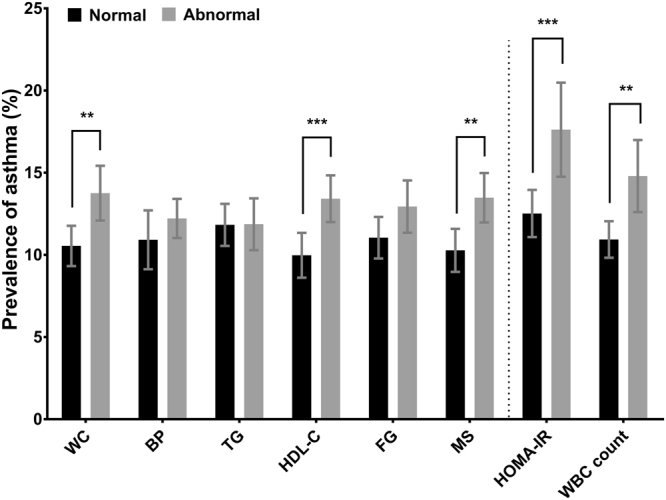
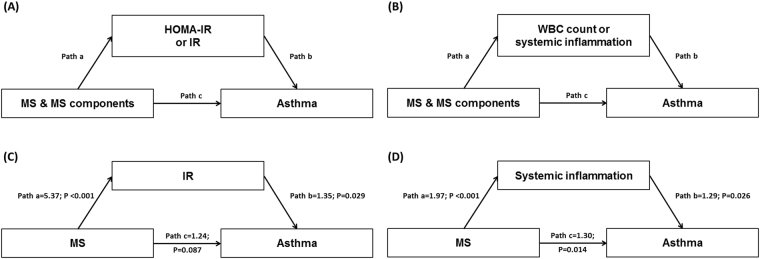
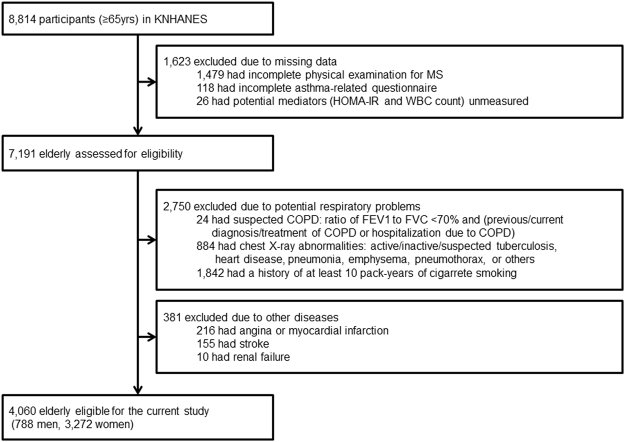
그림 출처: PubMed Central 공개 논문 (PMC6010438)
Conflict of interest statement
The authors declare no competing interests.
그 밖의 정보
- 출판 형태
- Journal Article
- 저널
- Scientific reports · eISSN 2045-2322
- 전자 출판
- 2018-06-20
- MeSH
- Aged · Aged, 80 and over · Asthma / blood / epidemiology / immunology · Cholesterol, HDL / blood · Cross-Sectional Studies · Female · Humans · Inflammation / blood / epidemiology / immunology · Insulin Resistance / physiology · Male · Metabolic Syndrome / blood / epidemiology / immunology · Waist Circumference / physiology
- Substances
- Cholesterol, HDL
- 참고문헌
- 38편