
Ann Oncol. 2017;28(1):110-115.
Quantitative proteomic analysis of HER2 expression in the selection of gastric cancer patients for trastuzumab treatment.
제1저자 안은경, 옥찬영 · 교신저자 오도연
소속 (6)
- NantOmics, Rockville, USA
- Oncoplex Diagnostics, Rockville, USA.
- Department of Internal Medicine, Seoul National University Hospital, Seoul, Seoul, Korea.
- Cancer Research Institute, Seoul National University College of Medicine, Seoul, Seoul, Korea.
- Department of Pathology, Seoul National University Hospital, Seoul, Korea.
- Department of Medicine, Section of Hematology/Oncology, University of Chicago, Chicago, USA.
Abstract
BACKGROUND A wide range of response rates have been reported in HER2-positive gastric cancer (GC) patients treated with trastuzumab. Other HER2-targeted therapies for GC have yet to show efficacy in clinical trials. These findings raise question about the ability of standard HER2 diagnostics to accurately distinguish between GC patients who would and would not benefit from anti-HER2 therapies.
PATIENTS AND METHODS GC patients (n = 237), including a subset from the Trastuzumab in GC (ToGA) trial were divided into three groups based on HER2 status and history of treatment with standard chemotherapy or chemotherapy plus trastuzumab. We applied mass spectrometry-based proteomic analysis to quantify HER2 protein expression in formalin-fixed tumor samples. Using HER2 expression as a continuous variable, we defined a predictive protein level cutoff to identify which patients would benefit from trastuzumab. We compared quantitated protein level with clinical outcome and HER2 status as determined by conventional HER2 diagnostics.
RESULTS Quantitative proteomics detected a 115-fold range of HER2 protein expression among patients diagnosed as HER2 positive by standard methods. A protein level of 1825 amol/µg was predicted to determine benefit from the addition of trastuzumab to chemotherapy. Trastuzumab treated patients with HER2 protein levels above this cutoff had twice the median overall survival (OS) of their counterparts below the cutoff (35.0 versus 17.5 months, P = 0.011). Conversely, trastuzumab-treated patients with HER2 levels below the cutoff had outcomes similar to HER2-positive patients treated with chemotherapy. (Progression-free survival = 7.0 versus 6.5 months: P = 0.504; OS = 17.5 versus 12.6 months: P = 0.520). HER2 levels were not prognostic for response to chemotherapy.
CONCLUSIONS Proteomic analysis of HER2 expression demonstrated a quantitative cutoff that improves selection of GC patients for trastuzumab as compared with current diagnostic methods.
© The Author 2016. Published by Oxford University Press on behalf of the European Society for Medical Oncology.
Keywords
HER2gastric cancermolecular characterizationproteomicstrastuzumab
Figures
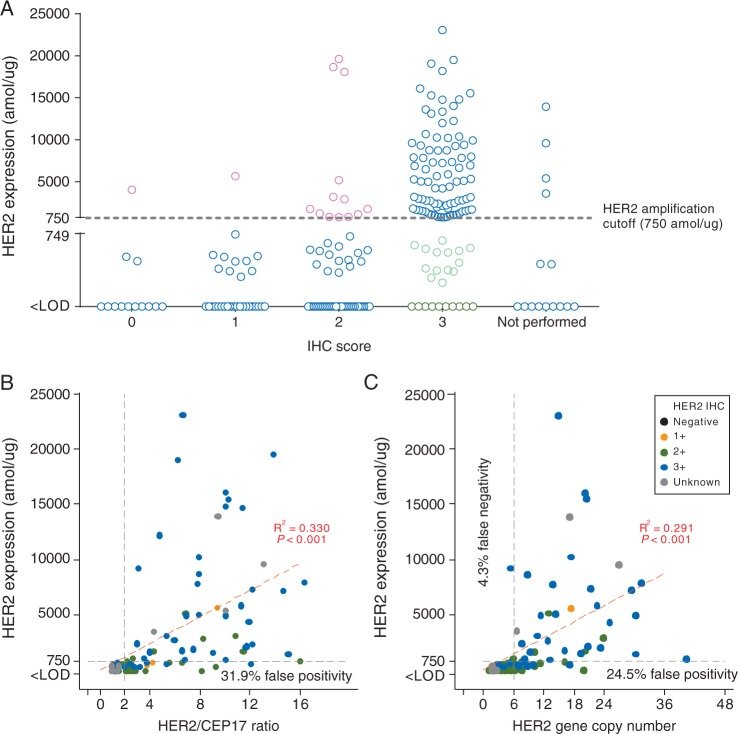
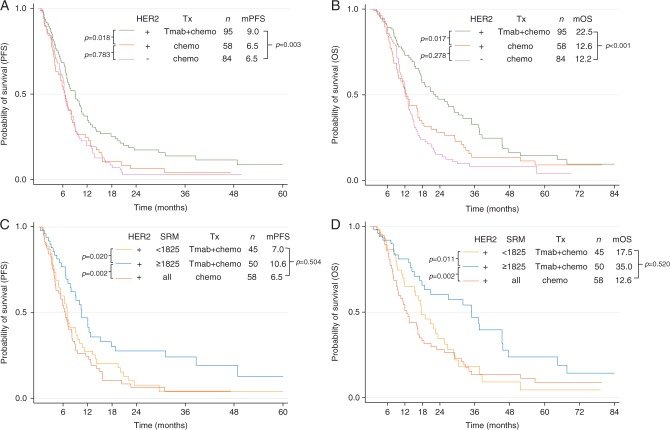
그림 출처: PubMed Central 공개 논문 (PMC5378223)
Comment · 정정
그 밖의 정보
- 출판 형태
- Journal Article
- 저널
- Annals of oncology : official journal of the European Society for Medical Oncology · eISSN 1569-8041
- MeSH
- Adult · Aged · Antineoplastic Agents / therapeutic use · Disease-Free Survival · Female · Humans · Immunohistochemistry · In Situ Hybridization, Fluorescence · Kaplan-Meier Estimate · Male · Mass Spectrometry / methods · Middle Aged · Molecular Targeted Therapy / methods · Patient Selection* · Proportional Hazards Models · Proteomics / methods · Erb-b2 Receptor Tyrosine Kinases / analysis / biosynthesis · Stomach Neoplasms / drug therapy / genetics / mortality · Trastuzumab / therapeutic use
- Substances
- Antineoplastic Agents · Erb-b2 Receptor Tyrosine Kinases · Trastuzumab · ERBB2 protein, human
- 연구비
- NCI NIH HHS K23 CA178203 · NCI NIH HHS P30 CA014599
- 참고문헌
- 19편