
Sci Rep. 2018;8(1):4095.
Comparison of non-insulin antidiabetic agents as an add-on drug to insulin therapy in type 2 diabetes: a network meta-analysis.
제1저자 윤정화, 민세희 · 교신저자 조영민, 한서경
소속 (4)
- Interdisciplinary Program in Medical Informatics, Seoul National University College of Medicine, Seoul, South Korea.
- Division of Endocrinology and Metabolism, Department of Internal Medicine, Seoul National University College of Medicine, Seoul, South Korea.
- Division of Endocrinology and Metabolism, Department of Internal Medicine, Seoul National University College of Medicine, Seoul, South Korea. ymchomd@snu.ac.kr.
- Department of Medicine, Seoul National University College of Medicine, Seoul, South Korea. hahns@snu.ac.kr.
Abstract
We aimed to evaluate the comparative efficacy and safety of dipeptidyl peptidase-4 inhibitors (DPP4i), glucagon-like peptide-1 receptor agonists (GLP-1RA), sodium-glucose co-transporter 2 inhibitors (SGLT2i), or thiazolidinedione (TZD) as an adjunctive treatment in patients with poorly controlled type 2 diabetes mellitus (T2DM) on insulin therapy. We searched Medline, Embase, the Cochrane Library, and ClinicalTrials.gov through April 2016. Bayesian network meta-analyses were performed with covariate adjustment. The primary outcome was the change in glycated hemoglobin A1c (HbA1c) from baseline. Fifty randomized controlled trials covering 15,494 patients were included. GLP-1RA showed the greatest HbA1c-lowering effect compared to the control (-0.84%; 95% credible interval, -1.00% to -0.69%), followed by TZD (-0.73%; -0.93 to -0.52%), SGLT2i (-0.66%; -0.84% to -0.48%), and DPP4i (-0.54%; -0.68% to -0.39%). SGLT2i showed the greatest fasting plasma glucose reduction. GLP-1RA and SGLT2i showed greater body weight reduction, whereas TZD increased body weight. TZD was ranked the highest in terms of insulin dose reduction. The risk of hypoglycemia was increased with TZD or GLP-1RA. The study provides the best available evidence on the comparative efficacy and safety of non-insulin anti-diabetic agents on top of pre-existing insulin therapy for inadequately controlled T2DM patients.
Figures
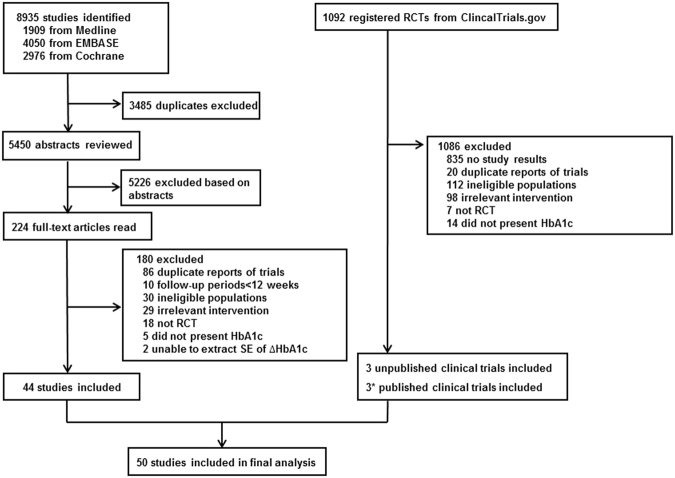
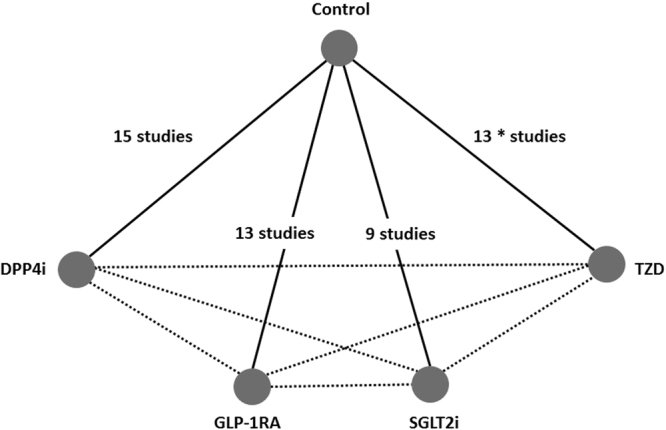
그림 출처: PubMed Central 공개 논문 (PMC5840350)
Conflict of interest statement
Y.M.C. received research grants from AstraZeneca and LG Chemical. S.H. received a consultation fee from Novartis. The other authors disclose no potential conflicts of interest relevant to this study.
그 밖의 정보
- 출판 형태
- Comparative Study, Journal Article, Research Support, Non-U.S. Gov't, Network Meta-Analysis
- 저널
- Scientific reports · eISSN 2045-2322
- 전자 출판
- 2018-03-06
- MeSH
- Diabetes Mellitus, Type 2 / drug therapy · Dipeptidyl-Peptidase IV Inhibitors / administration & dosage / adverse effects · Drug Therapy, Combination / methods · Enzyme Inhibitors / administration & dosage / adverse effects · Glucagon-Like Peptide-2 Receptor / antagonists & inhibitors · Glycated Hemoglobin / analysis · Humans · Hypoglycemic Agents / administration & dosage / adverse effects · Insulin / administration & dosage / adverse effects · Sodium-Glucose Transporter 2 / metabolism · Thiazolidinediones / administration & dosage / adverse effects · Treatment Outcome
- Substances
- Dipeptidyl-Peptidase IV Inhibitors · Enzyme Inhibitors · Glucagon-Like Peptide-2 Receptor · Glycated Hemoglobin · Hypoglycemic Agents · Insulin · Sodium-Glucose Transporter 2 · Thiazolidinediones · SLC5A2 protein, human · hemoglobin A1c protein, human · 2,4-thiazolidinedione
- 참고문헌
- 73편