
BMC Cancer. 2018;18(1):307.
Novel biomarker-based model for the prediction of sorafenib response and overall survival in advanced hepatocellular carcinoma: a prospective cohort study.
제1저자 김휘영, 이동현 · 교신저자 이정훈
소속 (5)
- Department of Internal Medicine, College of Medicine, Ewha Womans University, Seoul, Republic of Korea.
- Department of Internal Medicine and Liver Research Institute, Seoul National University College of Medicine, Seoul, Republic of Korea.
- Department of Internal Medicine, SMG-SNU Boramae Medical Center, Seoul, Republic of Korea.
- Department of Internal Medicine and Liver Research Institute, Seoul National University College of Medicine, Seoul, Republic of Korea. pindra@empal.com.
- Department of Internal Medicine, Seoul National University Hospital, 101, Daehak-ro, Jongno-gu, Seoul, 03080, Republic of Korea. pindra@empal.com.
Abstract
BACKGROUND Prediction of the outcome of sorafenib therapy using biomarkers is an unmet clinical need in patients with advanced hepatocellular carcinoma (HCC). The aim was to develop and validate a biomarker-based model for predicting sorafenib response and overall survival (OS).
METHODS This prospective cohort study included 124 consecutive HCC patients (44 with disease control, 80 with progression) with Child-Pugh class A liver function, who received sorafenib. Potential serum biomarkers (namely, hepatocyte growth factor [HGF], fibroblast growth factor [FGF], vascular endothelial growth factor receptor-1, CD117, and angiopoietin-2) were tested. After identifying independent predictors of tumor response, a risk scoring system for predicting OS was developed and 3-fold internal validation was conducted.
RESULTS A risk scoring system was developed with six covariates: etiology, platelet count, Barcelona Clinic Liver Cancer stage, protein induced by vitamin K absence-II, HGF, and FGF. When patients were stratified into low-risk (score ≤ 5), intermediate-risk (score 6), and high-risk (score ≥ 7) groups, the model provided good discriminant functions on tumor response (concordance [c]-index, 0.884) and 12-month survival (area under the curve [AUC], 0.825). The median OS was 19.0, 11.2, and 6.1 months in the low-, intermediate-, and high-risk group, respectively (P < 0.001). In internal validation, the model maintained good discriminant functions on tumor response (c-index, 0.825) and 12-month survival (AUC, 0.803), and good calibration functions (all P > 0.05 between expected and observed values).
CONCLUSIONS This new model including serum FGF and HGF showed good performance in predicting the response to sorafenib and survival in patients with advanced HCC.
Keywords
BiomarkerHepatocellular carcinomaPredictionResponseSorafenib
Figures
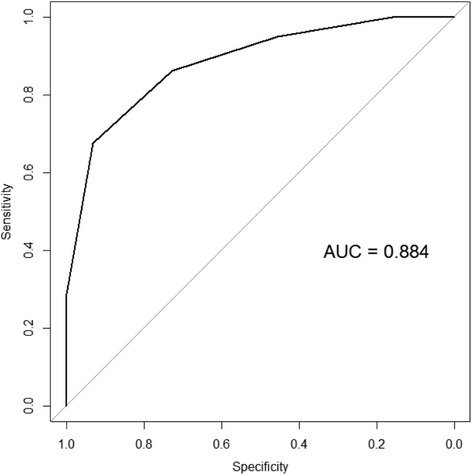
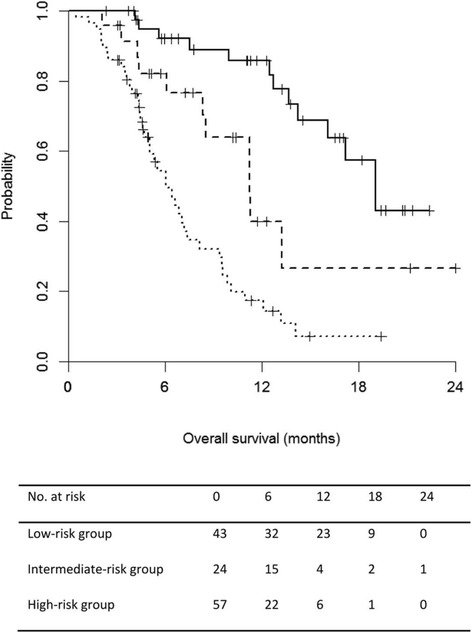
그림 출처: PubMed Central 공개 논문 (PMC5859435)
Conflict of interest statement
ETHICS APPROVAL AND CONSENT TO PARTICIPATE: The protocol of the present study conformed to the ethical guidelines of the World Medical Association Declaration of Helsinki, and was approved by the Institutional Review Board of Seoul National University Hospital (IRB No. 0506–150-005). All study participants provided written informed consent. CONSENT FOR PUBLICATION: Not applicable. COMPETING INTERESTS: The authors declare that they have no competing interests. PUBLISHER’S NOTE: Springer Nature remains neutral with regard to jurisdictional claims in published maps and institutional affiliations.
그 밖의 정보
- 출판 형태
- Journal Article, Research Support, Non-U.S. Gov't
- 저널
- BMC cancer · eISSN 1471-2407
- 전자 출판
- 2018-03-20
- MeSH
- Antineoplastic Agents / therapeutic use · Biomarkers / blood · Carcinoma, Hepatocellular / blood / drug therapy / mortality / pathology · Disease Progression · Female · Follow-Up Studies · Humans · Liver Neoplasms / blood / drug therapy / mortality / pathology · Male · Middle Aged · Models, Statistical* · Niacinamide / analogs & derivatives / therapeutic use · Phenylurea Compounds / therapeutic use · Prognosis · Prospective Studies · Sorafenib · Survival Rate
- Substances
- Antineoplastic Agents · Biomarkers · Phenylurea Compounds · Niacinamide · Sorafenib
- 연구비
- Doosan Yonkang Foundation Grant No. 30-2016-0240
- 참고문헌
- 45편