
Oncologist. 2018;23(2):155-e17.
Phase I Pharmacokinetic Study of Nivolumab in Korean Patients with Advanced Solid Tumors.
제1저자 이근욱, 이대호 · 교신저자 방영주
소속 (6)
- Department of Internal Medicine, Seoul National University Bundang Hospital, Seoul National University College of Medicine, Seongnam, Republic of Korea.
- Department of Oncology, University of Ulsan College of Medicine, Asan Medical Center, Seoul, Republic of Korea.
- Division of Oncology, Department of Internal Medicine, Kangnam St. Mary's Hospital, Catholic University, Seoul, Republic of Korea.
- Division of Hematology/Oncology, Department of Medicine, Samsung Medical Center, Sungkyunkwan University School of Medicine, Seoul, Republic of Korea.
- Department of Internal Medicine, Seoul National University College of Medicine, Seoul, Republic of Korea.
- Department of Internal Medicine, Seoul National University College of Medicine, Seoul, Republic of Korea bangyj@snu.ac.kr.
Abstract
LESSONS LEARNED This pharmacokinetic study of nivolumab showed that there is little ethnic difference in the handling of nivolumab.Nivolumab was well tolerated in Korean patients.
BACKGROUND This phase I study of nivolumab, an anti-programmed cell death-1 (anti-PD-1) monoclonal antibody, investigated the pharmacokinetics and safety of nivolumab in Korean patients with advanced solid tumors. Findings were compared with results from Japan and the U.S.
MATERIALS AND METHODS In this two-part study, patients received a single dose of nivolumab (1, 3, and 10 mg/kg; ONO-4538-13) and were followed up for 3 weeks. Those who met the required criteria proceeded to the second part (ONO-4538-14), and received the same dose as in part one every 2 weeks.
RESULTS Six patients per dose level were enrolled (n = 18). The mean elimination half-life of nivolumab among the groups ranged from 15.0 to 19.1 days. The maximum serum concentration and area under serum concentration-time curve increased almost dose-proportionally at doses from 1 to 10 mg/kg. Adverse drug reactions (ADRs; mostly grade ≤2) were reported in seven patients (38.9%). ADRs grade ≥3 occurred in one patient (5.6%; pneumonitis). Three patients (16.7%) developed ADRs related to thyroid dysfunction.
CONCLUSION The pharmacokinetic parameters of nivolumab were similar among patients from Korea, Japan, and the U.S. The safety profile was consistent with findings from previous studies.
© AlphaMed Press; the data published online to support this summary is the property of the authors.
Figures

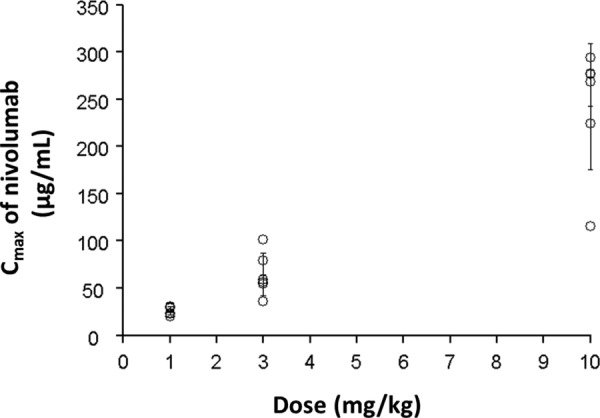
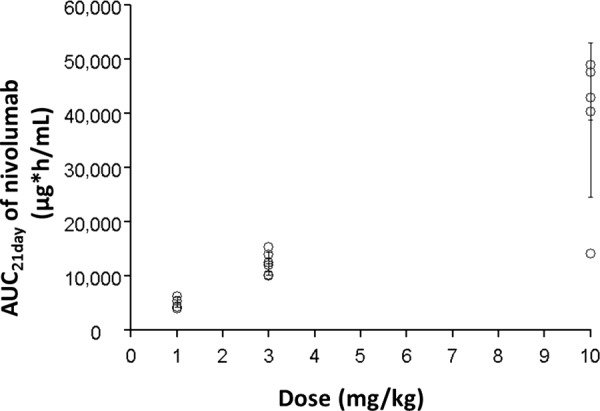
그림 출처: PubMed Central 공개 논문 (PMC5813749)
그 밖의 정보
- 출판 형태
- Clinical Trial, Phase I, Journal Article, Research Support, Non-U.S. Gov't
- 저널
- The oncologist · eISSN 1549-490X
- 전자 출판
- 2017-11-20
- MeSH
- Adult · Aged · Aged, 80 and over · Antineoplastic Agents, Immunological / pharmacokinetics / therapeutic use · Female · Follow-Up Studies · Humans · Male · Middle Aged · Neoplasms / drug therapy / pathology · Nivolumab / pharmacokinetics / therapeutic use · Prognosis · Tissue Distribution
- Substances
- Antineoplastic Agents, Immunological · Nivolumab
- 데이터
- ClinicalTrials.gov: NCT02261285, NCT02261298
- 참고문헌
- 13편