
Cancer Res Treat. 2018;50(1):30-39.
S-1-Induced Lacrimal Drainage Obstruction and Its Association with Ingredients/Metabolites of S-1 in Tears and Plasma: A Prospective Multi-institutional Study.
제1저자 김남주 · 교신저자 이근욱
소속 (10)
- Department of Ophthalmology, Seoul National University Bundang Hospital, Seoul National University College of Medicine, Seongnam, Korea.
- Department of Internal Medicine, Seoul National University Bundang Hospital, Seoul National University College of Medicine, Seongnam, Korea.
- Center of Biomedical Mass Spectrometry, Diatech Korea Co., Ltd., Seoul, Korea.
- Department of Internal Medicine, Seoul National University Boramae Medical Center, Seoul, Korea.
- Department of Ophthalmology, Seoul National University Boramae Medical Center, Seoul, Korea.
- Department of Internal Medicine, Seoul National University College of Medicine, Seoul National University Hospital, Seoul, Korea.
- Department of Ophthalmology, Seoul National University College of Medicine, Seoul National University Hospital, Seoul, Korea.
- Department of Surgery, Seoul National University Bundang Hospital, Seoul National University College of Medicine, Seongnam, Korea.
- Department of Clinical Pharmacology and Therapeutics, Seoul National University Bundang Hospital, Seoul National University College of Medicine, Seongnam, Korea.
- Medical Research Collaborating Center, Seoul National University Bundang Hospital, Seongnam, Korea.
Abstract
PURPOSE This prospective study was conducted to determine the incidence of lacrimal drainage obstruction (LDO) during S-1 chemotherapy and evaluate the association between the development of LDO and the concentrations of ingredients/metabolites of S-1 in tears and plasma.
MATERIALS AND METHODS A total of 145 patients with gastric cancer who received adjuvant S-1 therapy were enrolled. Ophthalmologic examinations were performed regularly during S-1 chemotherapy. Concentrations of tegafur, 5-chloro-2,4-dihydroxypyridine (CDHP), and 5-fluorouracil at steady-state trough level were measured in both tears and plasma.
RESULTS Fifty-three patients (37%) developed LDO. The median time to the onset of LDO was 10.9 weeks, and LDO developed most frequently in the nasolacrimal duct. Univariable analyses revealed that an older age (≥ 70 years), creatinine clearance rate (Ccr) < 80 mL/min, 5-fluorouracil concentration in plasma ≥ 22.3 ng/mL (median), CDHP concentration in plasma ≥ 42.0 ng/mL (median), and tegafur concentration in tears ≥ 479.2 ng/mL (median) were related to increased development of LDO. Multivariable analysis indicated that a high plasma 5-fluorouracil concentration was predictive of increased development of LDO (hazard ratio, 2.02; p=0.040), along with older age and decreased Ccr. Patients with LDO also developed S-1-related non-hematologic toxicity more frequently than those without LDO (p=0.016).
CONCLUSION LDO is a frequent adverse event during S-1 chemotherapy. An older age, decreased Ccr, and high plasma 5-fluorouracil concentration were found to be independent risk factors for LDO. The high incidence of LDO warrants regular ophthalmologic examination and early intervention in patients receiving S-1 therapy.
Keywords
FluorouracilLacrimal drainage obstructionS-1Stomach neoplasmsTears
Figures
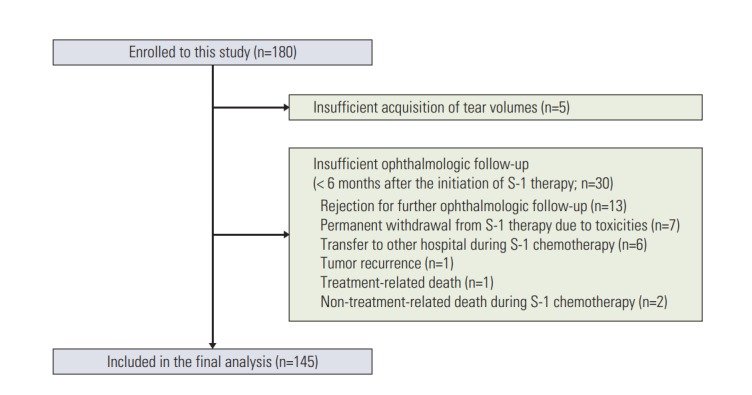
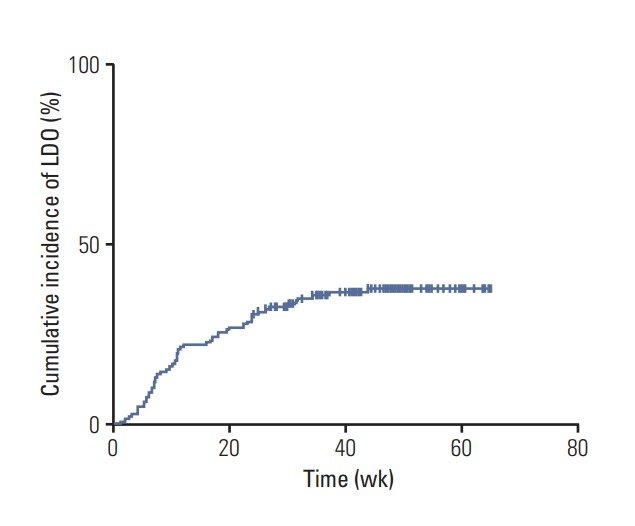
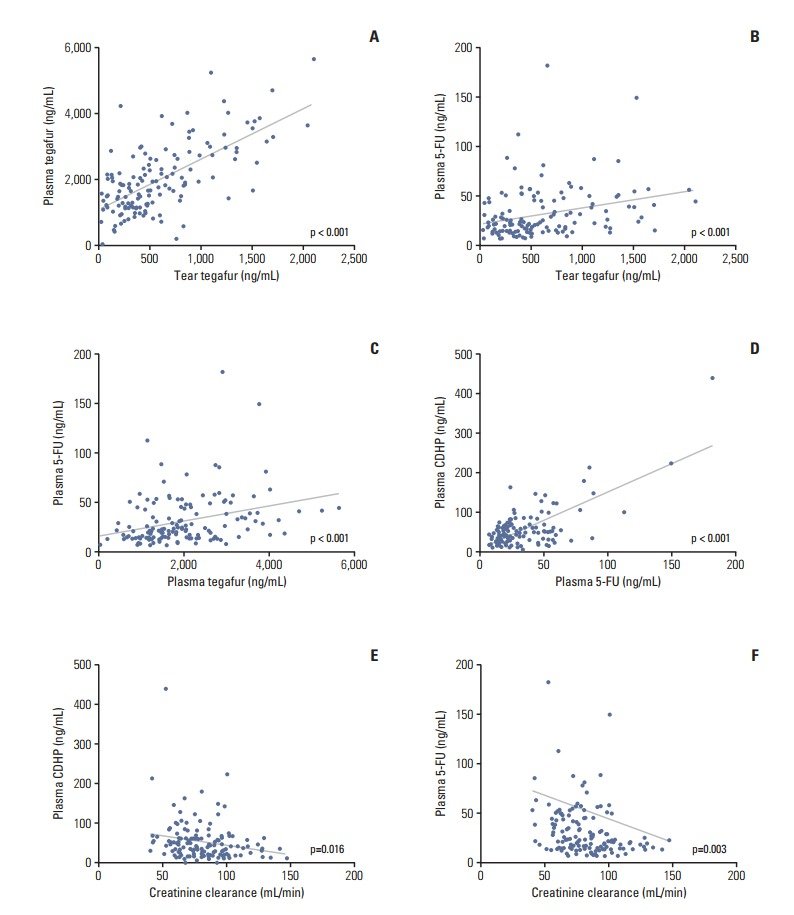
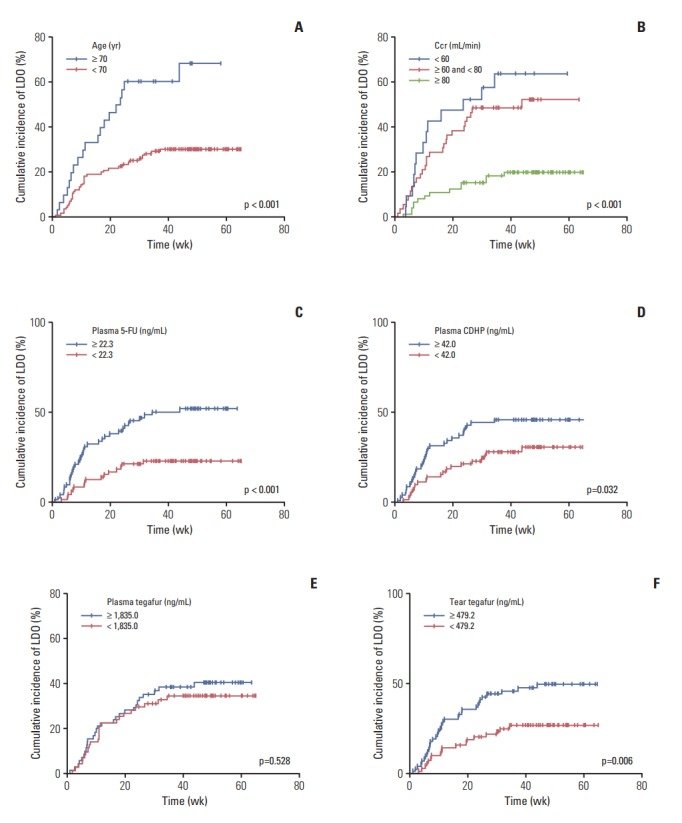
그림 출처: PubMed Central 공개 논문 (PMC5784617)
Conflict of interest statement
Conflict of interest relevant to this article was not reported.
그 밖의 정보
- 출판 형태
- Journal Article, Multicenter Study
- 저널
- Cancer research and treatment · eISSN 2005-9256
- 전자 출판
- 2017-02-27
- MeSH
- Adult · Aged · Aged, 80 and over · Drug Combinations · Female · Humans · Male · Middle Aged · Nasolacrimal Duct / pathology · Oxonic Acid / pharmacology / therapeutic use · Plasma / metabolism · Prospective Studies · Tears / metabolism · Tegafur / pharmacology / therapeutic use · Young Adult
- Substances
- Drug Combinations · S 1 (combination) · Tegafur · Oxonic Acid
- 참고문헌
- 14편