
J Interv Cardiol. 2020;2020:2475930.
Clinical Implications of Bifurcation Angles in Left Main Bifurcation Intervention Using a Two-Stent Technique.
제1저자 기유정, 정지현 · 교신저자 한정규
소속 (8)
- Cardiovascular Center, Seoul National University Hospital, Seoul 03080, Republic of Korea.
- Division of Cardiology, Department of Internal Medicine, Sejong General Hospital, Bucheon 14754, Republic of Korea.
- Department of Internal Medicine, St. Carollo Hospital, Sunchon 57931, Republic of Korea.
- Heart Vascular Stroke Institute, Samsung Medical Center, Sungkyunkwan University School of Medicine, Seoul 06351, Republic of Korea.
- Inje University Ilsan Paik Hospital, Goyang 10380, Republic of Korea.
- Division of Cardiology, Department of Internal Medicine, Presbyterian Medical Center, Jeonju 54987, Republic of Korea.
- Chonbuk National University Hospital, Jeonju 54907, Republic of Korea.
- Seoul National University Bundang Hospital, Sungnam 13620, Republic of Korea.
Abstract
OBJECTIVES The aim of this study was to assess the clinical impact of 3 bifurcation angles in left main (LM) bifurcation treated with the 2-stent technique.
BACKGROUND Data are limited regarding the impact of bifurcation angles after LM percutaneous coronary intervention (PCI).
METHODS Using patient-level 4 multicenter registries in Korea, 462 patients undergoing LM bifurcation PCI with the 2-stent technique were identified (181 crush, 167 T-stenting; 63% 1st generation drug-eluting stent (DES), 37% 2nd generation DES). Three bifurcation angles, between the LM and left anterior descending (LAD), the LM and left circumflex (LCX), and the LAD and LCX, were measured. The primary outcome was target lesion failure (TLF), a composite of cardiac death, myocardial infarction, and target lesion revascularization (TLR).
RESULTS In patients treated with the crush technique, the best cutoff value (BCV) to predict TLF was 152° of the LM-LAD angle. In the crush group, a significantly higher TLF rate, mostly driven by TLR, was observed in the LM-LAD angle ≥152° group compared with the <152° group (35.7% vs. 14.6%; adjusted hazard ratio 3.476; 95% confidence interval 1.612-7.492). An LM-LAD angle ≥152° was an independent predictor of TLF. In the T-stenting, no bifurcation angle affected the clinical outcomes.
CONCLUSIONS In LM bifurcation PCI using the 2-stent technique, wide LM-LAD angle (≥152°) was associated with a greater risk of TLF in the crush, whereas none of the bifurcation angles affected T-stenting outcomes.
Copyright © 2020 You-Jeong Ki et al.
Figures

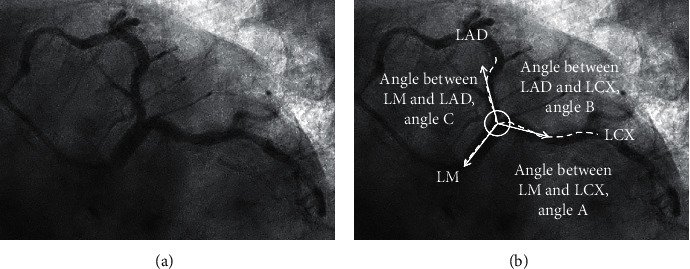

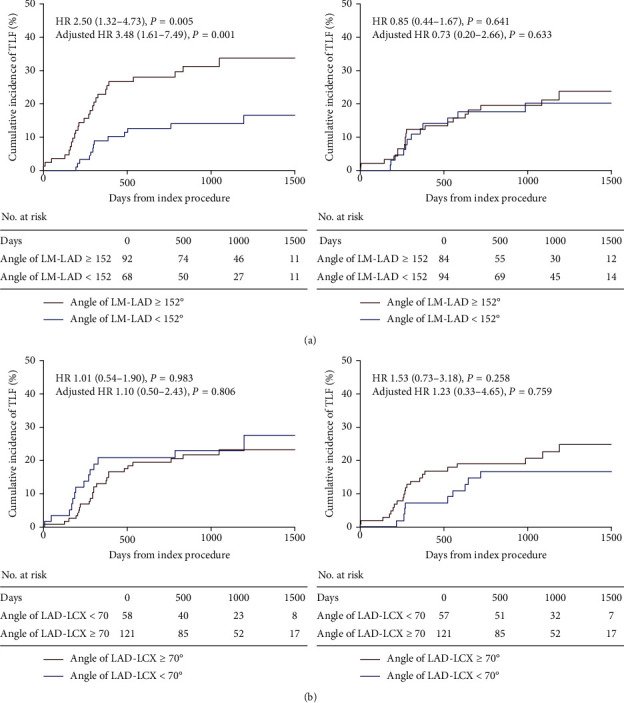
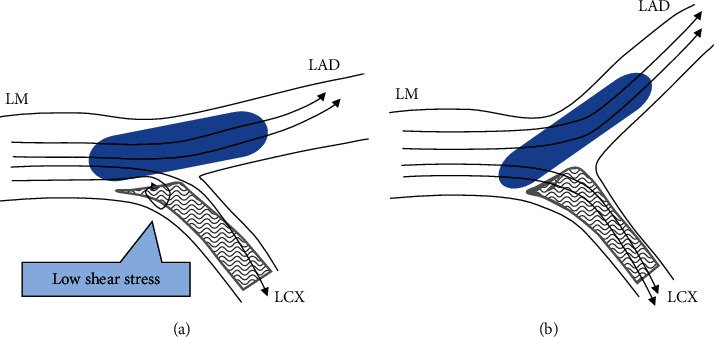
그림 출처: PubMed Central 공개 논문 (PMC7374237)
Conflict of interest statement
There are no relevant conflicts of interest.
그 밖의 정보
- 출판 형태
- Journal Article
- 저널
- Journal of interventional cardiology · eISSN 1540-8183
- 전자 출판
- 2020-07-11
- MeSH
- Coronary Angiography / methods · Coronary Artery Disease* / diagnosis / surgery · Coronary Restenosis* / diagnosis / etiology · Coronary Vessels* / diagnostic imaging / pathology · Drug-Eluting Stents / adverse effects · Female · Humans · Male · Middle Aged · Myocardial Infarction* / etiology / mortality · Outcome and Process Assessment, Health Care · Percutaneous Coronary Intervention* / adverse effects / instrumentation / methods
- 참고문헌
- 25편